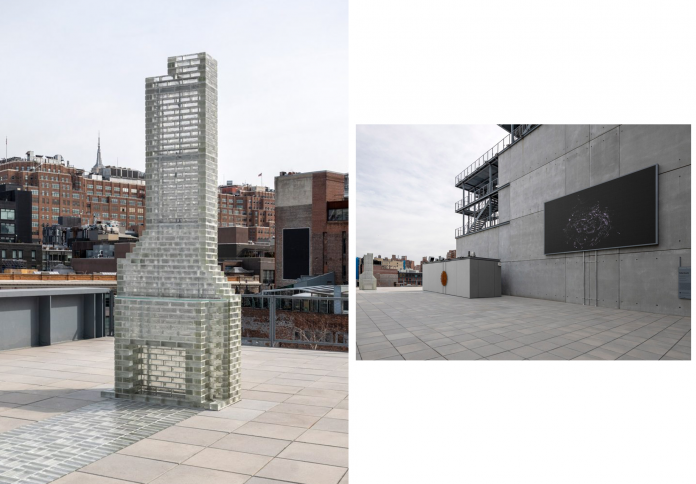
The aftermath of a wildfire is defined by what remains: the scorched earth, the warped metal, and, most hauntingly, the lone, defiant chimneys that often stand as the only remnants of a decimated home. For artist Kelly Akashi, these structures became the focus of a profound architectural meditation in the wake of the 2025 Los Angeles wildfires, which claimed her own residence and studio. Her latest work, “Monument (Altadena),” currently installed on the terrace of the Whitney Museum for the 2026 Biennial, is not merely a sculpture but a haunting reconstruction of memory. Crafted from 821 hand-cast glass bricks, the chimney stands as a translucent, fragile ghost of a lost domestic life, challenging our understanding of solidity, permanence, and the complex labor required to heal in the face of catastrophic loss.
A Different Material Language
“Monument (Altadena)” is a monumental undertaking, weighing over 6,500 pounds and accompanied by a detailed replica of the home’s original walkway. Akashi deliberately chose glass brick rather than traditional clay to reconstruct the chimney, a decision rooted in the necessity of finding a “different material language.” By swapping the opaque, heavy nature of brick for the fragile, light-transmitting properties of glass, Akashi unsettles the viewer’s perception of the chimney, an object typically associated with the hearth and the immutable stability of the home.

The artist’s process was one of deliberate, arduous reconstruction. Each brick acts as a record of labor, a physical manifestation of the effort required to process the trauma of displacement. As Akashi notes, “The tension between its recognizable form and unusual materiality felt akin to the act of rebuilding in my neighborhood.” By rendering a symbol of structural permanence into something transparent, the work forces a confrontation with the reality that, while we may rebuild our spaces, the original structures—and the memories tethered to them—can never be fully recovered.
Architecture as an Act of Reclamation
Beyond its aesthetic impact, the work serves as an interrogation of the recovery efforts following the 2025 fires. Akashi, who has been part of a local cohort of artists recovering and re-contextualizing materials from the charred landscape, views this sculpture as a broader commentary on the “deliberate labor of care.” In Los Angeles, the rebuilding process has been marked by uneven progress and systemic challenges; her chimney stands in contrast to these disjointed institutional efforts, asserting that true reclamation is an engagement with history rather than mere material endurance.
The installation is further contextualized by an accompanying piece, “Inheritance (Distressed),” a relief replica of her grandmother’s Corten steel dolly. Together, these elements compose a new body of work that holds the traces of the past while simultaneously signaling a departure from it. The Whitney Biennial presentation effectively elevates the personal narrative of the California wildfires into a broader civic dialogue, highlighting the role of architecture and design in addressing the urgent, existential threats posed by a changing climate.
The Persistence of Memory in Physical Form
Akashi’s practice has long interrogated the notions of time and memory, but here, the application of her knowledge of glass blowing and casting takes on a visceral, autobiographical urgency. The chimney serves as a beacon of both the past and the potential for a different future. As light passes through the glass, the solidity we once associated with the “hearth” is replaced by an ephemeral quality, reminding the viewer that homes are often more delicate than we dare to admit.

The installation at the Whitney—on view through mid-August—offers a stark, quiet moment of reflection within the bustling Meatpacking District. By documenting the physical loss of her own home, Akashi provides a way for audiences to grapple with the collective anxiety of a world increasingly shaped by fire. It is a work that does not offer a solution to the pain of destruction, but rather provides a space where memory is allowed to exist, transformed and made visible, inviting a necessary conversation about the value of what we build and what we eventually lose.