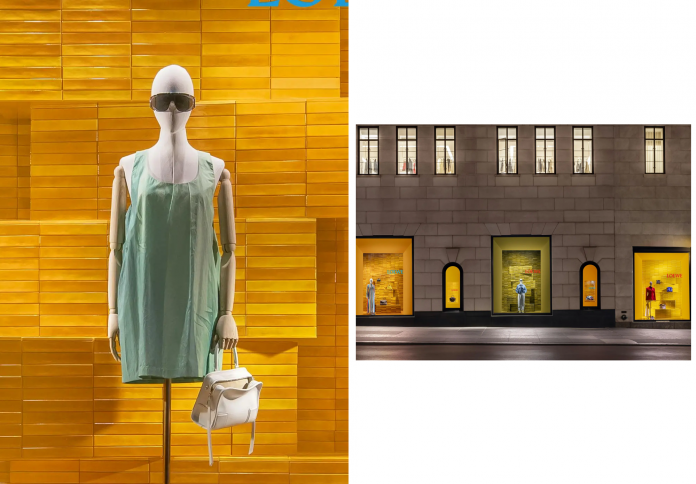
In a spectacular convergence of high-fashion and theatrical display, Loewe has transformed the iconic vitrines of Bergdorf Goodman in New York City into an immersive gallery for its Spring/Summer 2026 collection. Curated by creative director Jonathan Anderson, the installation—titled “Objectified”—marks a departure from the traditional retail display, favoring a surrealist narrative that elevates the handbag and the silhouette to the status of museum-worthy artifacts. By placing the season’s most coveted pieces within distorted, minimalist environments that play with scale, perspective, and light, the installation forces the passerby to engage with the collection not merely as products to be purchased, but as sculptural manifestations of a creative philosophy.
Distorting the Commercial Narrative
The installation serves as a physical manifestation of Jonathan Anderson’s long-standing obsession with the intersection of art and utility. Each window at Bergdorf Goodman acts as a singular stage, housing hyper-realistic, oversized versions of the S/S 2026 accessories—most notably the new Puzzle-Fold tote and the distorted Squeeze bag—alongside garments that appear to be in mid-motion. The genius of the display lies in its refusal to conform to the standard “lifestyle” imagery typically seen in luxury retail. Instead of showing the garments on human forms in an aspirational setting, the display centers on the “objecthood” of the design, stripping away the distraction of the environment to highlight the texture, structure, and sheer technical audacity of Loewe’s craftsmanship.
This approach is highly calculated. By framing the collection within a surrealist, almost gallery-like space, Loewe is signaling its status as a brand for the “thinking” consumer. The display invites the viewer to pause and interrogate the object, turning the act of window shopping into an exercise in visual literacy. It’s an effective strategy in 2026, where the saturation of digital marketing makes physical experiences that demand real-time focus increasingly valuable. The Bergdorf Goodman takeover is not just a showcase; it is a declaration that Loewe’s value proposition lies in its ability to disrupt the expected visual language of luxury, consistently prioritizing the avant-garde over the purely ornamental.
The Craft of “Techno-Surrealism”
Beyond the theatrics, the S/S 2026 collection itself marks a high point in Loewe’s pursuit of “techno-surrealism.” The garments featured in the windows showcase an exquisite tension between traditional tailoring and experimental materials, including high-tech silks, liquid-like leathers, and 3D-printed hardware. The interplay between the organic forms of the clothing and the rigid, distorted geometry of the window displays emphasizes the brand’s commitment to innovation. Anderson has consistently pushed the house to explore the limits of material science, and this collection feels like the culmination of those experiments, resulting in pieces that look simultaneously ancient and futuristic.
This material-first philosophy is what sets Loewe apart in an industry currently struggling to define the next phase of luxury. While other houses are pivoting toward subtle, minimalist classics, Loewe is doubling down on the “unexpected object.” The collection is a challenge to the wearer to embrace the absurd, the structural, and the intentionally strange. The Bergdorf Goodman windows act as a physical map of this vision, demonstrating that luxury, at its best, should provoke curiosity. It is a reminder that the most compelling fashion is that which creates a sense of wonder, turning the mundane reality of dressing into a performance of personal aesthetic inquiry.
A New Paradigm for Retail Exclusivity
As the “Objectified” installation draws crowds and becomes a viral fixture in the NYC fashion circuit, it reinforces a broader shift in how luxury brands approach their physical presence. The era of the “standard” window display is fading; in its place, we are seeing the rise of the “destination installation,” where the retail space functions as an extension of the brand’s creative runway. This shift is vital for brands like Loewe, which rely on their reputation for intellectual curiosity to maintain their cultural edge. By partnering with a legacy institution like Bergdorf Goodman, Loewe effectively bridges the gap between old-world luxury retail and the radical, forward-thinking spirit of the contemporary avant-garde.
Ultimately, this takeover is a masterclass in modern brand stewardship. It allows Loewe to maintain its status as an “it-brand” while simultaneously grounding its identity in a history of artistic exploration. For the consumer, the Bergdorf installation provides a rare opportunity to see the collection in a context that validates its artistic merit, making the subsequent purchase feel like an investment in a piece of design history. As Loewe continues to navigate the complexities of 2026’s luxury landscape, these physical interventions remain their most potent tool for brand storytelling, proving that in a digital world, nothing beats the impact of an idea made tangible.