For decades, the mention of Oaxaca in travel circles evoked the colonial charm, complex moles, and deep-rooted indigenous traditions of its highland capital. In 2026, however, the spotlight has shifted southward to the Pacific, where the Costa Chica—a rugged, sun-drenched stretch of coastline—has emerged as one of the world’s most compelling “breakout” destinations. Recognized by National Geographic as a “Best of the World” locale for 2026, this region is no longer the remote, arduous destination it once was. With the completion of a transformative superhighway reducing travel time from the capital to just a few hours, the Costa Chica stands at a delicate crossroads, offering a masterclass in how to balance accessibility with an unwavering commitment to ecological stewardship and community-led design.
A Surfer’s Sanctuary and the World’s Newest Reserve
The pulse of the Costa Chica is dictated by the Pacific. Renowned globally for its powerful breaks, the region has become a pilgrimage site for those who respect the sea’s raw, untamed energy. Puerto Escondido, in particular, is the crown jewel of this surf culture; its Zicatela Beach—famed as the “Mexican Pipeline”—is a legendary, high-stakes wave that draws the world’s most seasoned big-wave riders.
In early 2026, this status was officially codified when Puerto Escondido was designated as the 14th World Surfing Reserve. This prestigious title, granted by the Save the Waves Coalition, is more than an acknowledgment of the surf; it is a commitment to the conservation of the area’s coastline. For the novice or the professional, the region offers a variety of breaks, from the intense barrels of Zicatela to the more approachable, rhythmic waters of La Punta, ensuring the coast remains a playground for those who view surfing as a way of life rather than just a sport.
The Countercultural Coastline
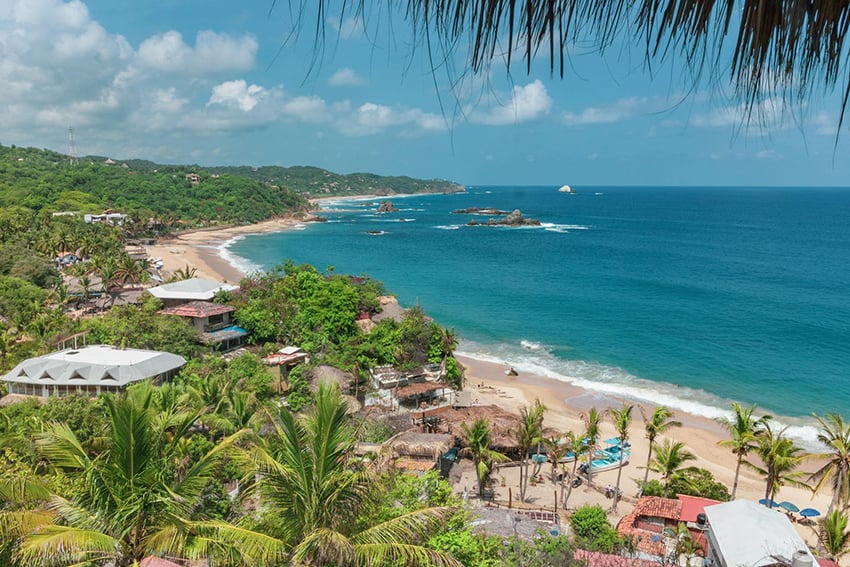
Beyond the surf, the Costa Chica is defined by its bohemian, countercultural spirit. Small, distinct enclaves like Mazunte, Zipolite, and San Agustinillo have cultivated an atmosphere of quiet rebellion against the excesses of mass tourism. Zipolite, famously known for its queer-friendly and clothing-optional beaches, remains a bastion of inclusivity and laissez-faire living, while Mazunte has evolved into a center for wellness, yoga, and ecological preservation, notably through the work of the National Turtle Center.
This region is uniquely marked by its strong Afro-Indigenous identity, a cultural inheritance that manifests in the vibrant “sones” and “chilenas” music and dance traditions of Pinotepa and Pochutla. Unlike the resort-heavy corridors of other Mexican coastlines, the Costa Chica’s enclaves are defined by their community-based projects and a low-density, intentional rhythm. Whether it’s navigating the mangroves of La Ventanilla in hand-paddled canoes or observing the bioluminescence of the Manialtepec Lagoon, travel here is an exercise in low-impact engagement.
Design-Forward Minimalism in the Wild
In recent years, the Costa Chica has become an unlikely laboratory for high-end architectural design that leans into the landscape rather than dominating it. The region’s aesthetic is one of “Refined Minimalism,” where structures are built to coexist with the heat, the humidity, and the wild beauty of the coast. The Casa Wabi art complex, designed by the world-renowned Tadao Ando, is the centerpiece of this movement, serving as a sanctuary where art, community, and architecture intersect in the quietude of the desert-meets-ocean landscape.
This design philosophy is mirrored in nearby hospitality projects like Casona Sforza and the solar-powered Hotel Terrestre. Both, designed by Mexican architect Alberto Kalach, represent a shift toward “sustainable luxury”—spaces that prioritize natural light, local materials, and a deep respect for the surrounding environment. For the visitor, this means experiencing a side of Mexico that is as aesthetically sophisticated as it is culturally grounded.
A Crossroads of Sovereignty and Stewardship
The defining challenge and beauty of the Costa Chica in 2026 is its embrace of “sovereignty as conservation.” Much of the region is held under communal or ejidal tenure, and the most successful tourism projects are those that empower local governance. Travelers here are not just tourists; they are witnesses to a rare, deliberate model of development that prioritizes the dignity of local livelihoods over the rapid expansion of mass-market infrastructure.
As the new superhighway brings the coast closer to the capital, the region’s resilience is being tested. Yet, the persistent emphasis on small-scale, conservation-oriented travel suggests that the Costa Chica will remain a “less traveled” alternative. For the visitor, it offers a glimpse into a future where the Pacific coast can be a place of both thrill and peace—a destination that remains deeply connected to its endemic birdlife, its turtle-nesting sands, and the rhythmic, ancient pull of the tide.