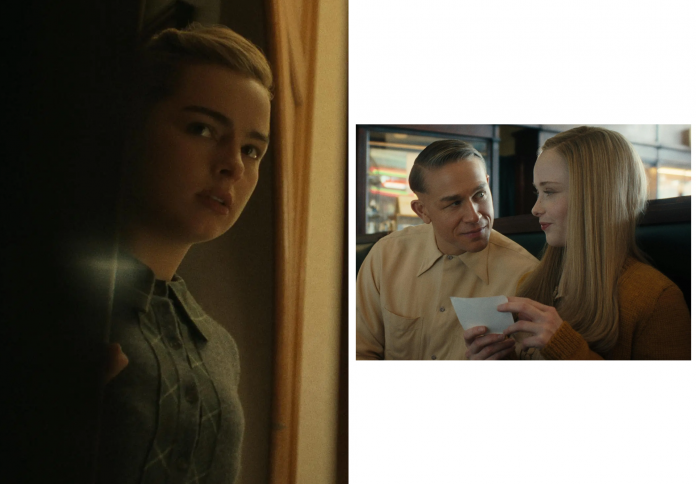
Monster: The Ed Gein Story, the third installment of Ryan Murphy and Ian Brennan’s Netflix anthology, returned to one of American true crime’s most mythologized figures. Charlie Hunnam plays Ed Gein, the Wisconsin murderer and grave robber whose crimes became entangled with the cultural histories of Psycho, The Texas Chain Saw Massacre, and The Silence of the Lambs. Released in October 2025, the series also features Laurie Metcalf, Lesley Manville, Suzanna Son, Tom Hollander, Olivia Williams, and Addison Rae. Its most important viewing question is where historical fact ends and dramatization begins. The season incorporates real people and events but also builds speculative connections, including material involving the 1953 disappearance of Evelyn Hartley, played by Rae. Gein was never established as responsible for that case. In a story already distorted by decades of horror mythology, that distinction is essential.
Ed Gein’s Real Crimes Were Already Surrounded by Legend
Ed Gein lived near Plainfield, Wisconsin, and became notorious after authorities discovered evidence in 1957 that he had murdered women and exhumed bodies from local cemeteries. The objects made from human remains found on his property produced a level of public horror that quickly exceeded the facts of the criminal case itself.
Because the crimes were so visually disturbing, Gein became a cultural shorthand for a much larger category of fictional killers. Over time, audiences have often encountered versions of him indirectly through horror cinema before learning the narrower historical record. That gap between person and legend is central to any dramatization of his life.

Horror Movies Expanded the Myth in Different Directions
Psycho, The Texas Chain Saw Massacre, and The Silence of the Lambs are frequently linked to Gein, but none is a straightforward adaptation of his crimes. Norman Bates, Leatherface, and Buffalo Bill borrow different elements of a broader mythology involving bodies, identity, domestic horror, and human skin. The fictional characters then became far more internationally famous than the specific details of the Wisconsin case.
Monster uses that afterlife as part of its subject, bringing filmmakers and performers into the narrative to show how American entertainment converted a local criminal story into enduring imagery. The approach is ambitious because it treats cultural consumption as part of the violence’s legacy rather than placing all attention on Gein alone.
Charlie Hunnam Carries the Transformation
Hunnam’s casting asked viewers to see an actor associated with charismatic, physically confident roles disappear into a socially isolated and deeply disturbing figure. Transformation is a familiar prestige strategy in true crime, but it carries ethical risk: technical achievement can make the criminal more fascinating than the people harmed.
The series attempts to counter that by surrounding Gein with relationships and cultural context, including his mother Augusta, played by Laurie Metcalf. Still, the centrality of the killer remains unavoidable. Hunnam’s performance is the mechanism through which the season organizes its psychological speculation, which means viewers should distinguish what an actor persuasively suggests from what history actually establishes.
Addison Rae’s Evelyn Hartley Story Requires a Clear Fact Check
Addison Rae plays Evelyn Hartley, a real teenager who disappeared from La Crosse, Wisconsin, in 1953 while babysitting. Her case remains unsolved. Gein was questioned in connection with other disappearances and became the subject of extensive rumor, but authorities did not establish that he abducted or killed Hartley.
That distinction is especially important because dramatized true crime can create memory more powerfully than documentation. Once two historical figures are placed inside the same suspense narrative, viewers may retain the emotional connection even if the series signals uncertainty. The responsible way to watch is to understand Hartley as a real missing person whose story should not be absorbed into Gein’s confirmed crimes without evidence.
The Season Is Ultimately About America’s Appetite for Monsters
The most productive reading of The Ed Gein Story is not as a definitive biography. It is as a series about the machinery that turns violence into folklore: newspapers, investigators, filmmakers, audiences, and later streaming television itself. By invoking Hitchcock and other cultural figures, the show acknowledges that Gein’s afterlife was manufactured through repeated retelling.
That self-awareness does not remove the problem; Monster is also another commercial retelling. The tension is the point viewers should keep in view. True crime often promises access to “what really happened” while using invention, compression, and performance to create narrative satisfaction. Gein’s story demonstrates how dangerous that promise can be. The facts were already horrifying. The myths that followed became an industry, and every new adaptation has to decide whether it is examining that industry or simply feeding it again.
True Crime Needs a Stronger Vocabulary for “Based on a True Story”
The phrase is broad enough to cover everything from careful reconstruction to speculative fiction built around real names. That ambiguity benefits dramatic marketing but can harm public understanding, especially when victims, missing people, and unsolved cases are folded into a story centered on a notorious criminal. Monster demonstrates why viewers need to ask not only whether something “really happened,” but which parts are documented, inferred, combined, or invented.
Evelyn Hartley’s inclusion is a clear example. Her disappearance is a real unresolved tragedy. Connecting her dramatically to Ed Gein creates narrative momentum, yet the historical record does not establish him as responsible. Once a show gives that possibility actors, sets, music, and a visual sequence, the invented connection can become easier to remember than the caveat. Streaming platforms increasingly operate as informal history teachers simply because their stories reach enormous audiences. That creates a responsibility shared by creators, critics, and viewers. Dramatization is not inherently unethical, and uncertainty can be dramatically rich. The ethical failure begins when narrative confidence is mistaken for evidence. In true crime, knowing the boundary is part of understanding the story.