A Moschino dress can resemble a tiered cake and still need to function as a dress. That practical contradiction is central to the house’s most memorable runway images: the joke has to be built. Jeremy Scott’s Barbie-inflected Spring/Summer 2015 collection, his cake-like Fall/Winter 2020 look, and Rossella Jardini’s earlier patterned dresses show different ways to bring visual humor into clothing. With Loris Messina and Simone Rizzo now leading the brand’s creative direction, the archive offers more than a collection of outrageous pictures. It reveals a design method in which recognition, exaggeration, and construction work together. The familiar object catches the eye first; the garment keeps the idea from dissolving into a passing gag.
The Cake Has to Move
Joan Smalls wore a tiered cake-like dress in Moschino’s Fall/Winter 2020 presentation. The silhouette translates a recognizable decorative object into something that must accommodate a moving body. Layers, ornamental details, and a wide outline make the cake association legible, but the runway tests a different set of requirements. The garment has to remain stable enough to be worn, and its proportions must allow the model to carry the image through the space without the visual concept falling apart.
This is the labor hidden inside an apparently immediate joke. A viewer may understand the reference in a second, while the object’s realization depends on many less visible decisions. How much can a tier project? Where does the body remain evident? How do decorative details survive movement? The dress’s success as humor is connected to its success as construction. If the cake were merely suggested by a printed slogan, the encounter would have a different scale and far less physical consequence.
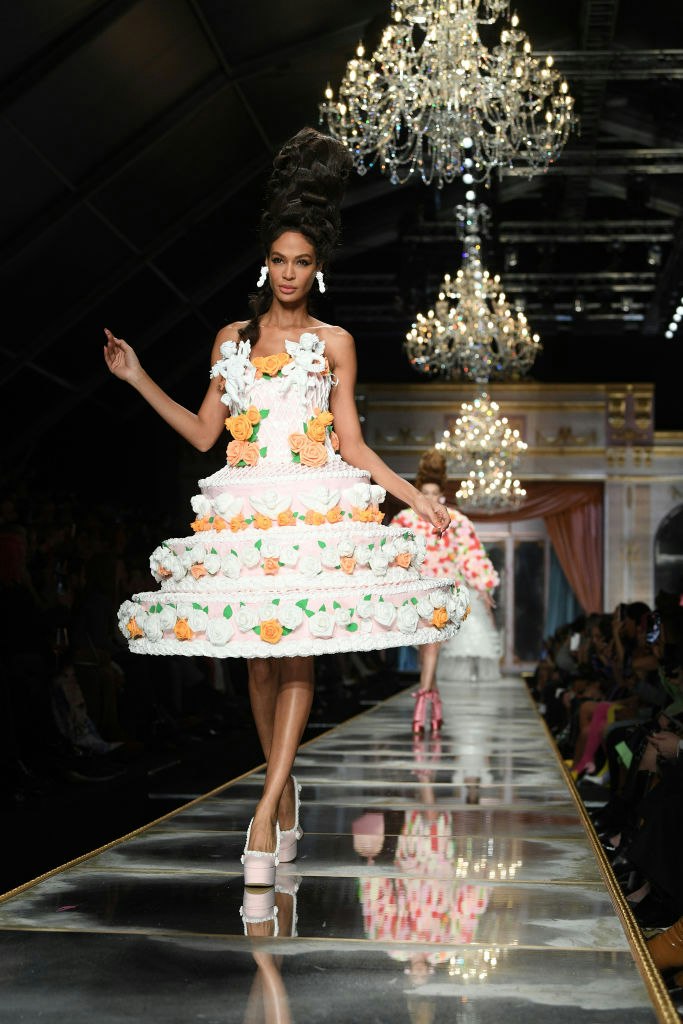
The accompanying pink platform heels and floral earrings extend the confectionery palette. They do not need to resemble another entire dessert to support the image. Their color and decorative character keep the outfit coherent while the dress supplies the main exaggeration. That distribution is part of the design’s control. A maximal look can still require editing, assigning the biggest visual event to one object and allowing smaller elements to reinforce it without competing for the same role.
Barbie Arrives on Wheels
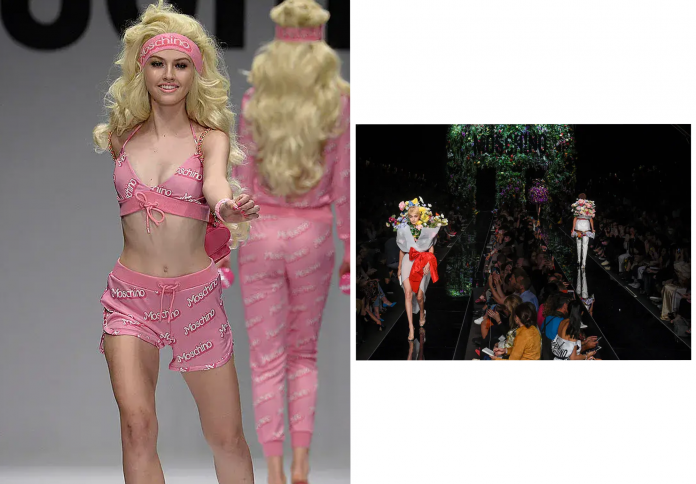
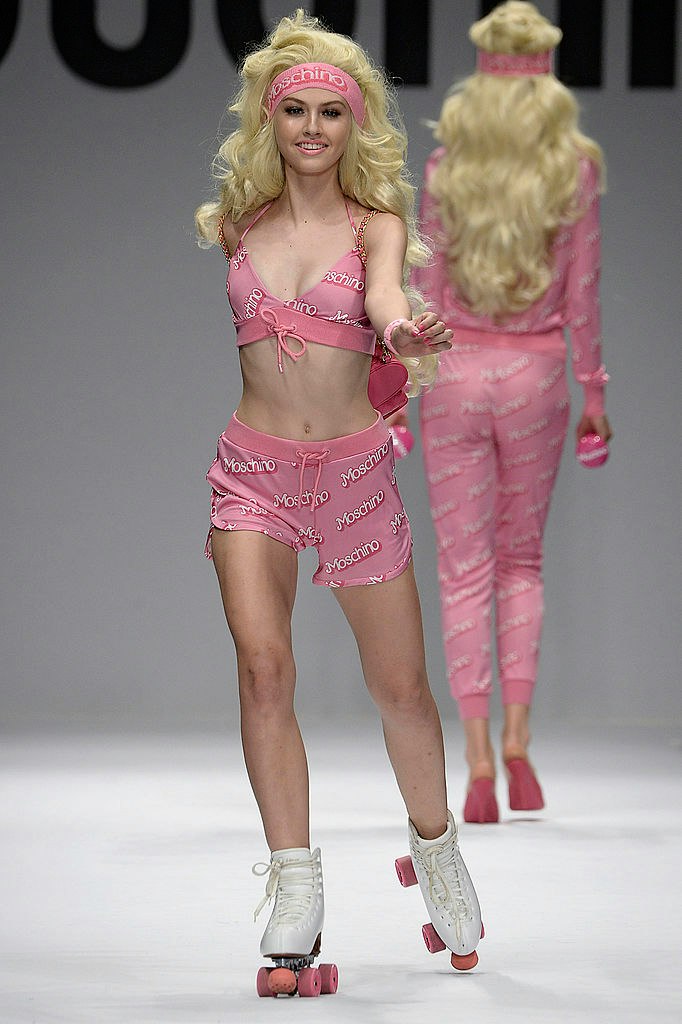
For Spring/Summer 2015, Scott brought Barbie references into clothing, hair, and the runway’s movement. Blonde volume and highly recognizable styling established the doll’s visual vocabulary at human scale. Roller skates added another dimension, turning a familiar association into a way of traveling through the presentation. The model did not simply wear an image; she performed part of its world. The joke occupied time and space as well as the garment’s surface.
Scaling a doll’s wardrobe up to a person also changes the relationship with the object. A toy can hold a pose indefinitely; a human body has to negotiate movement, balance, and the garment’s fit. The collection makes that difference visible even while celebrating the reference. Barbie’s familiarity offers immediate recognition, but the presentation’s vitality comes from living people carrying its artificial vocabulary. The visual fantasy is persuasive because the performers supply the motion that a static toy cannot.
Jardini’s Pattern Makes a Quieter Trick
Rossella Jardini’s patterned shift dress demonstrates a less monumental form of play. A mini shift dress with printed ruffles and an embroidered collar uses the surface to complicate how the garment is read. The eye encounters suggestions of detail that do not all operate as actual layers. This creates a small perceptual joke, inviting the viewer to distinguish what has been built from what has been represented. The dress remains comparatively compact while its surface supplies another level of activity.
Such play depends on precision. A printed ruffle must be placed in relation to the garment’s actual outline if the illusion is to remain coherent. Embroidery introduces a real tactile detail beside the represented one, making the distinction more interesting. The viewer moves between surface and structure, sometimes finding that the expected depth is an image and that a smaller feature is genuinely raised. The viewer finds the joke at close range, in the gap between a represented ruffle and the dress’s actual surface.
A Brand Cannot Repeat the Same Punch Line Forever
Moschino’s archive contains several kinds of visual wit, from a garment that becomes another object to a surface that misdirects the eye. Treating that range as a design resource is more useful than reducing the house to an obligation to be outrageous. A joke loses force when its mechanism becomes entirely predictable. The task for any creative leadership is to find new relationships between familiar things and clothing, preserving the intelligence of the method without merely reproducing its best-known results.
Messina and Rizzo’s appointment in 2026 places them after founder Franco Moschino, Jardini, Scott, and Adrian Appiolaza in the brand’s history. That chronology establishes a creative context, but it does not determine what every future collection should look like. The archive offers questions as well as images: how can a garment criticize, amuse, or surprise through its own construction? A new answer does not have to resemble a cake or a doll to belong to that conversation.
The runway also places the joke in a commercial setting. These are designed clothes shown within an industry that sells desire, and humor can address that industry from inside its own forms. The audience is invited to enjoy an image while recognizing the conventions being stretched. This gives Moschino’s play a sharper edge than a simple claim that fashion should be fun. The dress can be delightful and still make the familiar seriousness of luxury look slightly absurd.
Return to the cake dress and the method is visible. Its extravagance is funny because the reference is clear, but it remains memorable because somebody had to make that reference wearable. Under the icing-like details sits a construction capable of carrying the joke down a runway. Moschino’s humor has seams.