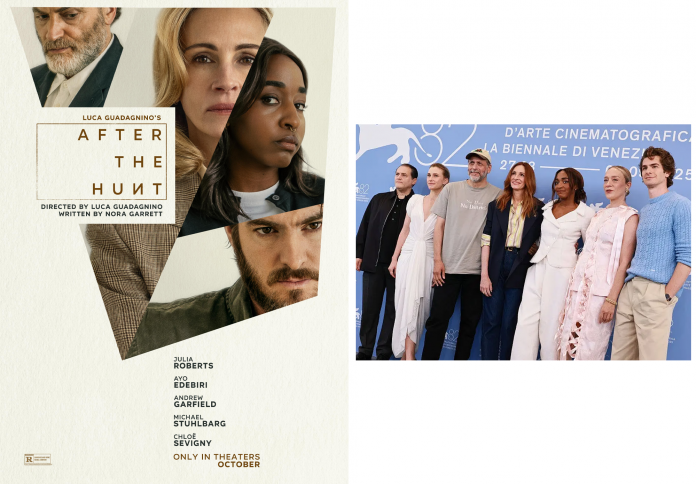
Luca Guadagnino’s After the Hunt arrived in 2025 carrying the kind of premise that resists comfortable alignment. Julia Roberts plays Alma Imhoff, a Yale philosophy professor whose professional and private life is destabilized when her protégée, Maggie Resnick, played by Ayo Edebiri, accuses Alma’s colleague and close friend Hank Gibson, played by Andrew Garfield, of sexual assault. Written by Nora Garrett, the psychological drama also stars Michael Stuhlbarg and Chloë Sevigny. The film premiered at Venice before opening the New York Film Festival and reaching U.S. theaters in October 2025. Its interest lies less in solving the accusation like a mystery than in observing how institutions and relationships deform under competing claims, loyalties, ambitions, and memories. Guadagnino places the conflict inside an elite academic world where everyone has a vocabulary for ethics. The uncomfortable question is whether sophisticated language makes anyone better at recognizing their own self-interest.
The Film Refuses a Simple Campus Thriller Setup
After the Hunt begins with a situation audiences may expect to organize quickly into victim, accused, witness, and institutional response. Instead, the film is built around uncertainty and the ways people position themselves when a serious allegation enters an intimate professional circle. Alma is not a neutral observer. Maggie is her student and protégée; Hank is her friend and colleague.
That triangle gives every response consequences beyond the immediate claim. To believe one person may mean betraying another. To hesitate can be interpreted as self-protection. To act decisively may still be shaped by incomplete knowledge. The university setting intensifies those tensions because careers, reputations, and intellectual identities are all tied to how the conflict is managed.

Julia Roberts Plays Authority Under Strain
Roberts’ casting is central to the film’s design. Her star image carries confidence and accessibility, qualities that make Alma’s authority legible before the story begins to fracture it. As a respected professor, Alma is accustomed to controlling a room through intelligence and social command. The accusation forces her into circumstances where neither status nor eloquence can guarantee control.
The performance gains tension from watching that confidence become defensive. Alma is not simply deciding what she believes about two other people. She is also confronting information from her own past and the possibility that her professional identity has been built around forms of compromise she prefers not to examine.
Edebiri and Garfield Complicate the Moral Geometry
Ayo Edebiri’s Maggie brings a younger generation’s expectations about institutional accountability into collision with Alma’s instincts. Andrew Garfield’s Hank occupies the position of the accused colleague whose history with Alma makes emotional distance almost impossible. The casting avoids obvious visual shorthand for innocence or guilt; both performers are capable of charm, vulnerability, and volatility.
That ambiguity is essential to the film’s method. After the Hunt does not ask viewers to enjoy uncertainty as a clever puzzle. It asks what uncertainty does to people when a decision still has to be made. Real institutions cannot postpone every response until perfect knowledge appears, but acting without perfect knowledge carries its own dangers.
Guadagnino Treats Conversation Like Physical Conflict
Across films such as Call Me by Your Name, Challengers, and Queer, Guadagnino has shown an interest in desire and power as forces that alter the atmosphere of a room. After the Hunt applies that sensibility to academic conversation. Dinners, offices, classrooms, and private exchanges become arenas where status is negotiated through language.
Nora Garrett’s screenplay gives the characters arguments sophisticated enough to reveal and conceal at the same time. A philosophical vocabulary can clarify an ethical problem, but it can also become armor. The film’s university world is full of people trained to analyze motives, yet self-analysis remains much harder than analyzing someone else.
The Film’s Discomfort Is the Point, Not a Defect to Solve
After premiering out of competition at the Venice Film Festival on August 29, 2025, After the Hunt opened the New York Film Festival before its October theatrical release. The debate around the film often centered on its refusal to provide the clean moral catharsis audiences might expect from a story involving an allegation of sexual assault.
That refusal is what gives the drama its shape. The movie is less a statement about one case than an examination of what happens when personal loyalty, institutional politics, generational difference, and buried history occupy the same ethical space. It does not imply that truth is unknowable or irrelevant. It shows that people frequently meet truth through systems of interest and interpretation. In After the Hunt, the most unsettling character is not necessarily the person who argues badly. It is the person who can argue brilliantly while remaining unsure whether the argument is serving justice or the self.
The Film’s University Setting Turns Language Into a Form of Status
Academia is an especially productive setting for After the Hunt because its characters are professionally rewarded for argument. They know how to frame a claim, identify contradiction, question assumptions, and perform intellectual confidence. Those skills can serve truth, but they can also become ways of protecting reputation or delaying moral exposure. The film repeatedly makes eloquence feel both attractive and suspicious.
That tension extends beyond the specific allegation at the center of the plot. Universities present themselves as spaces where difficult questions can be examined rigorously, yet they are also workplaces with hierarchies, career incentives, friendships, and institutional risk. A professor’s abstract commitment to justice can become much more complicated when the people involved are a protégée and a close colleague. Guadagnino uses that collision to make conversation suspenseful. The question is not whether language matters; it clearly does. The question is what happens when people trained to analyze every position can also construct elegant explanations for their own behavior. After the Hunt finds its unease in that gap between intellectual fluency and moral clarity, where the smartest person in the room may still be the least reliable interpreter of herself.