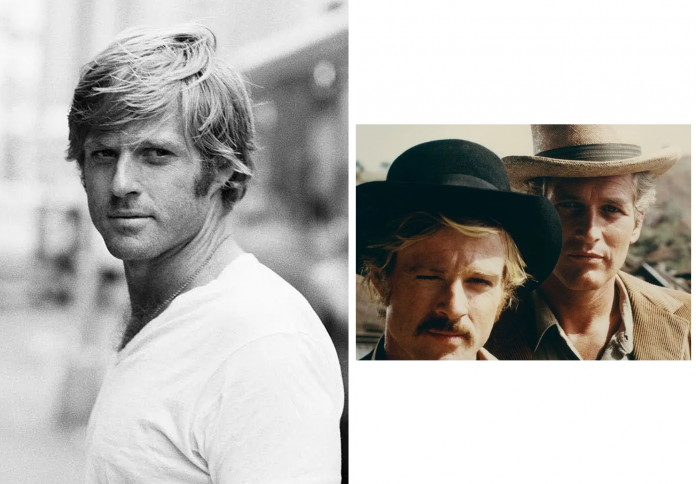
Robert Redford, who died on September 16, 2025, at age 89, leaves a film legacy richer than the image of the golden Hollywood leading man. His beauty and ease made him a defining star of the late 1960s and 1970s, but his most durable performances repeatedly complicated that appeal. In Butch Cassidy and the Sundance Kid and The Sting, charm becomes partnership and strategy. In The Way We Were, it becomes emotional limitation. In All the President’s Men, Redford suppresses glamour to play reporter Bob Woodward inside a procedural drama about institutions and evidence. Later films including The Natural and All Is Lost explored aging, myth, and endurance. His influence extended behind the camera through an Academy Award-winning directing career and the Sundance Institute, which helped create an ecosystem for independent filmmaking. Redford did not merely represent American confidence; his best work kept asking what that confidence concealed.
Sundance Kid Turned Cool Into Partnership
Butch Cassidy and the Sundance Kid made Robert Redford and Paul Newman one of cinema’s great pairings. Redford’s Sundance is quiet, lethal, and dryly amused, creating a counterweight to Newman’s more verbal Butch. Their chemistry depends on confidence shared between two people rather than displayed for the audience alone.
The film also gave Redford a name that would later echo far beyond acting. His Utah property and the institutions that grew around it adopted the Sundance identity, eventually linking a fictional outlaw to one of the most important support systems in American independent film. Few roles have had such a strange second life in the infrastructure of cinema itself.

The Way We Were Exposed the Limits of Beauty
Opposite Barbra Streisand in The Way We Were, Redford played Hubbell Gardiner, a gifted writer whose ease and attractiveness are part of what draws Katie Morosky toward him. Yet those qualities also become limitations. Hubbell’s instinct for comfort and social acceptance collides with Katie’s political intensity and emotional directness.
Redford’s performance works because he does not force Hubbell into obvious villainy. The character’s failures emerge through passivity, charm, and the desire to avoid conflict. The movie turns the traits that made Redford a romantic star into the very reasons a romance may not survive.
The Sting Made Deception Look Effortless
Reunited with Newman in The Sting, Redford played Johnny Hooker, a grifter drawn into an elaborate confidence game. The film’s pleasure comes from craft—both the characters’ craft in building a con and the filmmakers’ craft in revealing information. Redford’s relaxed screen presence makes the complexity feel easy even as the plot depends on precise manipulation.
The role earned him his only competitive Academy Award nomination for acting. That fact is striking given the scale of his star career. Redford’s influence was never best measured by award totals. He often worked in genres and performances where apparent effortlessness could be mistaken for simplicity.
All the President’s Men Replaced Glamour With Procedure
As Washington Post reporter Bob Woodward in All the President’s Men, Redford entered a film where the excitement lies in notebooks, phone calls, parking garages, source verification, and institutional pressure. He and Dustin Hoffman, playing Carl Bernstein, make reporting physical through repetition and urgency rather than action-movie spectacle.
Redford was also deeply involved in bringing the Watergate story to the screen, which makes the performance part of a larger pattern in his career: using star power to create space for subjects involving politics, environment, and American institutions. The film’s restraint remains one of his strongest answers to the assumption that charisma requires constant display.
Sundance May Be the Role That Outlives Every Character
Redford won the Academy Award for Best Director for Ordinary People, his 1980 debut behind the camera, and continued directing films including A River Runs Through It and Quiz Show. Yet his most consequential contribution beyond acting may be the Sundance Institute, founded in 1981, and the independent-film culture it helped foster.
That work transformed Redford from a participant in American cinema into one of its institution builders. Sundance created development opportunities and visibility for filmmakers working beyond conventional studio pathways, shaping careers and tastes for decades. After his death, it is tempting to freeze Redford into a montage of famous faces: outlaw, lover, grifter, reporter, ballplayer. His larger legacy resists that treatment. He used the authority of a classic movie star to widen the field for people who did not look or work like classic movie stars at all.
Redford’s Stardom Was Most Modern When He Used It Against the System That Made Him
Robert Redford benefited enormously from Hollywood’s star machinery, yet his most lasting institutional contribution was designed to create space outside it. That contradiction is central to understanding his legacy. Sundance did not emerge from a rejection of professional filmmaking; it emerged from someone with extraordinary access deciding that the industry’s dominant pathways were too narrow.
The result changed what American independent cinema could imagine about development, discovery, and audience. Films and filmmakers that might have struggled to attract studio attention gained workshops, a festival platform, critical visibility, and eventually a marketplace. Redford’s own fame helped draw attention, but the institution’s value came from redirecting that attention toward others. It is difficult to separate this work from the roles that made him powerful enough to attempt it. The handsome star of Butch Cassidy, The Sting, and The Way We Were accumulated cultural capital, then spent part of it building an alternative system. That may be the most revealing extension of his screen persona: the confidence associated with the classic American leading man turned toward creating more room for stories that did not require one.