Zara Larsson and makeup artist Sophia Sinot have made maximalist beauty central to a distinctive pop image. Their palette is unapologetically exuberant: patterned eyelids, brightly colored liner, crystals, and blush that refuses to disappear into the background. The looks are more than decorations attached to a performance costume. They help communicate a particular kind of pop stardom, one built around display, humor, and visual immediacy. In an online environment where a single close-up can circulate independently of a song or stage show, facial design acquires an almost independent life. Larsson's collaboration with Sinot offers a revealing example of how makeup can connect music, fashion, and digital culture without needing to become conventionally flattering or easy to reproduce. Its appeal comes from commitment to an idea, right down to the smallest painted detail.
A tiger stripe is not ordinary eyeliner
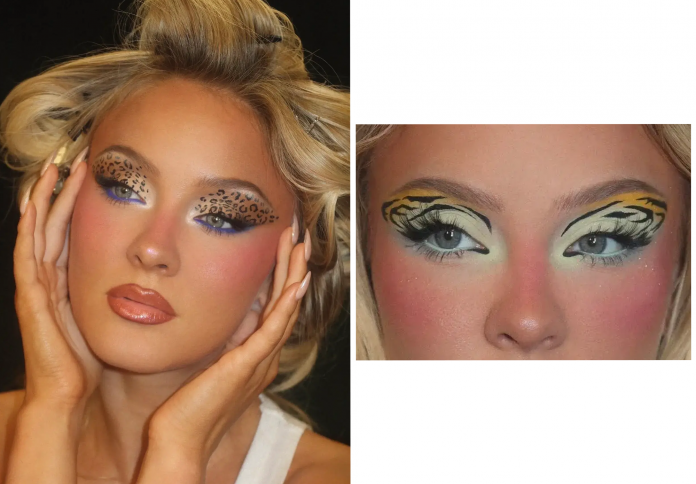
Among the looks described in Larsson's recent beauty coverage are tiger-striped lids, graphic blue liner, and sharply drawn shapes that make the eyes resemble a small illustrated surface. Animal pattern is not typically treated as everyday eye makeup. Its placement across the face changes the relationship between clothing and cosmetics: the makeup can echo a fashion print, compete with it, or establish an entirely new point of interest in a portrait.
The effect is strongest because the designs do not stop at unusual color selection. A simple wash of blue eyeshadow leaves the structure of the face largely unchanged. Freehand stripes and colored outlines redirect attention toward the artist's decisions. Their precision is part of the message. The viewer sees not only an expressive pop star but the hours of controlled work required to produce an apparently spontaneous image.
Sophia Sinot and the return of deliberate excess
Sinot's work with Larsson is built around a vocabulary of candy-colored pigment, glitter, crystals, and exaggerated forms. Satin-pink and lavender liners appear alongside polka-dot eyes and richly saturated cheeks. The combinations disrupt the familiar idea that makeup should choose one feature to emphasize and keep everything else subordinate. Instead, multiple details cooperate in a single visual direction, creating an image designed to be noticed.
Maximalism can fail when every element competes without purpose. These looks often succeed because motifs provide a clear organizing idea, whether animal markings or repeated dots. Placement matters as much as quantity. A crystal near the temple extends the design beyond the lid; a precise graphic line defines its edge. It is this compositional discipline, rather than sparkle alone, that distinguishes an editorial look from a collection of attention-grabbing products.
Beauty designed for the scrolling screen
A high-resolution close-up on social media allows viewers to inspect eyeliner angles, individual crystals, and the texture of applied color. Fans do not need to attend a performance to encounter the result. They can pause, save, and attempt their own versions. This gives the collaboration a second audience beyond music listeners: makeup artists and enthusiasts who treat the look as a technical puzzle.
The format also creates a paradox. Designs that look effortless in a short clip may have taken considerable time to execute. Their appeal online lies partly in that contrast between immediate impact and concealed labor. Tutorials and reproductions can reveal the process, but they also show why professional control of symmetry, spacing, and contrast makes the original so visually coherent.
The face and the stage persona
Larsson's fashion image has frequently embraced high-energy, body-conscious styling and bright colors. Makeup in that context does not need to supply restrained elegance; it can reinforce the sense that performance is a place for exaggeration. Yet some of the most memorable choices are playful rather than severe. Hearts, dots, and sparkling details introduce humor into an aesthetic that might otherwise read as purely confrontational.
There is a lineage here with theatrical pop image-making, although every generation negotiates its own tools and platforms. The current combination of close-up photography, social circulation, and rapidly shared beauty references rewards looks that can be understood immediately. Larsson and Sinot respond with surfaces that carry clear graphic signals. The makeup works at the scale of both the face and the thumbnail.
Expression without the demand for imitation
Not every glitter arrangement is suited to a morning commute, and that is hardly a failure. Editorial makeup can function as visual culture without becoming a universal routine. A viewer might borrow a contrasting color combination, the confidence to place blush unusually high, or the idea of drawing a repeated pattern. The influence is more flexible than copying an entire design crystal for crystal.
Larsson's recent beauty identity demonstrates what happens when an artist and a performer pursue a shared visual idea consistently. The images remain recognizable even as motifs change. For ordinary makeup users, the most useful lesson is not a requirement to wear more product. It is the possibility that color and ornament can be chosen for delight, humor, and a sense of authorship rather than merely for subtle correction.
A powerful beauty identity also depends on recognizing when a motif belongs to a particular performance and when it can carry over into everyday promotion. Sinot's geometric patterns function in portraits because each small mark is positioned in relation to expression, hair, and camera framing. A close-up emphasizes workmanship; a full-body image makes the makeup converse with costume and choreography. Both types of photograph tell different stories. For fans attempting a look, choosing which detail to borrow is therefore more practical than recreating the whole face. One color combination or a pair of contrasting dots can suggest the original's playful energy without demanding a professional kit.