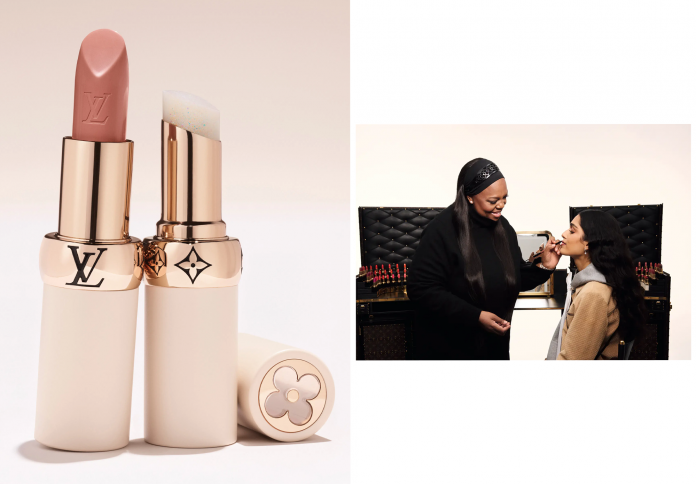
Pat McGrath's work sits at an unusual intersection: experimental runway beauty, the visual language of high fashion, and cosmetics sold to everyday customers. Her collaboration with Nicolas Ghesquière for La Beauté Louis Vuitton offers a fresh occasion to look at the accumulated ideas behind that influence. Makeup, in McGrath's hands, is not simply a final adjustment before a photograph; it can help determine the image's entire emotional register. Her signature is difficult to reduce to a single color or technique because transformation itself has been the through line. The significance of a luxury-house beauty venture is therefore more complex than a new lipstick counter. It connects the intimacy of applying pigment with the ambitions of a fashion institution, while raising the enduring question of how radical backstage ideas survive translation into products people can actually use.
The backstage laboratory
Long before a beauty look appears in campaign images, backstage work involves compromise among fabrics, lighting, casting, and the designer's intention. McGrath's career has repeatedly placed makeup at the center of that negotiation. A face can become luminous, sculptural, deliberately strange, or almost bare depending on the show. The effect may last only for the duration of a runway presentation, yet photographs can extend its influence for years.
That temporary quality explains much of makeup's freedom. Unlike a handbag, a look need not be built to last through a decade of ownership. Pigment can be removed; a surface can be revised. McGrath has used that freedom to treat skin, eyes, and lips as parts of a visual composition. When those experiments are reproduced in magazines and online tutorials, the boundary between fashion spectacle and personal beauty begins to shift.
From a mother's curiosity to a global practice
McGrath has described the importance of her mother Jean, whose resourcefulness with color and cosmetics helped shape her imagination. Her broader career developed through editorial work, designers, and the often invisible labor of backstage teams. This history matters because beauty trends are sometimes narrated as spontaneous inventions. In practice, a compelling image depends on accumulated skills: mixing shades, understanding how light changes surfaces, and noticing what a face needs in relation to a garment.
The nickname Mother, widely used by admirers and collaborators, recognizes a figure who has also mentored and inspired younger artists. Yet mythology can flatten the practical side of the accomplishment. The significance lies in sustained experimentation across many contexts rather than one universally reproducible signature look. McGrath's influence is best traced in the vocabulary others have absorbed, from unapologetic metallic finishes to the idea that runway beauty can carry conceptual weight.
Luxury beauty as an extension of fashion
Louis Vuitton introduced La Beauté with McGrath as creative director, joining a broader category in which fashion houses translate their image-making authority into makeup. The association with Nicolas Ghesquière makes the crossover especially visible. A designer's collection and a cosmetic range may share colors and cultural references, but they operate on different scales: clothing constructs a silhouette, while cosmetics invite a customer to work directly on their own face.
That personal dimension makes the opportunity substantial and the challenge demanding. A luxury price can signal craftsmanship and desirable objects, but lipstick still needs to apply well. Customers will interact with texture, wear, shade, packaging, and convenience more often than with a brand's creative manifesto. A product line ultimately earns credibility through the everyday rituals that advertising cannot fully stage.
The archive has become a living resource
Retrospective interviews invite audiences to view an artist's past as a sequence of milestones. McGrath's work resists that easy chronology because old photographs can still suggest new possibilities to today's makeup users. A glittering eye created for a runway years ago may reappear as inspiration for a club look; an unusually polished complexion can shift expectations in editorial photography. The archive functions as an active toolbox rather than a museum of finished ideas.
Digital circulation has intensified this effect. A detail once noticed mainly by fashion editors can now become an image reference shared among artists across the world. Replication, however, is never exact. Different faces and lighting require adaptation, and the distinctive power of an original look may reside in the overall composition, not a single named product. Inspiration is strongest when it invites interpretation instead of imitation.
A lasting influence measured in possibilities
It is tempting to judge a collaboration by which product sells out first or how enthusiastically a launch is photographed. Those metrics tell only a portion of McGrath's story. She has helped expand what the beauty industry regards as wearable, presentable, glamorous, or deliberately provocative. A dramatic editorial face and a restrained daily application can both draw from that same permission to experiment.
The Louis Vuitton project offers one more setting in which those ideas must be made tangible. Whether a customer chooses an intense lip or a quieter shade, the deeper contribution is the suggestion that makeup can be chosen deliberately, not merely used to correct a perceived flaw. The products will be judged in bathrooms and handbags, but the creative ambition begins where fashion imagery has always begun: with the decision to make a face say something.
The professional labor behind a runway look also deserves attention. Assistants prepare skin, organize tools, manage time, and help maintain consistency across a cast of models. Photographers and lighting specialists determine how pigments will be seen, while stylists establish the clothing against which the makeup is read. The celebrated artist remains the creative force, but the image is a coordinated production. This helps explain why copying a particular shade at home rarely reproduces an editorial photograph. McGrath's achievement includes not only a striking visual imagination but an ability to make that imagination work inside collaborative fashion processes with demanding schedules and exacting standards.