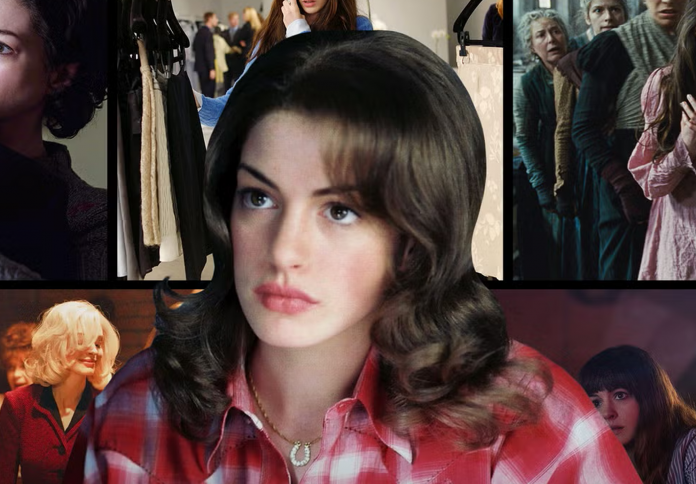
Anne Hathaway entered popular culture as an awkward teenager discovering a royal inheritance, then spent the next quarter century escaping every box that success created for her. Romantic comedies, prestige dramas, musicals, science fiction and sharply controlled supporting roles have each revealed a different use of her intelligence and emotional clarity. Her most familiar performances—Mia Thermopolis, Andy Sachs, Fantine and Catwoman—can obscure how varied the work around them has been. A ranking of her films is therefore less interesting as a fixed scoreboard than as a map of continual recalibration. Hathaway’s longevity comes from treating versatility not as occasional reinvention, but as the basic architecture of a career.
The Debut That Could Have Become a Trap
The Princess Diaries gave Anne Hathaway an entrance most actors would envy. At 18, she turned Mia Thermopolis from a collection of makeover conventions into an alert, funny adolescent whose discomfort survives the tiara. The role made Hathaway immediately legible to family audiences and established a warmth that studios could easily have repeated. Instead, the film became a starting point rather than a permanent category.
Early projects such as Ella Enchanted preserved fairy-tale buoyancy, but Brokeback Mountain introduced her to an adult dramatic register. The shift was not simply a rejection of sweetness. Hathaway began testing how directness, ambition and vulnerability could work inside different genres. She retained the audience’s trust while making the terms of that trust less predictable.

Andy Sachs and the Intelligence of Reaction
The Devil Wears Prada remains a defining performance because Hathaway understands that Andy’s transformation must be visible before it becomes verbal. Her posture, pace and clothing change, yet the more important evolution happens in reaction shots. She learns how Miranda Priestly’s world operates, becomes capable within it and then recognizes what that capability is costing.
The film’s endurance has made Andy an icon, and a sequel asks Hathaway to revisit a character audiences have debated for decades. Returning can easily become imitation of a beloved earlier performance. The challenge is to imagine what survived after Andy walked away: which lessons became useful, which compromises remain unresolved and how professional ambition looks after youth’s moral certainty has been tested by time.
Risk, Recognition and Rachel
Rachel Getting Married supplied one of Hathaway’s first great dramatic tests. As Kym, a recovering addict returning for her sister’s wedding, she makes neediness abrasive rather than charming. The performance does not ask viewers to excuse damage simply because the character is in pain. It allows guilt, self-absorption and genuine longing to occupy the same conversation. That complexity earned Hathaway her first Oscar nomination.
Les Misérables later produced the win, with Fantine’s suffering concentrated into a physically exposed musical performance. The role is brief relative to the film, yet Hathaway uses breath and vocal imperfection to make collapse feel immediate. The Oscar confirmed prestige credentials, but its greater value was demonstrating that her musical skill could serve character rather than operate as a separate showcase.

Genre Work Without Condescension
Hathaway’s strongest genre performances never suggest that she believes herself above the material. In The Dark Knight Rises, Selina Kyle combines physical control, opportunism and dry wit without flattening into a standard femme fatale. Interstellar asks her to deliver scientific argument and emotional conviction within the same mission. Ocean’s 8 lets her parody celebrity vanity while keeping Daphne Kluger strategically alert.
Even smaller work can reveal this discipline. In Dark Waters, her role as Sarah Bilott could have been reduced to supportive spouse, but Hathaway insists on the character’s legal intelligence and anger at being spoken around. The performance uses limited screen time to widen the moral cost of the central case beyond the courtroom.
A 2026 Built Around Range
The density of Hathaway’s 2026 slate makes the pattern unusually visible. Mother Mary places her inside a chamber drama as a pop star attempting a return. The Devil Wears Prada 2 reopens her most culturally persistent professional role. The Odyssey gives her Penelope’s mythic patience, while The End of Oak Street introduces a family displaced into the age of dinosaurs. Verity moves toward erotic thriller territory.
These projects do not form a neat brand statement, and that is the statement. Hathaway’s career is not organized around proving that she can transform beyond recognition in every film. It is organized around adjusting familiar qualities—clarity, alertness, emotional availability—to different worlds. Ranking her performances will always invite disagreement because audiences have met several distinct Anne Hathaways. The continuity lies in her refusal to treat any one of them as the final version.
The continuity extends to comedy, a skill that rankings often undervalue. Hathaway can make embarrassment quick and readable without turning a character into a joke, then let that comic openness deepen later pain. That bridge connects Mia, Andy, Daphne and several less celebrated roles. It also explains why directors can place her inside heightened premises: audiences accept the world because her reactions establish its emotional scale. Range, in her case, often begins with the precision of response.