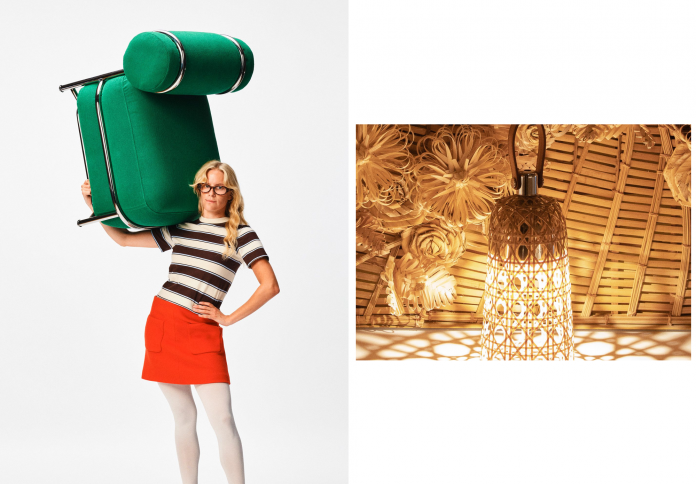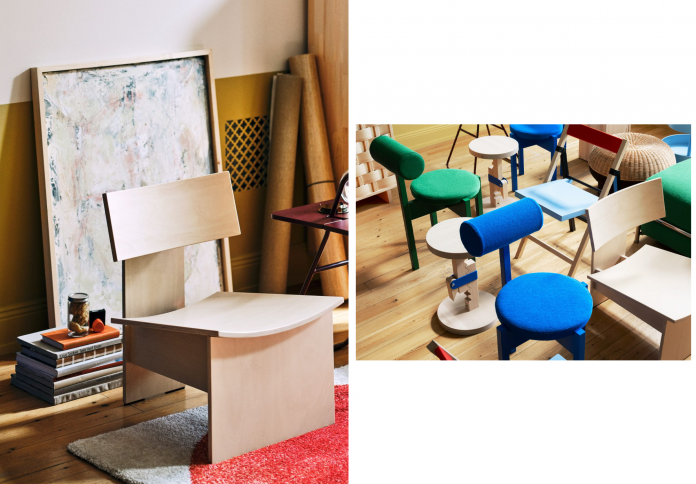
IKEA revived its experimental PS line in 2026 with forty-four products developed by twelve designers under an unusually open brief. The collection, the tenth edition of IKEA PS since the program began in 1995, centers on “playful functionality”: furniture and objects that move, rotate, inflate, hide, rock, fold, or otherwise reveal how they work through use. The pieces include a rotating floor lamp, an inflatable easy chair, a rocking bench, transformable furniture, handblown glass, vivid textiles, and objects whose mechanisms become part of their personality. What makes the collection relevant is not novelty for its own sake. Mass-market furniture often becomes visually cautious because it must serve millions of homes. IKEA PS argues that democratic design can still contain surprise, provided the surprise performs a real job. The best pieces feel less like jokes and more like invitations to touch, adjust, and understand.
PS Returns as a Place for Product Experiments
IKEA PS has historically occupied a useful position inside the company: more exploratory than the core range but still accountable to the realities of mass production and accessible pricing. The 2026 edition returns after a long pause with forty-four designs by twelve designers. Instead of one narrow aesthetic theme, the brief encouraged products that express function through play.
That framing matters because “playful” can easily become a euphemism for novelty. The collection is stronger when an unusual gesture changes how the object is used. A lamp that rotates, a chair that inflates, or a bench that rocks asks the user to participate. The mechanism is not hidden behind a neutral shell. Interaction becomes part of the visual identity and turns ordinary domestic behavior into a small event.

Movement Makes Function Understandable
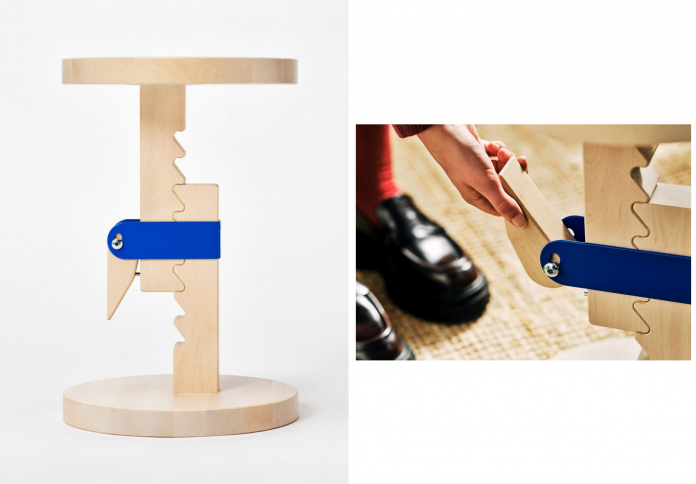
Some of the collection’s most memorable objects are kinetic. A piece that folds or changes height communicates its purpose by moving. This type of design can be especially intuitive because the user learns through action rather than through instructions. The object reveals what it can do by inviting a hand to push, pull, turn, or sit.
That approach has deep roots in IKEA’s design culture. Flat-pack furniture already asks customers to understand assembly, even when the final object looks conventional. IKEA PS extends that participatory relationship into everyday use. Instead of interaction ending once the screws are tightened, the furniture continues to change. The home becomes less a static composition and more a set of tools that can respond to different moments.
Twelve Designers Prevent a Single House Style
The 2026 lineup includes designers such as Henrik Preutz, Mikael Axelsson, Matilda Lindstam Nilsson, Ellen Hallström, Lex Pott, Lukas Bazle, Maria Vinka, Ola Wihlborg, Michelle Armas, David Wahl, Friso Wiersma, and Marta Krupińska. Their work moves across furniture, lighting, glass, textiles, and smaller domestic objects.
The variety prevents PS from reading like a trend package. Maria Vinka’s handblown glass and Michelle Armas’s expressive textiles do not need to share the same formal language as adjustable seating or transformable furniture. The collection gains coherence through attitude instead: visible ideas, direct materials, and a willingness to let products have character. For a global retailer, that kind of controlled inconsistency can be refreshing.
Mass Production Is the Hard Constraint
Experimental furniture shown at a gallery can accept fragility, high labor cost, or a limited audience. IKEA has to solve a different problem. Any PS concept that reaches stores must survive packaging, transportation, assembly, safety testing, manufacturing scale, and customer use across many markets. Playfulness is therefore meaningful only if it passes through a dense technical filter.
That constraint can improve ideas. A complicated mechanism must be simplified. A sculptural form has to fit into logistics. A surprising material must be sourced consistently. The process strips away gestures that cannot survive repetition. When an experimental detail remains, it has earned its place. This is one reason mass-market product innovation can be harder than it looks: the idea must be interesting and ordinary enough to manufacture thousands of times.
Democratic Design Does Not Have to Be Bland
The return of IKEA PS makes a broader argument about affordability. Products aimed at large audiences are often expected to become visually neutral so they can offend as few people as possible. That strategy has commercial logic, but it can also make homes feel interchangeable. The PS collection suggests another route: accessible furniture can offer personality without demanding luxury-level pricing or specialist knowledge.
Not every object will suit every room, and that is part of the point. A rotating lamp or bright textile can ask for a stronger reaction than a basic white cabinet. Choice becomes richer when mass retail includes both. The collection’s real success will be measured after the novelty fades: whether people keep adjusting, sitting on, moving, and living with these pieces. If the play survives daily use, PS will have proved that function and fun were never opposites in the first place.
PS Works Best When Experimentation Reaches Ordinary Homes
IKEA PS has always been most interesting when it treats experimentation as something that should survive contact with price, flat-pack logistics, small apartments, and daily mess. That separates the collection from limited-edition design exercises whose most radical ideas remain accessible only to collectors. A strange stool or adaptable table becomes culturally meaningful when thousands of people can actually test whether the idea improves a room.
The 2026 collection continues that democratic tension. Playfulness matters, but so does the engineering required to make a playful mechanism understandable without a showroom expert standing nearby. IKEA’s scale forces designers to simplify interactions, reduce unnecessary material, and anticipate assembly by people with different abilities and living conditions. Those constraints can limit form, yet they can also sharpen an idea. The collection’s value therefore lies less in novelty for its own sake than in translating experimental thinking into products that have to earn space in real homes. When PS succeeds, the unusual feature is not a visual trick. It becomes a behavior—something the owner adjusts, moves, shares, stores, or uses differently because the design made another way of living feel obvious.