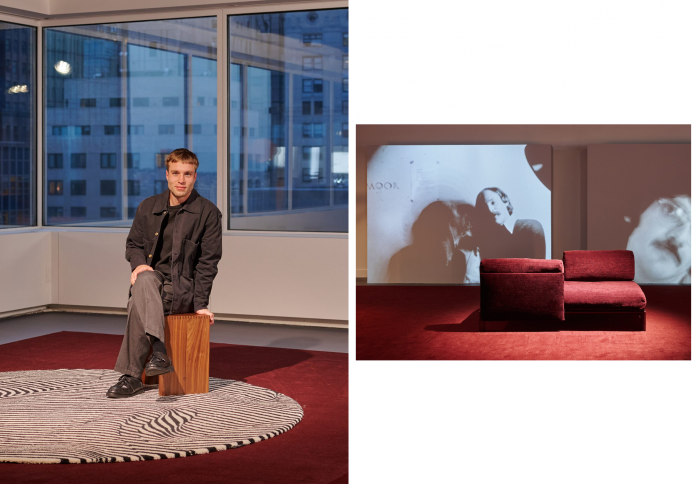
“Frame in Frame: Swiss Design in Motion,” presented during NYCxDesign 2026, treats an archive of experimental films as spatial material rather than something to be passively screened. More than two hundred works made in connection with the Film + Design course at the Basel School of Design—an initiative associated with Armin Hofmann and later Peter von Arx—were activated inside New York’s WSA building through a multi-channel installation. Curator Christian Herren and artist Daan Couzijn worked with a scenography by Ben Ganz that transformed Lehni aluminum shelving into projection infrastructure, while furniture by Panter&Tourron, USM, and other Swiss makers turned viewing into an inhabitable experience. The exhibition’s subject is motion design, but its method is equally important. By refusing the black-box cinema, it allows the films to collide with furniture, architecture, and one another, making design history feel unfinished and physically present.
The Archive Refuses to Sit Still
Archives are often designed to protect objects from change. “Frame in Frame” takes the opposite approach. Its collection of experimental Swiss films becomes active through projection, overlap, and movement inside the exhibition space. Rather than asking visitors to sit through a fixed program from beginning to end, the installation creates multiple points of encounter, allowing one work to lead unexpectedly toward another.
That structure fits the films themselves. The Basel School of Design’s Film + Design course encouraged work that examined framing, time, sequence, rhythm, abstraction, and the basic conditions of moving images. Many pieces were produced before “motion design” became a familiar professional category. Seen today, their experiments can feel remarkably contemporary because screens now surround daily life. The exhibition makes that historical continuity visible without turning the work into a chronology lesson.

Shelving Becomes Projection Architecture
Designer Ben Ganz used Lehni’s aluminum shelving system as the scenographic framework. The choice is clever because shelving is normally associated with storage, while here it becomes a support for images that cannot be stored in the same physical way as books or objects. Screens and projections inhabit the structure, turning archival organization into visual performance.
The lightness of aluminum also allows the installation to remain legible. Instead of building opaque walls around each film, the system creates frames within the larger room. Visitors can see across multiple works at once, producing the “frame in frame” condition suggested by the title. The exhibition is not only about films made by designers; it is itself a study in how design controls what can be seen, from where, and in relation to what else.
Furniture Changes How Film Is Watched
Panter&Tourron’s Anagram sofa for Vitra helps create a flexible cinema environment, while a USM Haller bar and other Swiss design elements extend the show beyond projection technology. These choices are more than national branding. They remind visitors that viewing is bodily. The posture of a chair, the height of a screen, the ability to turn toward another image, and the social arrangement of seating all affect how moving pictures are understood.
Traditional cinemas organize attention in one direction. “Frame in Frame” disperses it. A visitor may sit, stand, wander, or catch a fragment from the edge of another zone. That looseness resembles contemporary media consumption, but the physical setting slows it down enough to encourage comparison. Instead of scrolling through clips alone, people occupy a room where images share space and where other viewers become part of the experience.
Basel’s Experiments Anticipated a Screen Culture
Armin Hofmann is widely associated with Swiss graphic design, but the film work connected with Basel expands the familiar story of Swiss modernism beyond posters and typography. Under Hofmann and later Peter von Arx, students explored what happens when formal principles are given duration. A shape can transform, a grid can become a sequence, and a composition can change meaning simply through timing.
Those experiments now look newly relevant because design is increasingly temporal. Interfaces animate, brand systems move, social content loops, and buildings are represented through video before they exist. The archive shows that questions of motion were not added to graphic design by software. Designers were already studying rhythm and sequence through analog film decades ago. Digital tools accelerated the field, but the underlying problems—attention, transition, repetition, framing—remain recognizable.
Design History Works Best When It Reenters Use
The exhibition’s greatest achievement is avoiding the respectful distance that can make historical design feel complete. By combining rediscovered films with contemporary furniture and an active installation system, “Frame in Frame” presents the archive as a resource for current practice. The works are not valuable only because they are old or Swiss. They are valuable because they still generate questions.
That approach is especially appropriate during NYCxDesign, when the city is saturated with launches competing to appear new. An archive offers a different measure of novelty. Ideas that look current may have long precedents, while forgotten experiments can suddenly feel urgent again. “Frame in Frame” turns that realization into a room. Visitors do not simply learn that motion design has a history; they move through the evidence, surrounded by images whose unfinished energy makes the past feel surprisingly close.
An Archive Becomes More Legible When Visitors Can Feel Its Structure
Film archives are usually encountered through individual works: one restored movie, one poster, one director, one screening. An installation can make the archive itself visible as a designed system. Frames, thresholds, repeated proportions, and layered views give visitors a spatial analogy for selection—what is foregrounded, what remains behind, and how one image leads toward another.
That is especially appropriate for cinema, where framing is never neutral. Every shot excludes most of the world in order to direct attention toward a chosen portion. A frame-within-frame installation turns that cinematic condition into architecture. Visitors become aware of looking through, around, and past constructed boundaries as they move. The experience can suggest that an archive operates similarly: it preserves through acts of selection, cataloging, and access. The strongest cultural installations do not merely decorate a historical collection. They create a physical method for thinking about it. In this case, the visitor’s own movement supplies the edit, making preservation feel less like storage and more like an active sequence of choices about what can still be seen.