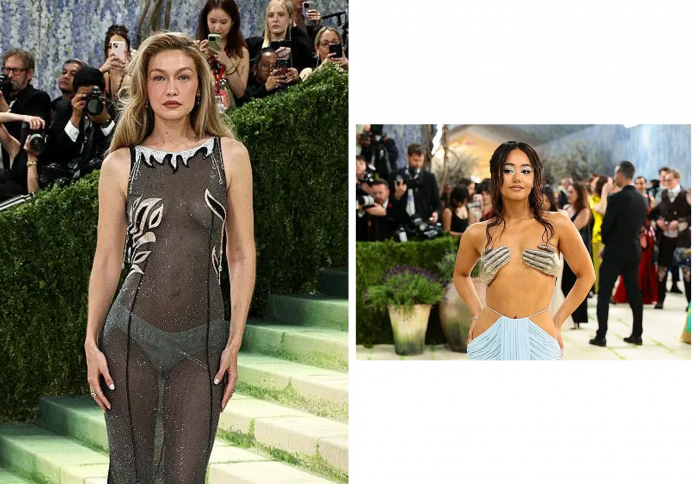
The naked dress is now so familiar on red carpets that shock alone can no longer explain its staying power. At the 2026 Met Gala, where “Fashion Is Art” framed the evening, transparency became a more useful design question: how can clothing reveal the body while still creating an image around it? Guests including Doja Cat, in sheer Saint Laurent, and Léna Mahfouf, in an architectural Burc Akyol look, approached visibility through different materials and silhouettes. Other attendees used translucent layers, open backs, or illusion construction rather than straightforward nudity. The result showed how broad the category has become. A naked dress can be soft or severe, romantic or confrontational, nearly invisible or heavily engineered. Its meaning now depends less on the amount of skin visible than on who controls the view and how the garment shapes it.
The Naked Dress Is No Longer a Single Look
The phrase “naked dress” suggests a simple formula, but contemporary red carpets use it to describe several different techniques. Some garments rely on transparent mesh or lace. Others use strategically placed embroidery, crystal work, body-colored panels, low backs, or sculptural pieces that reveal skin while keeping the outfit technically constructed.
That variety matters because it moves the conversation away from a crude question of how much a celebrity is showing. The more interesting issue is how the garment controls visibility. A sheer layer can blur the body, frame it, interrupt it, or make it appear more exposed than it actually is. The naked effect is often the product of significant design rather than the absence of clothing.

Doja Cat Used Sheerness as Part of a Larger Persona
Doja Cat’s Saint Laurent look fit comfortably within a fashion identity that frequently uses provocation, body transformation, and theatrical beauty. On her, transparency does not arrive as a one-night attempt to create headlines; it belongs to a longer public conversation about performance and image.
That continuity changes how the outfit reads. A sheer dress can feel vulnerable on one wearer and confrontational on another. Doja Cat tends to treat the body as an artistic instrument, changing hair, makeup, prosthetics, silhouettes, and levels of exposure with the same appetite for experimentation. The garment becomes one variable in a larger performance rather than the entire point.
Léna Mahfouf Made Exposure Architectural
Léna Mahfouf’s Burc Akyol look offered another route. A metal hand-like bustier and draped skirt used structure to make exposure feel sculptural. Instead of dissolving the garment into near-invisibility, the design placed hard material against the body and made the boundary between covering and revealing deliberately obvious.
That approach suited the Met Gala’s art framing because it foregrounded construction. The body was visible, but so was the designer’s intervention. Metal, drape, skin, and silhouette formed one composition. The visual interest came from the tension between them rather than from nakedness alone.
The Met Is a Laboratory for Controlled Risk
The Met Gala gives celebrities unusual permission to wear clothes that would be difficult to justify at a standard film premiere or awards ceremony. Its themes encourage experimentation, and the museum setting gives even overtly sensual dressing an additional conceptual frame. Designers can therefore push transparency further while arguing that the body is part of an artistic study.
That freedom does not eliminate controversy. Red-carpet images circulate outside the context of the gala almost instantly, where a sheer dress may be reduced to a headline about nudity. The wearer and designer are operating in two media environments at once: one that rewards explanation and another that rewards immediate reaction. Successful looks must often survive both.
Visibility Is Most Powerful When It Feels Chosen
The enduring appeal of the naked dress is tied to control. Red carpets are environments where bodies are intensely photographed, judged, and discussed regardless of what someone wears. A deliberately transparent garment can reverse part of that dynamic by making visibility an authored choice rather than an accidental exposure.
The 2026 Met Gala made that idea especially clear because so many guests treated the body as part of the artwork. Skin became negative space, surface, contrast, and structure. The category’s future may therefore depend less on becoming more revealing and more on becoming more inventive. Once shock has been normalized, design has to do the harder work. The strongest naked dresses are no longer memorable because they show the most. They are memorable because they make viewers reconsider what clothing is doing even when very little of it appears to be there.
The Category’s Future Depends on Moving Beyond the Language of Scandal
Calling every transparent look “naked” can flatten very different design ideas into the same headline. A mesh column, a metal breastplate, a crystal illusion, and a backless gown may expose similar amounts of skin while doing entirely different things with structure and meaning. The 2026 Met Gala made that limitation obvious because the body itself was often part of the artistic concept.
A more useful vocabulary would describe how a garment reveals. Does it blur, frame, sculpt, interrupt, or trace the body? Is transparency soft or confrontational? Does the wearer appear protected, vulnerable, armored, or deliberately theatrical? Those questions return attention to design without pretending that sexuality is irrelevant. The naked dress will likely remain a red-carpet staple because it produces immediate images, but longevity as a fashion idea requires more than escalation. Once audiences have seen nearly every possible level of exposure, innovation has to come from construction, context, and authorship. The body is not a trend that can be exhausted. The challenge is designing new relationships between that body and the material around it.