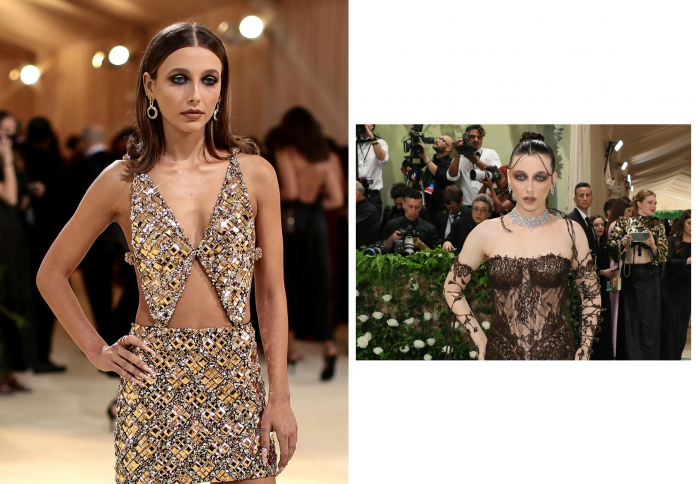
Emma Chamberlain’s Met Gala history is unusually revealing because it overlaps with her transformation from internet celebrity into a credible fashion-world presence. By 2026, she was no longer arriving as a digital outsider invited into an old institution; she was returning as a familiar red-carpet correspondent and a repeat guest with a well-developed visual language. Her custom Mugler look, created under Miguel Castro Freitas, pushed that evolution further through hand-painted imagery and an art-history mood that echoed the evening’s “Fashion Is Art” direction. The point was not simply that Chamberlain wore a more elaborate dress than she had in earlier years. It was that she had learned how to use the Met Gala as a storytelling format. Across repeated appearances, her style has become less about proving that she belongs and more about testing how personality, fashion history, and media fluency can occupy the same frame.
The Met Gala Became a Public Fashion Education
Emma Chamberlain’s early fashion fame arrived through an unusual route. She built an audience online before luxury houses began treating digital creators as an established part of their cultural ecosystem. Her first years around the Met therefore carried the fascination of someone crossing from one media system into another. The carpet was not just a place to wear a designer look; it was evidence that the border between internet celebrity and traditional fashion authority was already changing.
Repeated appearances altered that dynamic. Familiarity gave Chamberlain room to become more specific. Instead of relying on the novelty of an influencer at fashion’s most institutionalized night, she could make choices that assumed the audience already understood her relationship to the event. Her work interviewing guests for Vogue reinforced the shift. She became both participant and interpreter, someone who could move between the formal machinery of the carpet and the conversational language that made her famous.

A Correspondent Learns to Dress for the Story
Working as a red-carpet correspondent changes the practical demands of a Met Gala look. A garment must survive hours of standing, talking, reacting, and being photographed from multiple angles. It also has to hold its own beside the people being interviewed. Chamberlain’s strongest Met choices have increasingly understood that performance requirement: they create a memorable silhouette without swallowing the person expected to speak through it.
That dual role also suits her public persona. Chamberlain’s appeal has never depended on maintaining perfect distance. Her humor is often self-aware, and her interviews work because she can puncture the stiffness of a highly controlled celebrity environment. Fashion, in that context, becomes part of the conversation rather than a barrier around it. The best looks give her enough theatricality to belong to the event while leaving space for the informality that viewers expect from her.
Mugler Turned Painting Into a Wearable Illusion
For 2026, Chamberlain wore a custom Mugler design by creative director Miguel Castro Freitas that used hand-painted effects to make the body appear to emerge from a work of art. The garment drew on painting rather than simply reproducing a famous canvas. Its surface used color, texture, and trompe-l’oeil to blur the boundary between dress and image, a particularly direct response to the “Fashion Is Art” dress code.
The construction reportedly required days of hand painting and an extensive palette, emphasizing that the effect was produced through labor rather than a printed shortcut. That distinction mattered on a night built around the relationship between art and clothing. The dress treated the wearer as part of the composition, not as a neutral mannequin for a flat picture. Chamberlain’s body completed the image every time she moved.
Personal Reference Made the Art-History Idea Warmer
The 2026 look also resonated because Chamberlain has spoken about growing up around art through her father, an artist. That background gave the painted surface a more personal dimension than a generic museum reference would have offered. The dress could participate in the gala’s broad intellectual theme while still connecting to a visual language that existed in her life before fashion became part of her profession.
This is where a retrospective of her Met Gala appearances becomes more useful than a ranking. Style evolution is rarely a straight climb from “bad” to “good.” It is a process of gaining vocabulary. Chamberlain’s later looks can hold more references because she has accumulated more experience: with designers, with cameras, with fashion history, and with the peculiar social theater of the Met itself.
Belonging Is No Longer the Main Question
The most interesting change in Chamberlain’s Met Gala presence is that the conversation around her no longer needs to begin with whether an internet creator belongs there. That debate has largely been settled by culture itself. Digital personalities now sit inside fashion campaigns, front rows, editorial coverage, and luxury partnerships as routinely as actors and musicians do.
Chamberlain’s 2026 appearance showed what can happen after that door is already open. She used the event not as a credential but as a creative assignment. The hand-painted Mugler dress was ambitious, but its ambition felt connected to years of learning how this particular stage works. Her evolution on the Met steps is therefore bigger than a wardrobe timeline. It documents a generation of media change, with one creator becoming more fashion-literate as fashion itself became more fluent in the internet world that produced her.
Chamberlain’s Real Fashion Skill Is Translation
Emma Chamberlain’s unusual position at the Met is that she has learned to translate between two cultures that once viewed each other with suspicion. Luxury fashion values history, craft, codes, and controlled image-making. Internet culture values immediacy, self-disclosure, humor, and the sense that the person speaking is not hidden behind an institution. Chamberlain can participate in both without fully surrendering to either.
That is why her correspondent role is as important to her fashion evolution as the dresses themselves. She can discuss a highly engineered couture look while keeping the encounter conversational enough for viewers who do not know the archive reference. In turn, repeated exposure to designers and fashion history has made her own dressing more literate. The process is reciprocal. She did not simply receive legitimacy from fashion; fashion also learned how useful her communication style could be. By 2026, the hand-painted Mugler look functioned almost like evidence of that exchange. It was sophisticated enough for an art-driven theme, but Chamberlain’s presence kept it from becoming reverential. She could wear a painting-inspired object and still behave like a person rather than a museum label.