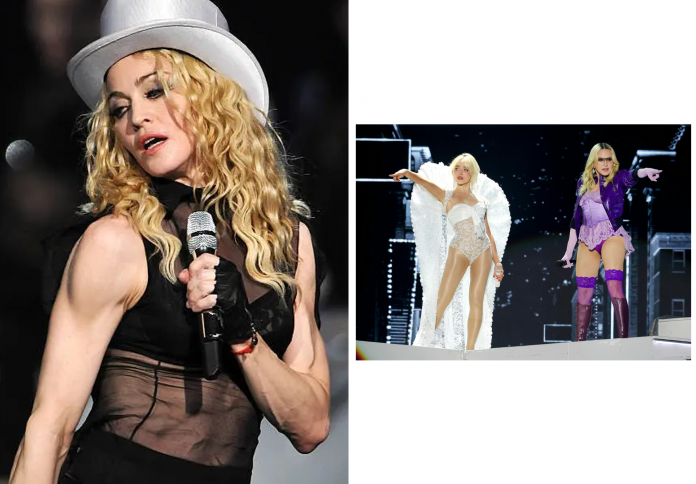
Madonna’s “Confessions II” arrives with an obvious historical burden: it follows one of the most beloved dance records in her catalog, 2005’s “Confessions on a Dance Floor.” Yet the 2026 album is more interesting when heard not as an attempt to recreate an old peak but as a conversation between different versions of the same artist. Reunited with producer Stuart Price, Madonna returns to continuous-motion club music while writing from a very different point in her life and career. The album, released July 3 through Warner Records, also brings younger collaborators into that lineage, including Sabrina Carpenter and Madonna’s daughter Lola Leon. Nostalgia is present, but it does not have to be the destination. The dance floor becomes a setting where memory, family, pleasure, and survival can occupy the same beat.
A Sequel With Twenty-One Years of Distance
Calling an album “Confessions II” creates expectations before the first note arrives. Madonna’s 2005 “Confessions on a Dance Floor” is remembered for its seamless club architecture and for singles such as “Hung Up,” “Sorry,” “Get Together,” and “Jump.” The record also earned the Grammy for best electronic/dance album. Returning to that title more than two decades later could easily have been an exercise in brand recognition.
Instead, the distance becomes part of the material. Madonna is not the performer she was in 2005 because no artist remains fixed for twenty-one years. The more productive question is what happens when an older musical language is reopened by the person who helped define it. “Confessions II,” released on July 3, 2026, lets familiar impulses—continuous rhythm, pop hooks, late-night momentum—carry lyrics shaped by a longer personal history.
_(cropped).jpg)
Stuart Price and the Architecture of Motion
The reunion with producer Stuart Price provides the clearest bridge between the two albums. Price was central to the original “Confessions,” and his presence gives the sequel a structural memory of that project without requiring a copy of its surface. Dance music depends on transitions, accumulation, and tension as much as on individual tracks. A producer who understands Madonna’s relationship to that form can build continuity while allowing the sonic details to change.
The 2026 record moves through strains of house and club-pop that acknowledge the past without treating the past as a museum. Its strongest moments recognize that nostalgia becomes more persuasive when it is used as material rather than as proof of importance. Listeners already know Madonna’s place in dance-pop history. What they need from a new record is not a lecture about that history, but a reason for the vocabulary to feel alive in the present tense.
Collaboration as Generational Exchange
“Confessions II” widens its frame through guest appearances, including Sabrina Carpenter and Lola Leon. Carpenter’s presence is particularly resonant because she belongs to a younger pop generation that has absorbed decades of visual and musical language Madonna helped normalize. Their collaboration creates a line of influence without requiring either artist to imitate the other.
Leon’s appearance introduces a more personal generational exchange. Family on a pop album can easily become a sentimental gesture, yet in Madonna’s catalog, autobiography has rarely been separate from performance. Bringing her daughter into the record places private history inside a public musical form. It also complicates the idea of a sequel. The first “Confessions” was made before many of the life experiences now shaping Madonna’s perspective. The second can carry those years directly into its sound and subject matter.
The Body Remains Central
Dance music has always made the body a central instrument in Madonna’s work. That does not simply mean sexuality or choreography. It also means endurance: the physical act of moving through a room, a tour, an illness, an era, or a career. By 2026, that theme inevitably lands differently than it did in the mid-2000s. The body is still a source of pleasure, but it also carries history.
That shift gives “Confessions II” emotional weight even when the tempo remains high. Pop culture often treats aging and dance as opposing ideas, as if movement belongs most naturally to youth. Madonna has spent much of her career challenging categories that are presented as fixed. A mature club record extends that argument. The beat does not erase time; it makes time audible by putting past and present into the same continuous motion.
Why Returning Can Still Mean Moving Forward
Sequels are often judged by how closely they reproduce the feeling of an original. That is the wrong standard here. No record can recreate the cultural circumstances of 2005, and trying would reduce “Confessions on a Dance Floor” to a set of production tricks. The more ambitious move is to reuse the framework while allowing a different life to occupy it.
“Confessions II” succeeds as an idea because Madonna treats return as a form of revision. The club remains a place for release, but also for reckoning. Familiar collaborators meet new ones; an established title carries new family history; dance-pop becomes less a retro destination than a method for staying in motion. The album does not need to prove that Madonna once mattered to this music. Its task is more interesting: to show what the music can still mean to her now.
The Most Interesting Sequel Is One That Argues With Its Predecessor
Calling a project Confessions II inevitably invites comparison with one of Madonna’s most coherent dance records. The useful creative question is therefore not how closely new material can reproduce the earlier album’s synth textures or continuous-club logic. It is what confession means for the same artist two decades later, after pop production, nightlife, celebrity culture, and Madonna’s own public history have all changed.
That distance can give the project tension. Dance music has always allowed Madonna to place intimate or confrontational ideas inside highly physical settings, making the body part of the argument. Revisiting that framework now could turn nostalgia into perspective rather than replication. The original album captured an artist using the club as both escape and self-examination. A sequel has the chance to examine what remains after the escape has become part of the archive. The strongest outcome would not persuade listeners that 2005 can be restored. It would show why Madonna still finds the dance floor useful as a place to edit, exaggerate, and rethink the story she has spent a career telling in public.