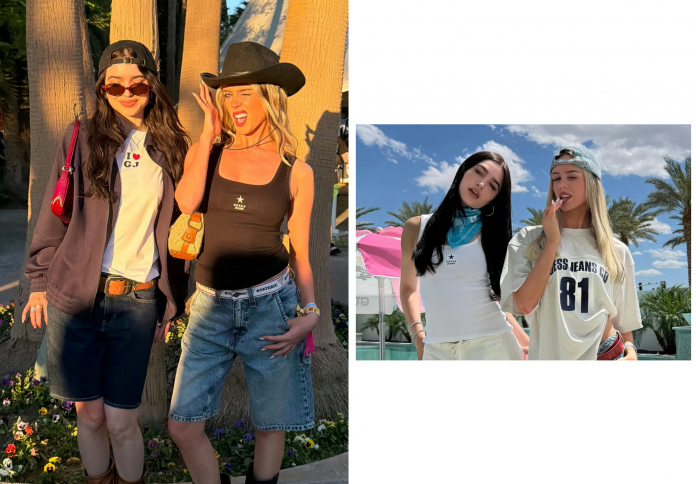
For Brooke and Jess, Coachella style is less about matching outfits than building a shared visual language. The UK-based creators, performers, and sisters approached the festival’s first weekend in 2026 with denim, vintage references, improvised details, and the kind of practical objects that keep a long desert day moving. Their method is revealing: mood boards set a direction, but personality decides the finish. One sister might push a look toward polished minimalism while the other reaches for something more playful, and the tension is the point. Their festival diary also shows how creator culture has changed the getting-ready ritual itself. Clothing, music discovery, filming, friendship, and recovery now happen in the same continuous stream, turning the familiar GRWM format into a portrait of how young audiences actually experience live events.
Two Looks, One Shared Frequency
Brooke and Jess have built an audience partly because they understand the appeal of appearing together without becoming visually interchangeable. At Coachella in 2026, that principle shaped their wardrobe. Denim became a common thread through Guess Jeans, but the sisters treated it as a base rather than a uniform. Their goal was to complement one another, not coordinate so precisely that the clothes erased the difference between them.
That idea sounds simple, yet it captures a larger shift in festival dressing. The most convincing looks now often come from a point of view rather than a prescribed aesthetic. Brooke and Jess use references, mood boards, and familiar fashion figures such as Kendall Jenner, Hailey Bieber, and Emma Chamberlain, but the final result depends on editing. Inspiration is useful only when it is translated into the wearer’s own habits, proportions, and confidence. Their outfits work as a dialogue because neither sister has to surrender her individual instinct.

Getting Ready Has Become Part of the Event
The modern festival day begins long before the first set. For creators, the hotel room or rental house can function as studio, dressing room, production office, and social space at once. Brooke and Jess move naturally through that ecosystem. A look has to photograph well, survive heat and walking, and still feel convincing when the cameras stop. That combination rewards clothes with enough personality to register quickly but enough comfort to remain wearable after several hours.
Their essentials underline the practical side of the fantasy. A power bank, hand sanitizer, vlog camera, lip balm, disposable camera, and mini perfume may not appear in the final outfit shot, but they determine how the day actually unfolds. Festival fashion can be discussed as pure image, yet the best choices acknowledge movement, dust, battery life, weather, and the simple need to feel like yourself late in the evening. Style becomes stronger when it can survive contact with reality.
Music Still Sets the Tempo
Brooke and Jess are not treating Coachella as a backdrop with a soundtrack added later. Their enthusiasm for KATSEYE came from a dance background and an appreciation for choreography, and they had already seen the group perform in London. That connection between performance and movement makes sense for creators whose own careers span acting, dancing, singing, and social media. They watch a set not only as fans but as people attentive to how a stage is built.
The festival also remains a place for discovery. The sisters have pointed to BLACKPINK as an artist they first encountered through Coachella, a reminder that a major festival can still function as a gateway rather than merely a reunion with established favorites. That matters in an era when recommendation systems can make musical discovery feel strangely individualized. Standing in a crowd restores a collective dimension: thousands of people encounter the same performer at the same moment, and a new favorite can become a shared memory.
The Value of Leaving Space in the Schedule
One of the less glamorous skills of surviving a festival is knowing when to stop moving. Brooke and Jess describe finding a patch of grass, grabbing a drink, and eating pizza as part of their recharge routine. The image is ordinary, which is precisely why it belongs in the story. A successful festival day is not a nonstop sequence of photogenic peaks; it is built from pauses that make the next set enjoyable.
That pacing also explains why they favor Weekend Two for some aspects of the experience. There is room to balance content creation with actually being present. The distinction is increasingly important for people whose work depends on documenting their lives. A creator can attend a concert and simultaneously be responsible for producing a record of attending it. Protecting a little unrecorded time becomes a way to prevent the event from turning entirely into material for the next post.
Festival Style After the Uniform Era
Coachella once seemed capable of generating a single dominant costume each year. The current landscape is more fragmented and, arguably, more interesting. Brooke and Jess embrace the fact that people arrive dressed dramatically, minimally, nostalgically, or experimentally. Their own approach reflects that freedom: personal references matter more than achieving a universal “festival” look.
The sisters’ Coachella story therefore lands somewhere between fashion diary and cultural snapshot. They are young performers who understand the camera, but they also understand that a memorable weekend depends on music, friendship, rest, and the people you chose to experience it with. Clothing gives the day a visual frame. It does not have to carry the entire meaning. That balance is what makes their style feel current: considered enough to communicate, relaxed enough to live in.