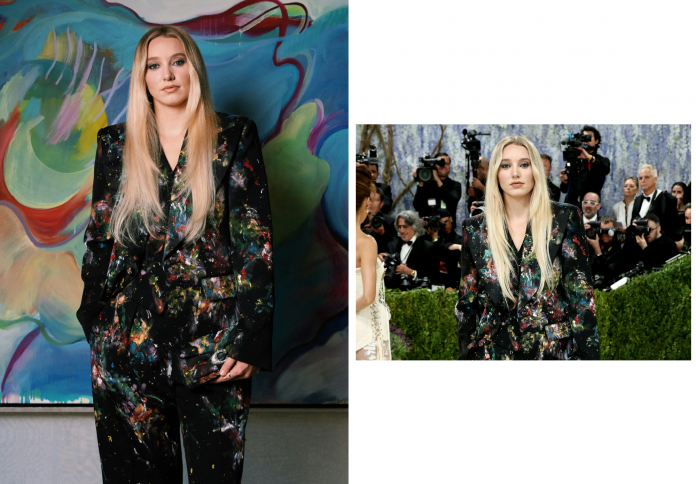
Paige Bueckers arrived at her first Met Gala in 2026 with an advantage many debut guests do not have: she already understood how clothing can carry identity under intense public attention. The Dallas Wings guard wore a custom Coach tuxedo by Stuart Vevers, built from black wool and satin but disrupted with hand-applied paint effects and Swarovski crystals. The look referenced artists’ workwear and included a number-five detail tied to her basketball identity, allowing the suit to answer the “Fashion Is Art” dress code without pretending that Bueckers had arrived from a different world. Her fashion story has developed alongside the WNBA’s expanding cultural reach, where tunnel fits, draft-night dressing, endorsements, and red carpets have become extensions of player branding. At the Met, Bueckers did not need to choose between athlete and fashion figure. The suit worked because it treated both as the same person.
A Met Debut Came After Years of Public Dressing
For Paige Bueckers, the Met Gala was not the first time fashion had accompanied a major career milestone. The No. 1 pick in the 2025 WNBA Draft had already entered professional basketball at a moment when player style receives almost continuous attention. Draft outfits, pregame arrivals, campaign imagery, and postgame press conferences now create a visual record that sits beside statistics and highlights.
That environment rewards players who understand clothes as communication. Bueckers has generally favored tailoring, clean proportions, and a mix of masculine and feminine codes rather than relying on one fixed formula. Her first Met appearance therefore felt like an enlargement of an existing vocabulary, not a sudden costume change prompted by a museum invitation.

Coach Used Workwear as the Artistic Entry Point
Stuart Vevers designed Bueckers’ custom Coach look around a three-piece tuxedo silhouette. Black wool and satin gave the outfit formal authority, while paint effects and crystal embellishment disrupted the surface. The references to artists’ workwear connected the garment to the gala’s art theme through process and mess rather than through a literal reproduction of a painting.
That choice was smart for an athlete. Workwear carries associations with movement, utility, repetition, and labor—qualities that sit comfortably beside the discipline of professional sport. The paint-like marks made the tuxedo appear used rather than untouched, while Swarovski details pushed it back toward evening spectacle. The tension between practical uniform and decorated object gave the suit its energy.
The Number Five Kept the Look Personal
One of the most effective details was also one of the smallest: the number five incorporated at the sleeve as a nod to Bueckers’ Dallas Wings jersey number. On a carpet where clothes can become overwhelmed by theme interpretation, that reference anchored the design to the wearer’s actual life.
Personalization works best at the Met when it does not require a long explanation to justify itself. A jersey number is already a compact identity marker. Moving it from a basketball uniform onto formal tailoring created a bridge between arenas without reducing either one to novelty. It also reinforced a larger truth about athlete style: the body wearing the clothes comes with an existing set of visual symbols, and good fashion design knows how to work with them.
Women’s Basketball Has Become a Fashion Platform
Bueckers’ appearance belongs to a broader cultural shift around the WNBA. Players increasingly arrive in the league with sophisticated personal brands, large social followings, and relationships with fashion companies that understand women’s basketball as a source of style as well as sport. Coach’s partnership with the league and its work with emerging players reflects that commercial recognition.
The result is not simply more expensive clothing around basketball. It is a wider range of ways athletes can present themselves. A player can be fiercely competitive on court, experimental in tailoring, glamorous on a carpet, and casual online without those identities cancelling one another. Fashion gives fans another language through which to read personality, while athletes give brands access to audiences organized around performance, community, and aspiration rather than traditional celebrity alone.
The Best Crossover Looks Do Not Erase the Athlete
Sports-fashion collaborations can become awkward when they treat athletic identity as something to hide for a “serious” fashion occasion. Bueckers’ first Met Gala avoided that trap. The tuxedo was elevated enough for the museum stairs, but its workwear reference, physical ease, and jersey-number detail kept basketball inside the design.
That is why the look felt convincing. Bueckers did not arrive as an athlete temporarily borrowing fashion credibility. She arrived as a public figure whose visual identity already includes clothes, sport, sponsorship, and self-expression. The Met Gala offered a larger canvas, and Coach responded by making the existing story more legible. In a year devoted to fashion as art, the suit suggested that the most interesting art can begin with the life a wearer already inhabits.
Athlete Style Is Most Powerful When It Preserves Physical Confidence
Formalwear can make athletes look strangely disconnected from the bodies that created their fame, especially when styling prioritizes conventional red-carpet elegance over movement. Paige Bueckers’ Coach suit avoided that problem. Tailoring gave her a defined silhouette, but the trouser shape, layered vest, and workwear references still allowed the look to feel grounded in someone accustomed to occupying space physically.
That confidence is becoming a recognizable feature of women’s basketball fashion. Players do not need to minimize height, musculature, or competitive presence in order to access luxury. Designers have an opportunity to work with those qualities instead of disguising them. Bueckers’ first Met appearance suggested how productive that collaboration can be: formal clothing can remain sharp while acknowledging the athlete’s own codes through number, proportion, and attitude. The broader cultural benefit is subtle but important. Young fans see elite sport and high fashion not as opposing identities but as adjacent forms of self-definition. The body that performs under pressure on court does not need a different set of permissions when it steps onto a carpet. It can remain visibly, confidently the same body.