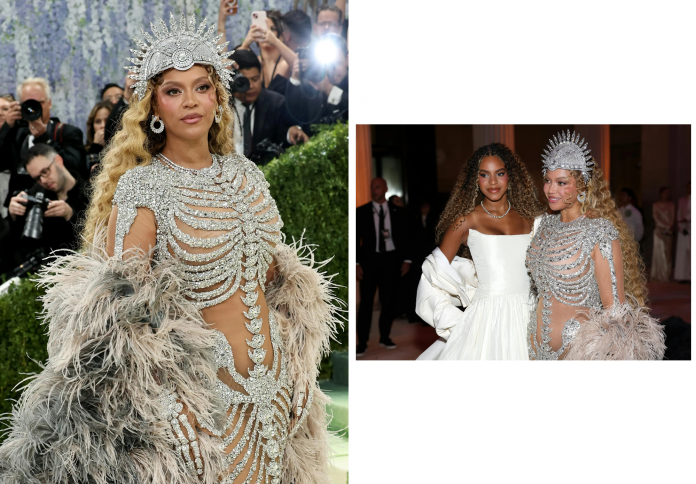
Beyoncé’s return to the Met Gala in 2026 came after a decade away from its red carpet, and she treated the occasion with the scale expected of both a co-chair and a performer whose fashion history is already part of the event’s mythology. Olivier Rousteing designed a crystal-covered skeletal illusion that traced the body over nude mesh, while a vast feathered opera coat and train expanded the silhouette far beyond it. The contrast was striking: exposed anatomy rendered as decoration beneath a garment that required several people to manage. Blue Ivy Carter joined her mother at the gala for her own debut, adding a generational layer to an appearance already loaded with history. The look answered “Fashion Is Art” through the body itself. Rather than covering anatomy with fantasy, it made bones ornamental, turning the internal structure of a person into the glittering surface of a couture image.
A Ten-Year Absence Changed the Stakes
Beyoncé’s previous Met Gala appearance had been in 2016, a long interval for a star whose earlier looks helped define the event’s transition into a global fashion spectacle. Returning in 2026 as a co-chair meant that the night could not function as a routine red-carpet stop. The absence had created its own expectation.
That expectation is partly why the arrival carried so much force. Beyoncé’s fashion image now exists across tours, films, album eras, western wear, couture commissions, and an enormous archive of performance costumes. The Met had to offer something distinct from those other stages. A skeletal illusion provided exactly that: an image simple enough to read immediately but strange enough to feel separate from familiar concert glamour.

Olivier Rousteing Put the Interior on the Outside
The custom design used crystal embellishment to map a skeleton over a skin-toned base, transforming bones into a decorative system. The idea turned anatomy into ornament without losing the visual recognition of a body beneath the dress. Gloves extended the skeletal tracing, making the illusion feel continuous rather than confined to the torso.
Fashion frequently reshapes the body through corsetry, padding, tailoring, and proportion. Rousteing’s design did something conceptually different: it emphasized the structure already inside. The skeleton became a kind of couture architecture, a reminder that every silhouette begins with the physical frame of the wearer before fabric adds another one around it.
Feathers Supplied the Opposite Kind of Volume
If the crystal skeleton reduced the body to structure, the feathered outer layer moved in the opposite direction. A vast opera coat and train expanded Beyoncé’s presence into theatrical volume, with attendants needed to control the garment as she moved. The contrast created the look’s drama: hard visual bones beneath a cloud of softness and motion.
That opposition also made the outfit photograph well from multiple distances. Close images captured crystals and anatomical lines, while wide shots registered the train as an event in itself. Met Gala dressing depends on both scales. The garment must reward detail photography and still hold its silhouette on one of the most crowded image stages in fashion.
Blue Ivy Made the Return Generational
Blue Ivy Carter’s Met Gala debut beside her mother added another story to the evening. Celebrity fashion is often discussed as individual self-expression, but family appearances reveal how style knowledge can also be transmitted. Blue Ivy has already grown up near performance wardrobes, award-show dressing, and fashion campaigns, making the museum carpet less a sudden entry into glamour than another extension of an unusually visual family life.
Her presence also changed the emotional reading of Beyoncé’s return. The star was not simply revisiting an event from an earlier career chapter. She was arriving in a new role, with a daughter old enough to participate in the ritual herself. Fashion history, in that sense, was happening at two speeds: a veteran returning and a next generation beginning.
The Body Became the Artwork and the Frame
The 2026 dress code gave guests permission to treat clothing as art, but Beyoncé’s look complicated the division between artwork and wearer. The skeleton motif suggested that the body was not merely a pedestal supporting a designed object. Its anatomy was the image. The coat then acted almost like a frame around that image, amplifying and partially concealing it.
That layered relationship is what kept the look from being only spectacular. Beyoncé has worn countless crystal gowns and monumental trains. Here, those familiar tools were organized around a sharper idea about structure, exposure, and scale. After ten years away from the Met steps, she returned with a garment that did not need to announce its importance. The body did the conceptual work, and the couture made that body impossible to overlook.
A Skeleton Is the Rare Motif That Makes Celebrity Status Temporarily Irrelevant
Beyoncé’s skeletal dress also carried a democratic image hidden inside extraordinary couture: beneath status, glamour, and performance, the body is structured by the same basic anatomy. That idea is simple enough to become cliché, yet the design made it visually productive by rendering bone through crystals and placing it beneath an extravagant feathered shell.
For a star whose public image is associated with exceptional control, the motif introduces an interesting tension. The skeleton suggests vulnerability and mortality while the scale of the coat asserts near-monumental power. Neither reading cancels the other. In fact, the contrast is what gives the look its emotional depth beyond spectacle. Fashion frequently promises transformation—become taller, sharper, richer, stranger, more desirable. Rousteing’s design briefly moved in the opposite direction by revealing an imagined interior structure before building fantasy back around it. On a night asking whether fashion is art, the answer became almost anatomical. Art can decorate the body, distort it, protect it, and mythologize it, but it still begins with a physical person inside. The crystals made that hidden fact visible.