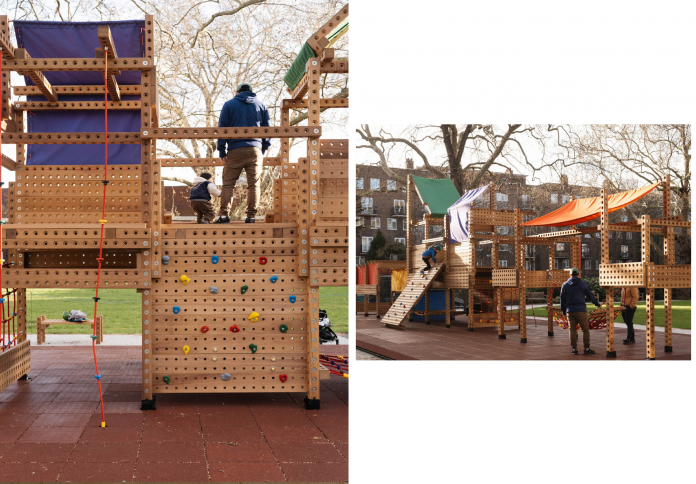
For the nearly 50 million children currently living in displacement, the basic human right to play is often sidelined in favor of immediate survival needs like food, shelter, and medicine. Yet, play is far from a luxury; it is a fundamental pillar of psychological healing, social development, and the restoration of normalcy in the face of trauma. UK-based charity Playrise, in collaboration with architecture studio OMMX and engineers Webb Yates, has introduced a breakthrough solution: a modular, flat-pack playground system designed specifically for the extreme conditions of refugee camps and disaster-relief zones. By reimagining the playground not as a fixed installation, but as an “inhabitable toy,” Playrise is providing displaced children with the agency to build, adapt, and define their own spaces for joy, connection, and resilience.
Design as Humanitarian Infrastructure
The Playrise system represents a departure from traditional, expensive, and often unsustainable playground donations. Developed through extensive co-design workshops with children in refugee camps across Ethiopia, Egypt, and Sudan, the system focuses on versatility and community ownership. It is constructed from a simple kit of parts—beams and planks made of robust, sustainably sourced iroko hardwood—that are joined using standardized metal connectors. This “Lego-like” simplicity allows the structure to be flat-packed for easy transport and assembled on-site by anyone, without the need for specialist tools or heavy machinery.

The architectural intelligence of the design lies in its adaptability. Because the structures are reconfigurable, they are not limited to a single function. A set of components can be transformed from a swing set or a slide into a tunnel, an obstacle course, or even a stage for theater. This versatility addresses a critical observation from the team’s research: in environments where children have little to no control over their daily lives, the ability to physically rearrange their own play space provides a vital, therapeutic sense of autonomy.
Prioritizing Safety and Climate Resilience
Beyond modularity, the Playrise team faced the unique challenge of designing for some of the harshest environments on Earth. Previous attempts to install metal playground equipment in these regions often failed because the structures became dangerously hot under the desert sun, burning children upon contact, or became unusable after a single broken part rendered them unsafe. Playrise’s choice of timber avoids these thermal issues, providing a material that is tactile, inviting, and remains at a comfortable temperature even in extreme heat.

Safety was meticulously integrated into the structural engineering. Webb Yates worked to ensure that all fixings and connection points were designed to prevent finger entrapment, while the system itself uses secure, removable footings that can be stabilized in everything from loose desert sand to hard-packed urban concrete. Furthermore, the design is inherently maintainable. Should any single component degrade, it can be easily replaced, ensuring the playground remains a permanent, reliable asset for the community rather than another piece of derelict, discarded equipment.
Restoring the Right to Play
The deployment of these playgrounds—starting with the Aysaita camp in Ethiopia—is a profound statement on the importance of child-centered design in humanitarian aid. The team’s approach is underpinned by the conviction that play is an essential component of recovery. In the absence of structured education, the Playrise structures become a site of “informal learning,” where children develop motor skills, resolve conflicts, build peer relationships, and exercise their imaginations.

By treating the playground as a piece of vital infrastructure rather than an ornamental “add-on,” Playrise has created a model that acknowledges the humanity and potential of displaced children. It is a deeply humane project that demonstrates how architectural practices can operate with empathy and precision in humanitarian contexts. As the charity looks to expand the program, the vision is to provide NGOs with a “menu” of differently sized kits, ensuring that children fleeing war or disaster can find a safe, consistent space where they are, above all else, allowed to simply be children.