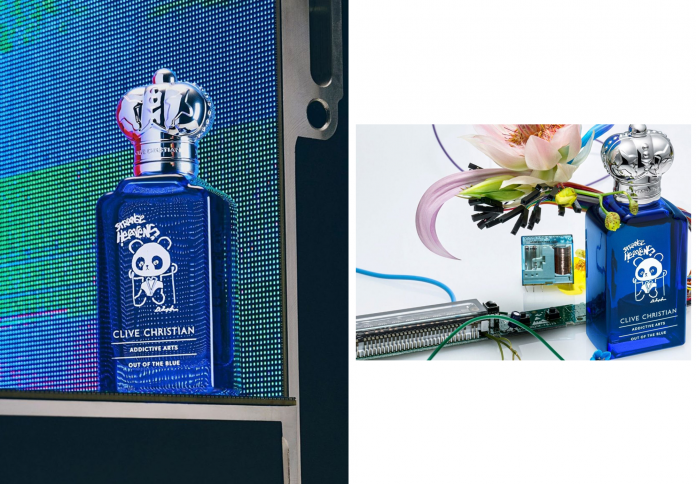
Luxury perfume has long relied on the visual cues of opulence—the gilded caps, the intricate flourishes, and the heavy crystal glass that command attention from a vanity. Yet, the latest collaboration between Clive Christian Perfume and contemporary artist Domingo Zapata, titled “Strange Heavens Out of the Blue,” proposes a shift toward a more narrative form of indulgence. By transforming the perfume bottle into a compact gallery for his signature panda motif, Zapata has moved beyond mere ornamentation. He has crafted an object that mirrors the scent within: a complex, sensory dialogue between innocence and decadence, inspired by the dark, alluring contradictions found in Oscar Wilde’s The Picture of Dorian Gray.
The Panda as an Emotional Anchor
At the center of this collaboration is the panda—a recurring and deeply personal motif in Zapata’s neo-expressionist body of work. For the artist, the panda is far more than a decorative callback; it serves as a symbolic anchor representing balance, joy, and the mysteries of the human condition. By positioning this playful, recognizable figure against the “enigmatic sensuality” of the fragrance, Zapata creates a visual tension that reflects the core philosophy of the perfume: that innocence and desire are not opposing forces, but partners in the human experience.

The bottle itself functions as a site of emotional charge. Zapata, who has built a career on large-scale murals and expansive canvases, found the constraint of the 50ml flacon to be a “welcome challenge.” He treated the surface as a space for precision and intimacy, ensuring that the artwork held the same weight and finesse as his larger paintings. The result is a collectible object where the artist’s gesture and the house’s craftsmanship spar and mingle, inviting the wearer to hold a fragment of his artistic world in the palm of their hand.
A Convergence of Fragrance and Literature
The “Strange Heavens” moniker draws directly from Oscar Wilde’s vivid descriptions of Victorian decadence. The fragrance, part of Clive Christian’s cutting-edge Addictive Arts collection, is a technical feat, boasting a 25% perfume oil concentration achieved through “headspace” technology—an alchemical process that captures molecules to create hyper-realistic olfactory profiles. The scent opens with a bold, energizing hit of coffee, aniseed, and pink pepper, before sinking into an intoxicating heart of jasmine absolute and orange blossom.

The base, however, is where the “Dorian Gray” inspiration truly settles. Notes of cocoa absolute, vanilla caramel, and smoke fusion create a dark, lingering trail that feels both opulent and slightly dangerous. It is a fragrance built on the collision of light and shadow, designed to evolve on the skin in a way that feels intentional and narrative-driven. As Zapata notes, fragrance shares a fundamental quality with his art: both are sensory experiences that can linger in the memory far longer than a static image ever could.
Blurring the Boundaries of Luxury
This partnership marks a significant moment for Clive Christian as they continue to redefine the boundaries of niche perfumery. By integrating Zapata’s visual language into the physical bottle—each piece bearing his signature—the brand has blurred the line between the product as a commodity and the product as a work of fine art. For the collector, “Strange Heavens Out of the Blue” is a testament to the idea that true luxury is not found in excess, but in the convergence of storytelling, rarity, and emotional resonance.
As the collaboration continues to circulate within the global luxury market, it highlights a growing trend in the high-end sector: the elevation of the “utilitarian” object into a gallery-worthy piece. Whether sitting on a shelf or resting on the skin, the fragrance serves as a reminder that the most profound experiences often reside within the smallest spaces. It is, ultimately, a tribute to the “art of surrender,” inviting us to find beauty in the contradictions that define our lives.