Set atop a hill that gazes across the sunburnt terrain of Sonora toward the Arizona border, the new U.S. Consulate in Nogales is more than a diplomatic facility—it is a thoughtful mediation between nations, climates, and communities. Designed by Ennead Architects, the 8.4-acre compound turns security into hospitality, tradition into innovation, and the harsh desert into a canvas of modern civic identity. It is architecture as diplomacy, refracted through stone, shadow, and landscape.
Shade as symbol and strategy

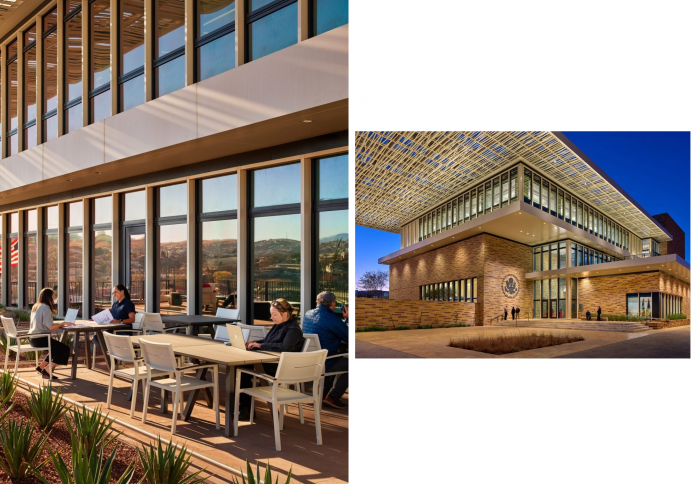
In the relentless light of the Sonoran Desert, shade is both shelter and metaphor. The consulate’s defining gesture is a soaring steel canopy inspired by the ramada—an open-air shade structure rooted in regional vernacular. Suspended above the main arrival court, this monumental cover provides passive cooling, filters light, and casts dramatic patterns across the ground, evoking the dappled texture of mesquite branches while projecting civic dignity.
The structure is light yet tectonic. Its perforated metal panels allow for airflow and views, while its sheer presence gives a clear architectural identity to the compound without resorting to fortification. Instead of walls that divide, the canopy unites—bringing coherence to the various programmatic zones and a sense of shelter to those who approach.
A dialogue with climate and context
The material palette is grounded, deliberate, and responsive. Stone cladding in warm, striated tones echoes the layered geology of the surrounding hills, anchoring the building within its environment. This stone acts as thermal mass, absorbing heat during the day and releasing it slowly at night—reducing energy demand while visually connecting the architecture to the earth it inhabits.

Landscaping is native and purposeful: desert flora like oak, juniper, and acacia not only soften the site but provide habitat and seasonal change. These gardens are not decorative—they are integral to the building’s environmental strategy, working in tandem with solar panels, rainwater systems, and a high-performance envelope that targets LEED Silver certification. In every decision, the desert is not resisted but embraced.
Spaces that guide and welcome
Circulation through the consulate is designed to feel intuitive, even gracious. Visitors are greeted by a shaded court that leads into a luminous double-height lobby—an intermediary between the open landscape and the secured core. There are no abrupt transitions; instead, movement is softened through thresholds framed by landscape, filtered light, and generous spatial volumes.

A ceremonial staircase, terraced gardens, and open-air walkways link the various wings of the complex, which include offices, meeting rooms, public service counters, and recreation zones for staff. These programmatic elements are distributed with spatial clarity, but the experience remains holistic—a constellation of spaces stitched together by landscape and light.
Diplomacy rooted in place
As a diplomatic post, the Nogales Consulate carries symbolic responsibility. Ennead approached this with nuance, embedding cultural references throughout the design. Artworks by both American and Mexican artists animate the interiors, telling stories of shared ecology, migration, and memory. These interventions lend intimacy to the institutional setting—offering moments of reflection amid bureaucracy.

Beyond design, the project was also a local investment: materials were sourced regionally, and much of the labor came from nearby communities. This commitment to place-making extends not just to the form, but to the people who built it and those it now serves. The consulate is no longer just a gateway between two nations—it becomes a civic landmark grounded in mutual respect.
In the end, the U.S. Consulate in Nogales redefines what diplomatic architecture can be. It is not defensive, nor monumental in the traditional sense. Instead, it is careful, generous, and attuned—responding to its setting with a balance of clarity and care. Through stone and shadow, Ennead Architects have crafted a place where diplomacy is not just enacted, but quietly embodied.