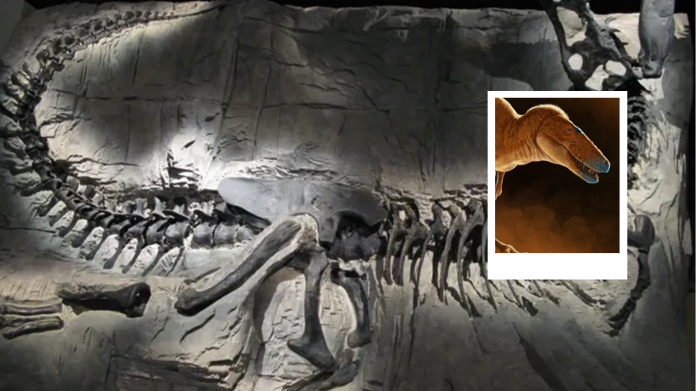
Scientists have uncovered a new species of dinosaur that redefines our understanding of tyrannosaur evolution. The discovery, made from fossils long housed in a Mongolian museum, places this smaller, early predator at the base of the fearsome T. rex family line.
A prince among predators
In an astonishing twist to dinosaur history, paleontologists have identified a previously unrecognized species that is now considered the closest known ancestor of all tyrannosaurs. Named Khankhuuluu mongoliensis, or “Dragon Prince of Mongolia,” this dinosaur lived approximately 86 million years ago—well before the rise of its infamous descendant, Tyrannosaurus rex.
The discovery, recently published in the journal Nature, emerged not from a new dig site but from existing fossil specimens stored in a Mongolian collection. Originally misclassified as Alectrosaurus, the two partial skeletons were reevaluated by PhD student Jared Voris and Professor Darla Zelenitsky of the University of Calgary. Their findings suggest Khankhuuluu marks a crucial evolutionary shift: from the small, swift-footed ancestors of the Jurassic period to the colossal apex predators of the Cretaceous.‘Prince’ refers to this being an early, smaller tyrannosauroid,” explained Prof. Zelenitsky. “It sits at a critical point in the family tree, just before tyrannosaurs became the ‘kings’ of the Late Cretaceous.”
From nimble hunters to bone-crushing giants
Unlike the towering T. rex, which could weigh up to eight tons, Khankhuuluu was a relatively modest predator at around 750 kilograms. Yet its anatomical features signal the beginning of a transition toward the more robust forms of later tyrannosaurs. In particular, its skull anatomy—including a distinctive nasal bone structure—hints at the evolutionary origins of the immense bite force that would later define T. rex. “These traits were the building blocks,” said Voris. “We’re seeing the early stages of adaptations that would later allow tyrannosaurs to crush bone and prey on massive herbivores.”
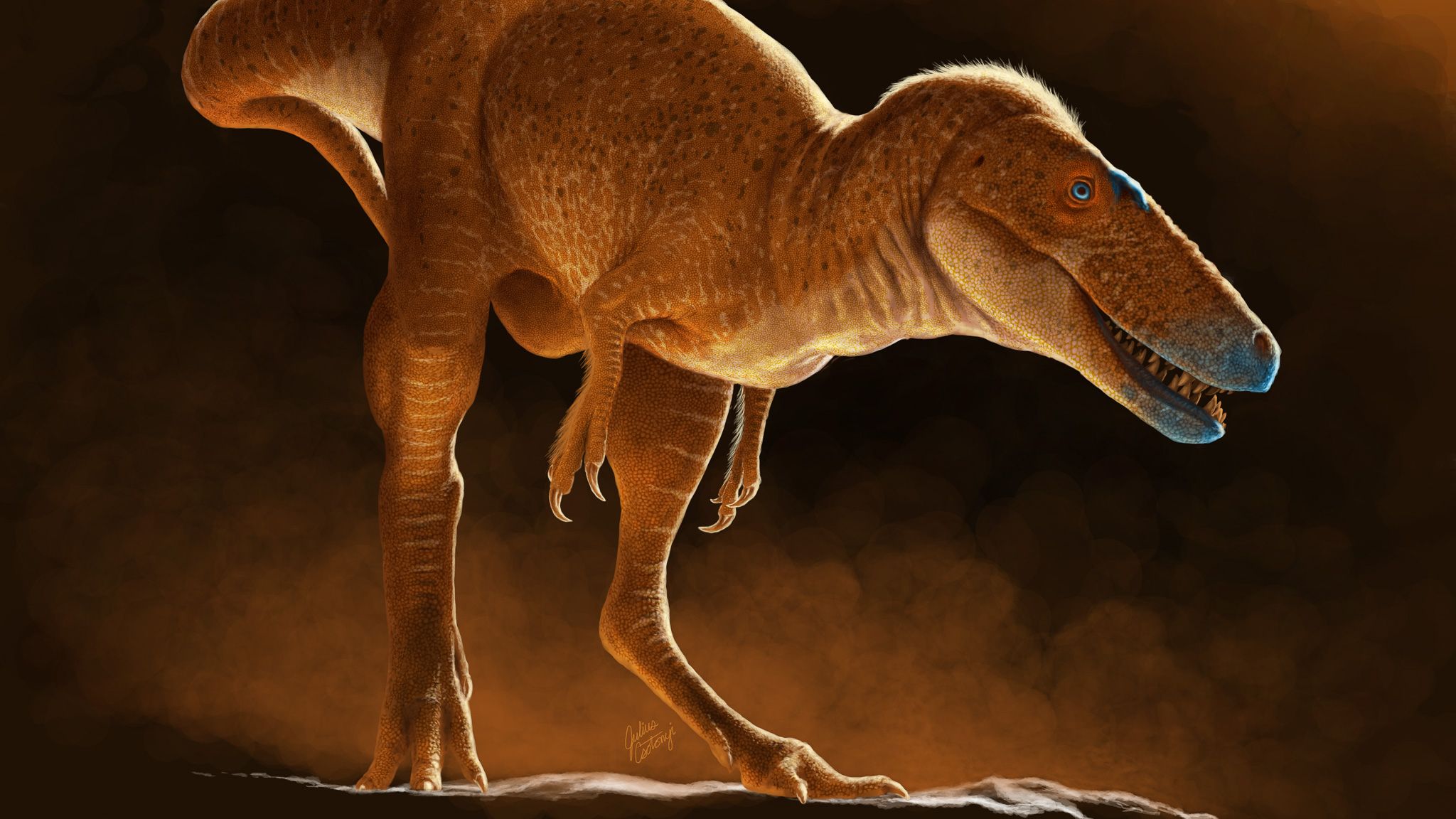
Tyrannosauroids— the broader superfamily to which both Khankhuuluu and T. rex belong—initially evolved as small, bipedal carnivores. For millions of years, they lived in the shadows of larger predators, likely scavenging or targeting smaller animals. This new species shows that their eventual dominance wasn’t a sudden leap but a gradual accumulation of traits that boosted their hunting capabilities.
A forgotten fossil’s second chance
The fossils that led to the Khankhuuluu breakthrough had been sitting in a museum since the early 1970s. Discovered in Mongolia during a period of intense paleontological activity, they were initially believed to belong to an already-known species. But when Jared Voris took a closer look, he noticed crucial differences—especially in the skull and limbs—that didn’t match the classification.
“I remember getting a text from him that he thought this was a new species,” Prof. Zelenitsky recalled. That hunch turned into a years-long investigation, eventually culminating in the formal naming and description of Khankhuuluu mongoliensis.
This kind of scientific detective work underscores the value of museum collections. Fossils, even those collected decades ago, can still yield new discoveries when examined through the lens of modern science and evolving knowledge.
Migration, adaptation, and survival
The evolutionary success of tyrannosaurs wasn’t just a matter of physical traits—it was also about movement. During the Late Cretaceous, land bridges connected modern-day Siberia and Alaska, allowing dinosaurs to migrate between Asia and North America. This migration provided new opportunities for adaptation, and may have accelerated the evolutionary split between different tyrannosaur groups. “That movement back and forth between the continents basically pushed the evolution of different tyrannosaur groups,” said Voris.
The spread of tyrannosaurs across continents allowed them to find new ecological niches and evolve distinct traits. Khankhuuluu’s discovery in Mongolia reinforces the idea that Asia played a key role in the early history of tyrannosaurs—contrary to the popular image of T. rex as a purely North American icon.
Princes before kings

The story of Khankhuuluu mongoliensis is more than just a footnote in dinosaur history—it’s a missing link that reshapes the tyrannosaur narrative. From a smaller, agile predator to one of the most fearsome creatures to ever walk the Earth, the tyrannosaur lineage was shaped by countless evolutionary steps over millions of years.
“This discovery helps us revise the tyrannosaur family tree and rewrite what we know about their evolution,” Prof. Zelenitsky emphasized. “It shows us that before tyrannosaurs became kings, they were princes.”
In a field where each new fossil has the potential to upend decades of scientific thought, Khankhuuluu is a reminder that there’s still much to learn from the ancient past—and that sometimes, history waits quietly in the corners of museum shelves, ready to rewrite itself.