A major new exhibition at Tate Modern explores the work of Korean artist Do Ho Suh, whose intricate, life-sized fabric sculptures of his former homes challenge the boundaries between personal and public space. Drawing from South Korea’s evolving housing culture, Suh’s work captures the emotional architecture of memory, migration, and belonging.
Reconstructing memory through space
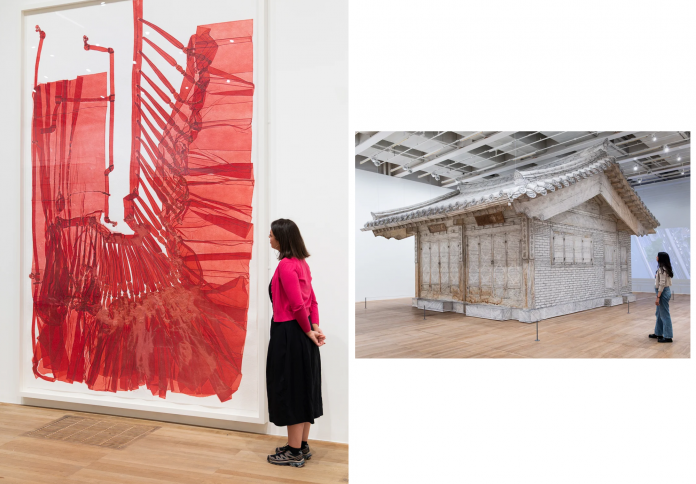
Visitors arriving at the second floor of London’s Tate Modern are met with an unexpected and poetic spectacle: a life-sized facsimile of a traditional Korean house, meticulously recreated using layers of translucent mulberry paper. Traced in graphite, the structure is a delicate rubbing of Do Ho Suh’s childhood home in Seoul. The installation not only blurs the lines between drawing and architecture but introduces the artist’s lifelong exploration of what it means to belong.
The exhibition, titled Walk the House, marks Suh’s largest solo show in the UK to date. Now based in London, the artist’s nomadic life—spanning Seoul, New York, and various other cities—has profoundly shaped his artistic language. His preoccupation with home as both a physical and psychological space manifests in the most unexpected materials: gauzy textiles, stitched hallways, and ephemeral rubbings. These elements form a body of work that is at once deeply personal and universally resonant.
Inspired by hanok, shaped by displacement
The title of the show draws from the Korean term hanok, a style of traditional architecture built with modular wooden frames that could be disassembled and moved. This architectural flexibility mirrors Suh’s vision of home—not as a static location, but as something transportable, transitional, and subject to time’s erosion.
In Suh’s youth, his family’s home stood as an outlier amid Seoul’s rapid modernization. It sparked the artist’s fascination with domestic spaces that could simultaneously hold memory and exist in flux. This idea is poignantly realized in Perfect Home: London, Horsham, New York, Berlin, Providence, Seoul (2024), where a tent-like replica of his London apartment is overlaid with fittings and fixtures from other homes he’s lived in around the world.
Another key piece, Nest/s (2024), features a long corridor composed of pastel-hued fabric that fuses the hallways of his various past residences. Visitors are invited to walk through this tunnel, engaging with what Suh describes as “in-between spaces”—corridors, staircases, and entrances that often go unnoticed, yet are where much of our daily lives unfold.
Breaking down walls—literally and metaphorically
In an unprecedented move, Tate Modern removed all internal gallery walls for Walk the House, echoing Suh’s architectural interventions and allowing visitors to experience space in a way that mimics memory: non-linear, overlapping, and open-ended. “We wanted to evoke an experience closer to the function of memory itself,” said Dina Akhmadeeva, one of the show’s curators.
This openness is central to works like Staircase-III (2010), a delicate, fabric rendition of a staircase Suh once used. The installation is carefully adapted to each new venue, its structure mutable and impermanent—just like the experiences it represents. In removing physical barriers, Suh also dismantles conceptual ones: between past and present, inside and outside, individual and collective.
His use of fabric, especially translucent textiles, furthers this sense of vulnerability and transparency. Many of Suh’s structures appear ghostlike, suggesting the presence of people, memories, and events long gone. “An empty space becomes a vessel for memory,” Suh explains. “Over time, you project your own experiences onto it, and it becomes something you carry with you.”
The personal, the political, and the poetic
While Suh’s work may seem delicate, it often addresses powerful socio-political themes. In the film Robin Hood Gardens, he documents the interiors of a London public housing project slated for demolition. Using drones and photogrammetry, the film preserves not just architecture but the lives within it—furnishings, colors, and the subtle signs of human presence.
Suh’s critique of ownership, access, and class is often veiled in gentler materials. For instance, Rubbing/Loving: Company Housing of Gwangju Theater (2012) reflects on South Korea’s 1980 Gwangju Uprising. Created blindfolded as a metaphor for state censorship, the rubbing renders an architectural space flattened and uninhabitable—symbolizing the silencing of memory and trauma.
The exhibition begins and ends with works that challenge political power. Bridge Project (1999) addresses territorial boundaries and land ownership, while Public Figures (2025), a reimagining of a work shown at the Venice Biennale, features an empty plinth upheld by miniature figures. It’s a visual metaphor for unseen labor and collective resilience, resonant with Korea’s history of colonization and dictatorship.
Finding permanence in people
For Suh, who experienced displacement early in life, the concept of home has always been elusive. But during the COVID-19 lockdowns, his work took a more intimate turn. He began to focus on the people who make a house feel like home. Two small tunics made for his daughters—complete with pockets holding their favorite objects—are tucked within the exhibition. Crayons, small toys, and fragments of a child’s world become new architectural anchors. “As a parent, it was a very vulnerable situation,” Suh reflected. “But it helped us to be together.” These personal details add another layer to the show’s larger themes, reminding viewers that permanence can often be found not in walls or structures, but in relationships.
Walk the House is more than a retrospective—it’s a meditation on memory, migration, and the impermanence of space. Do Ho Suh invites visitors to walk not just through rooms, but through ideas and emotions that transcend borders. In doing so, he gives form to something we all long for: the sense of home, wherever we may find it.