While the Arsenale and Giardini remain the focal points of the Venice Architecture Biennale, the real treasures may lie scattered across the city’s quieter corners—from restored convents to church crypts, hidden gardens, and cultural palazzi. These ten off-the-beaten-path exhibitions offer fresh narratives on architecture, resilience, and planetary futures.
Restoring the sacred: Holy See Pavilion
Located in the 12th-century Santa Maria Ausiliatrice complex, this year’s Holy See Pavilion presents an unusual proposition—architecture as an act of care. Conceived by Mexican practice Tatiana Bilbao Estudio and Spanish studio Maio Architects, the pavilion is not a finished product but a work-in-progress.
Visitors are invited to engage with the live restoration of the historic complex, joining artisans, architects, and locals in workshops, musical rehearsals, and ongoing repairs. The experience redefines the notion of architecture as spectacle by foregrounding restoration as a communal, spiritual, and tactile process.
Building for extremes: Deserta Ecofolie
In a hidden garden near the Giardino delle Vergini, the Royal Danish Academy’s Centre for Industrialised Architecture (CINARK) has constructed Deserta Ecofolie, a prototype dwelling built to withstand the harsh conditions of Chile’s Atacama Desert.
Clad in thatched wall panels framed in timber and equipped with fog catchers and photovoltaic cells, the structure explores how biogenic materials and prefabrication can meet both environmental and humanitarian needs. It is part shelter, part research lab—offering a practical yet poetic vision for off-grid living.
Unearthing infrastructure: Hong Kong Pavilion
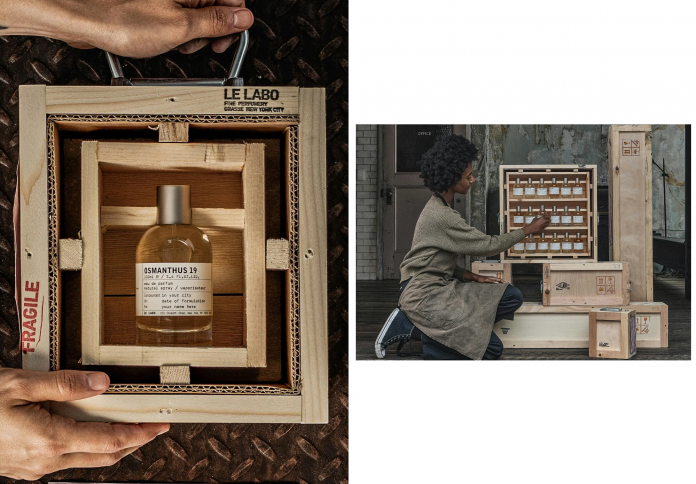
Just across from the Arsenale, the Hong Kong Pavilion steps away from the city’s glossy image to celebrate its lesser-known architectural treasures. Projecting Future Heritage, curated by Fai Au, Ying Zhou, and Sunnie SY Lau, showcases overlooked public infrastructure, from market halls to housing estates.
The bamboo-framed entrance pays homage to Hong Kong’s traditional scaffolding techniques, while drawers full of archival drawings and community histories urge a reevaluation of what constitutes architectural heritage. It’s an invitation to see beauty and value in the everyday.

A new home for art: Fondation Cartier by Jean Nouvel
As the Fondation Cartier prepares to vacate its historic Paris home, it previews its next chapter in Venice’s Fondazione Giorgio Cini. The exhibition offers a rare look at Jean Nouvel’s radical transformation of a Haussmannian building into the gallery’s future base.
The star of the show is a walk-through sectional model that slices the building open, revealing public spaces and light wells. Alongside it, screen-based renderings and conceptual sketches map out Nouvel’s vision—an architecture of light, transparency, and reinvention.
Planetary provocations: The Next Earth
Hosted at Palazzo Diedo Berggruen Arts and Culture, The Next Earth: Computation, Crisis, Cosmology is a dual effort by think tank Antikythera and MIT Architecture. The ground floor features a video installation that melds philosophical theory with digital aesthetics, while the upper floor exhibits 37 speculative projects by MIT faculty.
The exhibition confronts questions of planetary survival, ecological ethics and the computational future of architecture. It’s a space for critical imagination—where climate models, data aesthetics, and cosmological visions converge.
Designing beyond Earth: Universe Pavilion
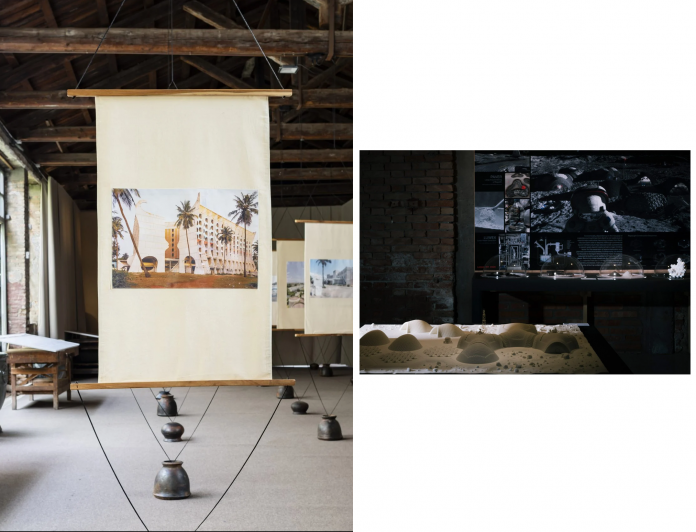
Located at Fàbrica 33, the Universe Pavilion: Sheltering in Space – A Guide ventures beyond our planet to explore how architecture can support life in extraterrestrial environments. Co-created by Astronautin GmbH and Fondazione Efesto, the pavilion presents speculative designs for habitats on the Moon, Mars, and beyond.
With AR experiences, architectural models and conceptual art, the exhibition weaves resilience, scarcity, and adaptability into a compelling narrative. It’s a powerful reminder that the boundaries of architectural imagination are as vast as space itself.

Spotlight on the global south: Togo Pavilion
Making its Venice debut, the Togo Pavilion is a bold step toward architectural inclusion. Installed in the Squero Castello gallery, the exhibition focuses on Togo’s overlooked modernist heritage. Curated by Studio Neida, the show includes models and images of architectural landmarks like a brutalist hotel with curving facades resembling kissing faces. The pavilion makes a compelling argument for the preservation of African architectural history as part of the global design conversation.
Revisiting a modernist master: Harry Seidler retrospective
At the recently reopened San Marco Art Centre (SMAC), a new exhibition titled Migrating Modernism honors the legacy of Austrian-born, Australian architect Harry Seidler. Known for projects like the Australia Square tower in Sydney and the Australian Embassy in Paris, Seidler’s work defined a distinctly cosmopolitan modernism.
Curated as part of SMAC’s reopening by David Chipperfield, the show provides a retrospective of Seidler’s work, tracing his global impact and architectural philosophy. It also complements the biennale’s broader theme of displacement and global exchange.

Architecture in motion: MVRDV’s Sombra
Part of the Time Space Existence exhibition, Dutch firm MVRDV’s Sombra redefines passive climate control through kinetic design. The arched structure is made of triangular, perforated panels that open and close in response to sunlight—without motors.
Instead, thermal canisters expand when heated, triggering the movement of airbags that reposition the panels. The result is a self-regulating shading device that blends elegant engineering with environmental intelligence.
Roots and ruins: Lithuanian Pavilion
In a former church—Santa Maria dei Derelitti, Lithuania has created a quietly powerful pavilion that interrogates the link between architecture and the natural world. Archi/Tree/tecture features a literal uprooted tree, paired with a digital cube and models of local buildings designed in harmony with native flora.
The contrast of organic decay and digital abstraction speaks to the potential of design to mediate between human construction and ecological systems. It’s a meditative endnote in a biennale rich with urgent inquiry