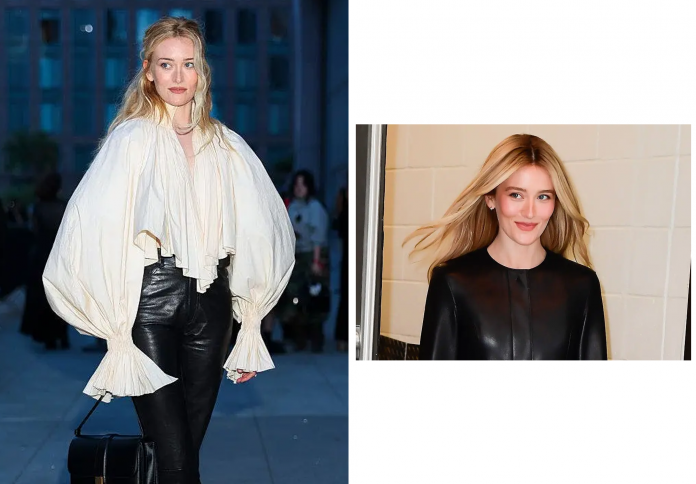
In the landscape of 2026 fashion, few figures have captured the cultural imagination with the same quiet authority as Sarah Pidgeon. Since her breakout portrayal of Carolyn Bessette-Kennedy (CBK) in the FX limited series “Love Story,” Pidgeon has become the unexpected standard-bearer for a new iteration of “90s-inspired minimalism.” Her style—meticulously curated with stylist Emma Jade Morrison—does not merely mimic the legendary publicist’s iconic wardrobe; it dissects it. By balancing the effortless, unfussy elegance that defined Bessette-Kennedy with a contemporary appetite for artisanal detail and risk-taking, Pidgeon has emerged as a front-row darling who treats fashion not as a costume, but as a deliberate act of intellectual inquiry.
The “CBK” Effect: A Study in Refined Minimalism
Pidgeon’s fashion narrative began with the “method dressing” required for her role in “Love Story,” where she gained access to archive-quality pieces and intimate details of Bessette-Kennedy’s personal uniform. However, unlike many who treat CBK’s style as a static relic, Pidgeon has shown a rare ability to evolve these codes for the present day. Her aesthetic is built upon the foundational pillars of the 90s—neutral tones, perfectly tailored trousers, light-wash denim, and classic knitwear—yet she injects these staples with a modern “cool-girl” finish. Whether she is stepping out in a crisp white tank paired with low-rise bootcut jeans or an impeccably cut trench coat, she evokes the same “effortlessly elegant” poise that made Bessette-Kennedy a street-style icon nearly three decades ago.
This commitment to timelessness has positioned her as a master of the “capsule wardrobe,” a concept she champions by frequently re-wearing key items. In an era of rampant overconsumption, her penchant for styling the same leather jacket or pair of loafers across various high-profile events serves as a refreshing rejection of disposable luxury. It is a philosophy rooted in the idea that true style is not about the constant acquisition of the “new,” but the mastery of pieces that hold enduring value. For Pidgeon, the goal is “relevance over the ravishing,” ensuring her looks feel lived-in and authentic rather than overly staged.
Beyond the Basics: Artisanal Techniques and Red Carpet Risk
While her off-duty style remains rooted in minimalist neutrals, Pidgeon’s red-carpet appearances reveal a more audacious side of her sartorial identity. She has become an expert at “subtly artisanal” method dressing, particularly through her embrace of designers like Yohji Yamamoto—a favorite of the real-life Bessette-Kennedy. By choosing structural, asymmetric pieces that highlight technique and texture, Pidgeon demonstrates that minimalism does not have to be plain. Her willingness to wear challenging silhouettes, such as sculptural dresses with dropped waists or unconventional ruffles, proves she is not content to be a simple mirror of the past.
This duality—the minimalist street-style uniform and the avant-garde red-carpet risk—is what defines her “style chutzpah.” She effectively uses her platform to highlight craftsmanship, often favoring brands like Prada, Loewe, and Chanel for their ability to balance classic elegance with forward-thinking design. By selecting outfits that require “thinking fashion,” she has carved a unique space for herself as a muse for designers who value intellectual rigor. Her approach to red-carpet dressing is consistently thoughtful, prioritizing interesting shapes and unexpected proportions that speak to her evolving confidence as a leading lady in the industry.
A Blueprint for the Modern Muse
Pidgeon’s influence on 2026 fashion extends well beyond the boundaries of television and film promotion. Her ability to synthesize the “New York minimalist” aesthetic with her own distinct, risk-taking sensibility has made her a touchstone for consumers and designers alike. She has effectively bridged the gap between the nostalgia-fueled desire for 90s simplicity and the contemporary necessity for sustainability and “slow luxury.” In doing so, she has become a template for a new kind of celebrity style—one that is grounded in personal consistency, thoughtful curation, and an unwavering belief that the most effective fashion statements are those that remain timelessly functional.
As she moves forward, Pidgeon continues to refine this uniform, constantly searching for the balance between the icons of the past and the demands of the future. Her journey from a relatively unknown actor to fashion’s current darling is a testament to the power of a well-defined identity. She has proven that whether she is navigating the streets of New York in a leather funnel-neck coat or gracing an awards show in a complex Yamamoto original, her underlying philosophy remains the same: elegance is not about how loud your outfit is, but how effectively it communicates who you are.