Nestled in Stockholm’s Södermalm district, the newly opened Stockholm Stadshotell is a masterclass in quiet luxury. Housed in a 19th-century building originally built as a charitable residence for upper-class women, the hotel weaves historic preservation with a contemporary Arts and Crafts spirit—resulting in a refined, textural retreat.
Honoring heritage with architectural sensitivity
Constructed between 1873 and 1875 at the request of Queen Josefina, Stockholm Stadshotell was initially conceived as a sanctuary for elderly women of noble lineage. Now reborn as a boutique hotel at Björngårdsgatan 23, the building’s architecture is experiencing a second life—thanks to a renovation that respects its original character while offering a distinctly modern guest experience.
Nestled in Stockholm’s Södermalm district, the newly opened Stockholm Stadshotell is a masterclass in quiet luxury. Housed in a 19th-century building originally built as a charitable residence for upper-class women, the hotel weaves historic preservation with a contemporary Arts and Crafts spirit—resulting in a refined, textural retreat.
Honoring heritage with architectural sensitivity
Constructed between 1873 and 1875 at the request of Queen Josefina, Stockholm Stadshotell was initially conceived as a sanctuary for elderly women of noble lineage. Now reborn as a boutique hotel at Björngårdsgatan 23, the building’s architecture is experiencing a second life—thanks to a renovation that respects its original character while offering a distinctly modern guest experience.
The transformation was led by Ateljé Nord, who worked in close collaboration with preservation authorities to ensure the building’s unique features remained intact. “We were unable to move certain walls or alter the original staircases and corridors,” says co-founder Fredrik Carlström. “Rather than see this as a limitation, we embraced the building’s quirks—like the long hallways and unusual layouts—and made them integral to the design language.”
These arched corridors now serve as atmospheric passageways that connect the 32 guest rooms and suites with shared spaces such as the reception, two restaurants, a lounge, a bar, and a tranquil garden courtyard. By integrating rather than overriding the building’s historical idiosyncrasies, the team created a sense of place that feels both rooted and refined.
A warm, crafted minimalism
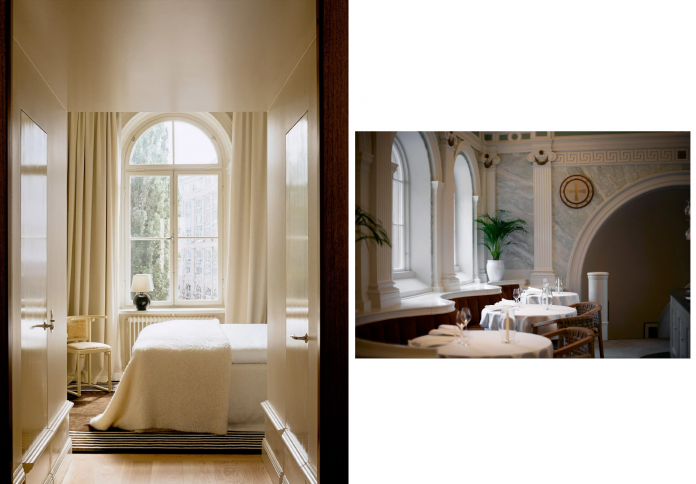
Stockholm Stadshotell’s guest rooms were designed in partnership with Studio Escapist to offer what Carlström describes as “understated retreats.” The palette is deliberately muted: soft greys, gentle taupes, and earthy neutrals that let the materials speak for themselves. Natural wood, stone, linen, and handmade finishes define the interiors, emphasizing warmth over opulence.
Built-in cabinetry and burr-birch bed frames by Swedish carpentry firm Tre Sekel anchor the rooms with tactile solidity. Italian linens from Liv Casas and bathroom fittings by Lefroy Brooks bring subtle luxury without ostentation. “We leaned into the Arts and Crafts ethos of honesty in materials and craftsmanship,” says Carlström. “You can see it in the joinery, the handwoven textiles, and the preference for solid wood and natural pigments.”
Each room is unique, eschewing formulaic hotel design in favor of custom-crafted elements. In the attic suites, expressive features like sloped ceilings and bolder textures bring a different energy—what Carlström calls “a bit more palazzo than monastery.” These design choices underscore the hotel’s guiding principle: thoughtful restraint infused with soul.
Handcrafted details and artisanal gestures
The Arts and Crafts movement of the 1870s served as a philosophical and aesthetic guide throughout the project. Not content with simply referencing the past, the team worked with local artisans to create bespoke furnishings that add narrative richness and material depth to the interiors.
Design studio Austere developed a custom armchair and ottoman upholstered in textiles by British designer Rose Uniacke. Dorthé Atelier, a family-run workshop, crafted restaurant chairs, guest room mirrors, and solid wood tables. Stockholm-based artist Klara Knutsson created a series of wood inlays for the hotel’s elevators, featuring stylized scenes of the city—including a tribute to Babette, the first restaurant opened by the hotel’s restaurateur team.
Even the smallest details were treated with care. Ceramic key fobs were handmade, signage was hand-painted, and custom Asta vases were produced by Anne Nilsson’s Nybruk glassworks in three sizes. Together, these details cultivate a tactile intimacy rarely found in commercial hospitality spaces.
Dining steeped in story and setting
The hotel’s gastronomy-forward vision is a joint effort by Johan Agrell, Jon Lacotte, Dan Källström, Ian Nicholson, and Carlström—all of whom bring experience from restaurants in Stockholm, London, and Los Angeles. Two venues—the ground-floor Bistro and the upstairs Matsalen—offer contrasting atmospheres rooted in place and history.
The Bistro takes cues from classical European cafes and cultural institutions like art schools and train stations. Tiled walls and floors create a utilitarian framework, softened by curved plywood benches and pink Italian marble sinks—subtle nods to Swedish architect Gunnar Asplund’s Faith Chapel. It’s a space where simplicity and elegance converge.
Upstairs, Matsalen occupies a former chapel that retains its vaulted ceilings, gilded angels, ionic pilasters, and hand-painted wall details. Here, reverence for the past is palpable. Rather than compete with the building’s original grandeur, the interiors harmonize with it, creating a quiet, contemplative setting for intimate dining experiences.
A celebration of place, craft, and quiet character
Stockholm Stadshotell is not a hotel that shouts. Instead, it whispers—through wood grain, softened corners, and hand-finished edges. It offers an experience grounded in history, craftsmanship, and intention. The emphasis isn’t on trend, but on texture; not on novelty, but on nuance.
In a city increasingly shaped by minimalism and modernism, Stockholm Stadshotell offers an alternative vision of refinement—one where old corridors lead to new comforts, and artisanal touches elevate everyday rituals. By respecting the past and investing in the handmade, it becomes more than a place to stay. It becomes a place to slow down, observe, and take in the beauty of restraint.

The transformation was led by Ateljé Nord, who worked in close collaboration with preservation authorities to ensure the building’s unique features remained intact. “We were unable to move certain walls or alter the original staircases and corridors,” says co-founder Fredrik Carlström. “Rather than see this as a limitation, we embraced the building’s quirks—like the long hallways and unusual layouts—and made them integral to the design language.”
These arched corridors now serve as atmospheric passageways that connect the 32 guest rooms and suites with shared spaces such as the reception, two restaurants, a lounge, a bar, and a tranquil garden courtyard. By integrating rather than overriding the building’s historical idiosyncrasies, the team created a sense of place that feels both rooted and refined.
A warm, crafted minimalism

Stockholm Stadshotell’s guest rooms were designed in partnership with Studio Escapist to offer what Carlström describes as “understated retreats.” The palette is deliberately muted: soft greys, gentle taupes, and earthy neutrals that let the materials speak for themselves. Natural wood, stone, linen, and handmade finishes define the interiors, emphasizing warmth over opulence.
Built-in cabinetry and burr-birch bed frames by Swedish carpentry firm Tre Sekel anchor the rooms with tactile solidity. Italian linens from Liv Casas and bathroom fittings by Lefroy Brooks bring subtle luxury without ostentation. “We leaned into the Arts and Crafts ethos of honesty in materials and craftsmanship,” says Carlström. “You can see it in the joinery, the handwoven textiles, and the preference for solid wood and natural pigments.”
Each room is unique, eschewing formulaic hotel design in favor of custom-crafted elements. In the attic suites, expressive features like sloped ceilings and bolder textures bring a different energy—what Carlström calls “a bit more palazzo than monastery.” These design choices underscore the hotel’s guiding principle: thoughtful restraint infused with soul.
Handcrafted details and artisanal gestures

The Arts and Crafts movement of the 1870s served as a philosophical and aesthetic guide throughout the project. Not content with simply referencing the past, the team worked with local artisans to create bespoke furnishings that add narrative richness and material depth to the interiors.
Design studio Austere developed a custom armchair and ottoman upholstered in textiles by British designer Rose Uniacke. Dorthé Atelier, a family-run workshop, crafted restaurant chairs, guest room mirrors, and solid wood tables. Stockholm-based artist Klara Knutsson created a series of wood inlays for the hotel’s elevators, featuring stylized scenes of the city—including a tribute to Babette, the first restaurant opened by the hotel’s restaurateur team.
Even the smallest details were treated with care. Ceramic key fobs were handmade, signage was hand-painted, and custom Asta vases were produced by Anne Nilsson’s Nybruk glassworks in three sizes. Together, these details cultivate a tactile intimacy rarely found in commercial hospitality spaces.
Dining steeped in story and setting

The hotel’s gastronomy-forward vision is a joint effort by Johan Agrell, Jon Lacotte, Dan Källström, Ian Nicholson, and Carlström—all of whom bring experience from restaurants in Stockholm, London, and Los Angeles. Two venues—the ground-floor Bistro and the upstairs Matsalen—offer contrasting atmospheres rooted in place and history.
The Bistro takes cues from classical European cafes and cultural institutions like art schools and train stations. Tiled walls and floors create a utilitarian framework, softened by curved plywood benches and pink Italian marble sinks—subtle nods to Swedish architect Gunnar Asplund’s Faith Chapel. It’s a space where simplicity and elegance converge.

Upstairs, Matsalen occupies a former chapel that retains its vaulted ceilings, gilded angels, ionic pilasters, and hand-painted wall details. Here, reverence for the past is palpable. Rather than compete with the building’s original grandeur, the interiors harmonize with it, creating a quiet, contemplative setting for intimate dining experiences.
A celebration of place, craft, and quiet character

Stockholm Stadshotell is not a hotel that shouts. Instead, it whispers—through wood grain, softened corners, and hand-finished edges. It offers an experience grounded in history, craftsmanship, and intention. The emphasis isn’t on trend, but on texture; not on novelty, but on nuance.
In a city increasingly shaped by minimalism and modernism, Stockholm Stadshotell offers an alternative vision of refinement—one where old corridors lead to new comforts, and artisanal touches elevate everyday rituals. By respecting the past and investing in the handmade, it becomes more than a place to stay. It becomes a place to slow down, observe, and take in the beauty of restraint.