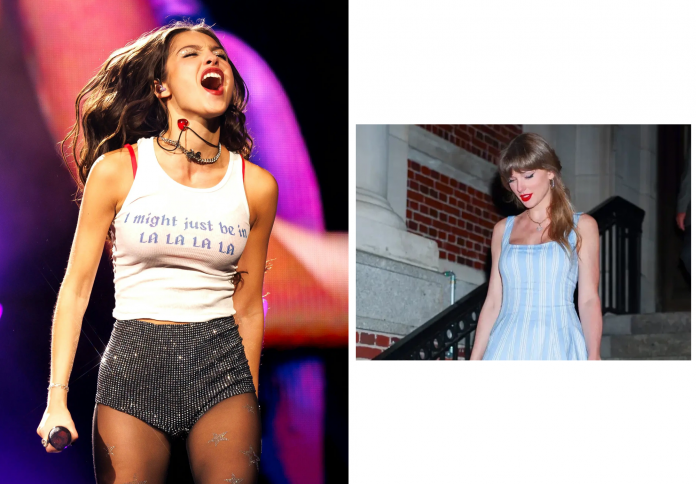
For years, the internet has been captivated by the evolving dynamic between Taylor Swift and Olivia Rodrigo, a relationship that began as a moment of pure musical mentorship and eventually spiraled into years of intense fan speculation, “detective” sleuthing, and unverified narratives regarding a rift. While the two artists have never confirmed a conflict, the public discourse has often painted them as rivals, driven by industry milestones, songwriting credits, and long periods of silence. However, a recent high-profile encounter at a Paul McCartney concert in March 2026 has served as a touchstone for many fans, reigniting the conversation about whether the alleged “beef” was ever more than a story projected by the media and the constraints of their respective, highly scrutinized careers.
From Idolization to Industry Scrutiny
The relationship initially blossomed in early 2021 when Olivia Rodrigo, then a rising star, gained widespread attention for her breakout hit “drivers license.” Taylor Swift, citing her own experience with early-career success, publicly championed Rodrigo, even gifting her personalized items and hand-written notes. This early period was defined by mutual admiration, with Rodrigo frequently identifying Swift as her primary songwriting influence and idol. The shift in public perception began in mid-2021, when it was revealed that Swift and her collaborators were granted retroactive songwriting credits on Rodrigo’s track “Deja Vu,” due to its thematic and melodic similarities to Swift’s “Cruel Summer.”
This development became the cornerstone of the “feud” narrative. While songwriting credits for interpolations are a standard, albeit complex, aspect of the music business, fans and industry observers began to interpret the situation as a signal of cooling relations. As the two stars grew more distant in their public interactions, the online community began to dissect their lyrics, social media activity, and even their presence at award shows for hidden meanings. Despite Rodrigo repeatedly dismissing these rumors in interviews—most notably in her 2023 Rolling Stone profile—the narrative persisted, with fans often framing later songs like “vampire” as potential reflections on a fractured mentorship.
The Paul McCartney Moment: A Turning Point?
In March 2026, the online cycle reached a new peak when both artists attended an intimate, star-studded Paul McCartney concert at the Fonda Theatre in Los Angeles. Images circulated showing the two in the same social orbit, leading to a frenzy of speculation about their current status. For many, the sight of them in the same room was a relief; for others, it remained a subject of intense debate, with some noting they were not explicitly seen in conversation. However, the event effectively acted as a “reset” button for the discourse, with Rodrigo herself addressing the situation on the New York Times Popcast in May 2026.
In her remarks, Rodrigo dismissed the concept of the “internet detective,” explaining that diving into every theory regarding her personal life would be impossible and ultimately unproductive. She maintained her long-standing stance that she keeps to a very small circle and harbors no “beef” with anyone in the industry. Her calm refusal to engage with the drama mirrors Swift’s own general approach to the intense scrutiny surrounding her relationships, highlighting a commonality in how both women manage their high-profile lives: by prioritizing their peace and professional focus over the endless, often contradictory narratives spun by the internet.
Navigating the Reality of Modern Fame
The saga of Swift and Rodrigo serves as a compelling case study of how celebrity relationships are managed in the era of social media. The “feud” was never substantiated by either artist, yet it functioned as a persistent cultural object that satisfied a demand for “lore” and conflict within the pop music fandom. By examining the facts—the shared professional credits, the early support, and the eventual privacy—it becomes clear that the “rift” was largely a product of a fast-paced media environment that often conflates industry technicalities with personal betrayal.
Ultimately, the lesson of their alleged friction is a reminder of the pressure exerted on female artists to constantly define their relationships to one another. Whether they are friends, rivals, or simply colleagues navigating separate paths, the focus remains on the music they create. As both stars move into their respective new eras—with Rodrigo teasing her “OR3” project and Swift continuing her massive influence on the global stage—the focus is returning, appropriately, to the art itself. The “feud,” whether it ever existed or not, appears to be a closed chapter, leaving behind only a fascinating footnote in the 2026 cultural landscape.