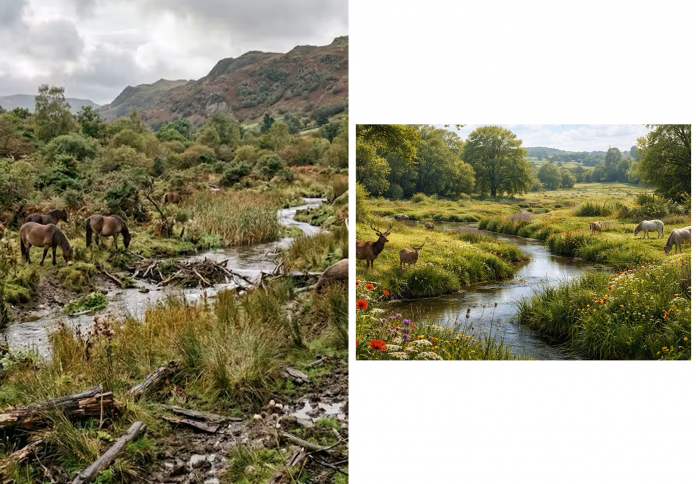
In the urgent global mission to restore degraded ecosystems, rewilding has emerged as a visionary, if controversial, strategy. Proponents argue for a hands-off approach that allows nature to dictate its own pace of recovery, while critics maintain that human intervention remains essential. As conservationists increasingly turn to artificial intelligence to model these complex environmental shifts, a new dilemma has surfaced: AI, by its very nature, seeks patterns, stability, and optimized outcomes. In doing so, it risks sanitizing the very essence of rewilding. By reducing the unpredictable, often brutal, and chaotic “messiness” of the natural world into sleek digital simulations, we risk creating a version of nature that looks pristine on a screen but fails to account for the unpredictable, nonlinear dynamics that define true ecological resilience.
The Sanitization of Ecological Chaos
At the heart of the conflict between AI-driven modeling and actual rewilding is the concept of “control.” AI models thrive on structured data—historical weather patterns, population counts, and vegetation density—to predict future success. However, rewilding is fundamentally an exercise in relinquishing control. It relies on stochastic events—a freak flood, an unexpected pest outbreak, or the unpredictable behavior of a keystone species—to break stagnant ecological patterns and stimulate diversity.

When we use AI to “design” a rewilded landscape, we inherently gravitate toward optimized success. We favor the outcomes that look “correct” in our simulations. This creates a digital bias where the “messy” reality—the failed reintroductions, the competing interests of local stakeholders, and the slow, often painful, path to equilibrium—is smoothed over. AI presents rewilding as a predictable, manageable process, ignoring that nature’s greatest resilience often stems from the very disorder we are trying to algorithmically eliminate.
The Data Deficit and the Human Factor
A significant critique of relying on AI for conservation is that these models often treat nature as a closed system. They struggle to incorporate the “human element”—the complex social, political, and economic factors that dictate the success of any environmental project. Rewilding is not merely a biological endeavor; it is a human one. It requires the consent and cooperation of local communities, the navigation of land-use conflicts, and the balancing of livelihoods with habitat restoration.
AI models often view human interference as a variable to be mitigated, rather than an integral part of the ecological fabric. By failing to account for the emotional, cultural, and political baggage that comes with land management, AI creates an idealized “rewilding” that exists only in a vacuum. When these digital projections meet the real-world friction of local communities or shifting policy environments, they often fail because they were never designed to handle the human, messy complexity that dictates true ecological success on the ground.
Algorithmic Arrogance and the Value of the Unknown
There is a subtle, dangerous arrogance in the belief that AI can provide us with a master plan for the natural world. By chasing the “perfect” model, we risk falling into the trap of believing that we have finally “solved” nature. This perspective ignores the intrinsic value of the unknown—the emergent properties of an ecosystem that arise precisely because they are not planned or predicted.
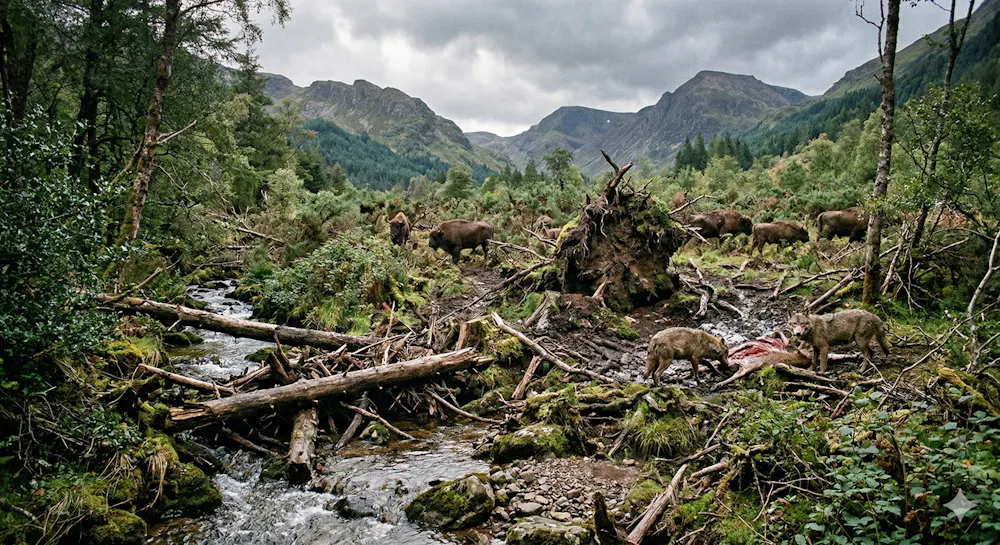
If we continue to favor AI-optimized rewilding, we risk institutionalizing a “tame” version of nature. We might create habitats that are biodiverse in theory, but stagnant in practice, lacking the wildness that only true, unmanaged biological competition can foster. The beauty of rewilding lies in its capacity for surprise, in the way a landscape might shift in ways we never anticipated. To replace that organic surprise with algorithmic precision is to mistake a map for the territory.
Towards a Humbler Model of Technology
This is not to suggest that AI has no place in conservation; it is an invaluable tool for tracking changes at a scale that exceeds our perception. However, it must be demoted from the role of “planner” to that of “observer.” A more sustainable integration of AI would involve using it to highlight our own ignorance—using models to show us where we don’t know the answer, rather than forcing a solution.
True rewilding requires us to be comfortable with discomfort. It demands that we accept that nature does not have a “desired output” that we can optimize for. As we move forward, we must ensure that our digital tools remain subservient to the ecological reality they are meant to support. We need a technology that doesn’t just process data, but acknowledges the limits of what can be known, leaving space for the chaotic, beautiful, and fundamentally messy processes of a world that was never meant to be optimized.