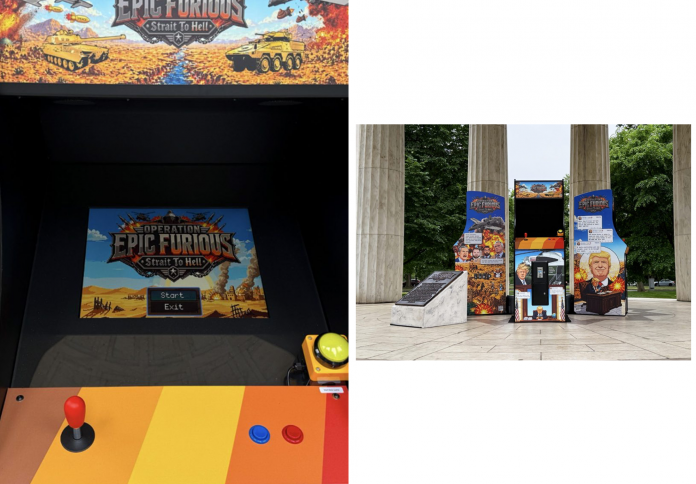
In May 2026, three functioning arcade cabinets appeared near Washington’s World War I memorial as a deliberately provocative piece of protest art. Created by the collective Secret Handshake, “Operation Epic Furious: Strait to Hell” used retro role-playing game aesthetics to satirize the way the Trump administration presented the U.S.-Israel war with Iran through social media, memes, and entertainment-coded imagery. Players could navigate pixelated versions of political figures and scenarios inspired by government messaging, an approach designed to make the experience feel uncomfortably close to the media language it was criticizing. The work’s politics are explicit, but its more durable question reaches beyond one administration: what happens when war is communicated through the visual grammar of games, trailers, and viral posts? By making that grammar literally playable, the installation asks viewers to notice how easily political messaging can borrow the mechanics of entertainment.
A Cabinet Where a Monument Usually Speaks
The location of “Operation Epic Furious: Strait to Hell” was part of the work. Secret Handshake installed three arcade machines near the District of Columbia War Memorial, a structure dedicated to residents of Washington who died in World War I. The juxtaposition placed playful hardware beside a site built for remembrance, making the contrast between game language and the human stakes of war impossible to ignore.
The installation was temporary and openly political. Its creators were not offering a neutral simulation of policy; they were criticizing the Trump administration’s media presentation of the conflict involving the United States, Israel, and Iran. The work later moved to another Washington venue, but the original placement sharpened its argument. A memorial asks visitors to slow down and remember. An arcade cabinet asks for input, reward, repetition, and forward motion. Putting the two together creates friction before anyone presses a button.

Satire Borrows the Language It Attacks
The game uses pixel art and role-playing conventions associated with early “Zelda,” “Final Fantasy,” and “Pokémon” titles. Political figures appear as characters, and the player moves through scenarios that parody official messaging. This aesthetic is intentionally accessible. Retro game design carries nostalgia and humor, which makes it an effective vehicle for satire but also creates the central discomfort of the work.
Secret Handshake’s critique depends on imitation. The collective argues that government communications around military action have increasingly used visual forms associated with online entertainment. By turning that tendency into an actual game, the artists collapse the distance between metaphor and interface. The player is forced to confront a question that scrolling can obscure: if war is packaged using the cues of entertainment, does the audience begin to consume it differently?
Political Communication Now Competes for Attention
Governments have always used images, slogans, and spectacle to shape public perception during conflict. What has changed is the attention environment. Official statements now circulate beside sports clips, influencer videos, advertisements, jokes, and game footage on the same screens. The pressure to be shareable can reward messages that are emotionally immediate and visually simplified.
That does not mean every stylized government post turns war into a game, nor does it mean audiences cannot distinguish propaganda from entertainment. The installation’s value lies in making the resemblance available for scrutiny. It asks whether communication designed to dominate a feed can compress moral and geopolitical complexity into a format optimized for reaction. Satire exaggerates that process so the mechanics become easier to see.
The Work Also Implicates the Player
A protest artwork can become too comfortable when it allows the viewer to feel morally superior to the people being criticized. The arcade format complicates that position. To experience the piece, a visitor performs the behavior under examination: choosing, advancing, consuming an event through game mechanics. The attraction of the interface is part of the problem.
That does not make the player responsible for policy. It makes attention itself part of the subject. People are drawn to systems that reward interaction, and political communicators understand that. The installation uses pleasure against itself, allowing recognizable game conventions to pull the audience closer before revealing why that attraction feels wrong in this context. The strongest moment is not necessarily a joke; it is the realization that the interface is enjoyable enough to be unsettling.
Protest Art in the Feed Era
“Operation Epic Furious” belongs to a long tradition of artists using parody to challenge political power, but its medium is particularly suited to the 2020s. A playable cabinet can exist physically, circulate through video clips, and be experienced online. It can be photographed as an object, discussed as a political statement, and interacted with as software. The protest therefore travels across the same media ecosystem it critiques.
Viewers can disagree with the collective’s politics while still taking the formal question seriously. When institutions communicate through memes, cinematic edits, and game-like imagery, designers and artists have reason to examine what those choices do to public understanding. The Washington arcade does not resolve the ethics of political media. It makes them tangible. By putting a joystick between the viewer and a representation of conflict, it turns a familiar gesture into an uncomfortable editorial question.
Satirical Games Work Because Participation Creates Complicity
An arcade cabinet asks for more than attention. To understand the joke, a player has to touch the controls, accept the rules, and repeat actions until the system responds. That physical participation gives political satire a tool that posters and social posts do not have. A game can make someone experience the absurdity of a system rather than only read an argument about it.
The danger is simplification. War, diplomacy, and political decision-making contain consequences that cannot be responsibly reduced to a score. Effective parody acknowledges that gap by making the mechanics themselves uncomfortable or obviously inadequate. The cabinet’s cultural function is not to simulate policy accurately; it is to expose how easily public events can be packaged as spectacle, competition, and team identity. Installed in Washington, D.C., the work gains another layer because political power is not an abstract theme there. The city is both workplace and stage for national decision-making. An arcade machine in that context can look frivolous and accusatory at once, using the visual grammar of entertainment to question when political messaging begins to resemble a game people are encouraged to watch rather than a set of consequences they must understand.