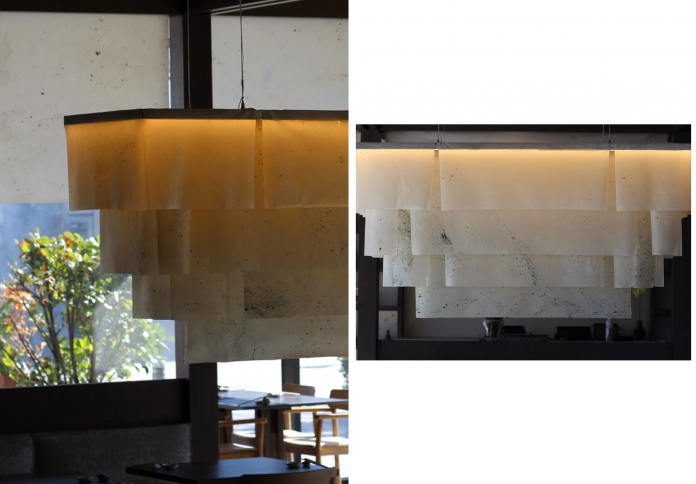
The most compelling material experiment at a renovated Sticks’n’Sushi restaurant in Lyngby, Denmark, begins with something that could easily have remained waste. Copenhagen-based Natural Material Studio used leftover kelp and spirulina algae from the kitchen to create semi-translucent lighting and room dividers, connecting the restaurant’s food cycle to its interior. Working with a protein-based biopolymer called Procel, the studio dried and processed the organic leftovers before casting them into hand-made sheets. Studio Emily Broom commissioned the pieces as part of a broader renovation that pairs Japanese-influenced restraint with smoked oak and tactile surfaces. The project is small enough to understand and specific enough to matter. Rather than applying a generic “sustainable” finish, it asks a more interesting question: what if an interior could be made partly from the exact materials that pass through the building every day?
Waste Becomes Part of the Brief
Restaurants generate a constant stream of material that usually disappears from the customer’s view. Peelings, shells, trimmings, spent grounds, and seaweed may be essential to the food system but rarely become part of the architectural story. At Sticks’n’Sushi in Lyngby, leftover kelp used for miso soup and spirulina algae were redirected into the design process instead of being treated only as waste.
Natural Material Studio, led by Bonnie Hvillum, worked with those remnants to produce pendant lighting elements and soft room dividers. The decision creates a direct relationship between kitchen and dining room. Material circularity is often discussed at an abstract scale, where supply chains are difficult for a visitor to imagine. Here, the loop is legible. A material associated with the menu reappears overhead and between spaces, giving the restaurant a quiet internal logic.

Procel Turns Organic Matter Into Surface
The seaweed and algae were dried and broken down before being incorporated into Procel, the studio’s protein-based biopolymer. The mixture includes a plant-oil softener and a small amount of chalk, then is cast by hand into thin, translucent sheets. The resulting surface does not try to imitate conventional plastic or glass. Its irregularity records the fact that it came through a different material process.
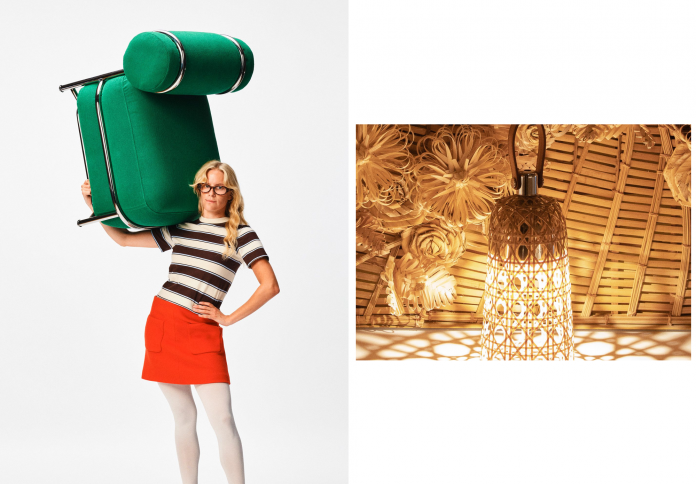
Those sheets are layered over rectilinear LED frames, allowing light to reveal variations in density and color. The material therefore performs in two ways: it diffuses illumination and communicates its own composition. That second function is important. Many bio-based materials are asked to look exactly like petroleum-based ones, which can erase the reason they are interesting. Here, translucency and texture become evidence of origin rather than defects to be engineered away.
The Restaurant Gains a Material Narrative
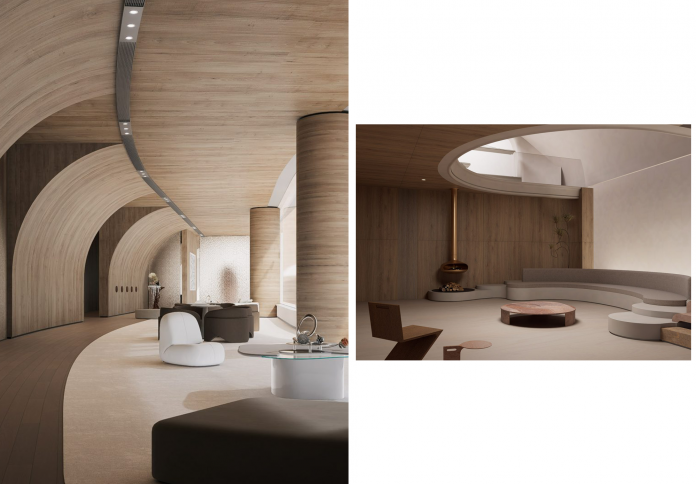
Studio Emily Broom’s renovation uses smoked oak and restrained forms to establish a calm backdrop with references to Japanese minimalism. Natural Material Studio’s pieces sit comfortably within that language because they are visually delicate rather than overtly demonstrative. The installation does not turn the restaurant into a science display. A diner can simply experience warm light and soft boundaries without needing to read a technical explanation.
Yet the story is available for anyone who wants to look deeper. That layered experience is valuable in hospitality design. A space should work sensorially before it works conceptually, but concept can intensify attachment once discovered. Knowing that the glowing material above the table incorporates leftovers from the kitchen changes the way a visitor reads the room. The interior begins to feel less like a collection of sourced finishes and more like an ecosystem.
Circularity Needs Specific Loops
Claims about circular design can become vague when a material is theoretically recyclable but no realistic path exists for recovering it. Natural Material Studio describes Procel as biodegradable, home-compostable, and capable of being remelted and reused. Those properties are promising, though the practical value ultimately depends on how the pieces are maintained and what happens when the installation is replaced.
The strongest part of the Sticks’n’Sushi project is therefore not a broad environmental promise. It is the specificity of the input. Waste from one operation becomes material for another part of the same environment. That loop can be explained in a sentence and seen in a room. Design gains credibility when its environmental logic is concrete enough to trace, rather than being carried only by a certification label or a distant offset.
An Interior Can Digest Its Own Activity
The project points toward a richer model for material sourcing. Buildings are usually imagined as endpoints: products and finishes arrive from elsewhere, are installed, and eventually leave as waste. But active spaces constantly produce resources of their own—food scraps, heat, water, packaging, worn textiles, and other streams that could influence future design decisions.
Natural Material Studio’s seaweed lighting offers a modest example of what it means to treat those streams as creative material. The outcome is not valuable because every restaurant should make lamps from its leftovers. It is valuable because the process begins with the life already happening inside the building. That approach produces an aesthetic that could not simply be copied into another site without changing the story. In a design culture crowded with interchangeable “natural” palettes, specificity may be one of the most sustainable qualities an interior can have.
Waste Becomes More Persuasive When It Solves a Real Atmospheric Problem
The seaweed lighting project is compelling because the material story does not stop at “waste was reused.” Restaurant interiors ask light to perform several jobs at once: illuminate food, flatter faces, create intimacy, guide movement, and contribute to the identity of the room. If a material recovered from the kitchen can participate in that atmosphere, circularity becomes part of experience rather than a message attached afterward.
That distinction matters as sustainable design language becomes easier to imitate. A discarded ingredient does not automatically become good material simply because its origin sounds virtuous. It still has to be processed, shaped, maintained, and integrated into an object that works. Natural Material Studio’s experiment is strongest when the seaweed is allowed to retain visual traces of its origin instead of being transformed until it resembles anonymous plastic. The restaurant then contains a subtle loop: food preparation generates a leftover; the leftover becomes a surface that changes how future meals are seen. Circular design is often discussed at industrial scale, but small closed-loop relationships like this can make the idea unusually legible.