Designer Sara Martinsen has redefined what it means to live close to nature. In a world obsessed with innovation and global sourcing, her new guest pavilion near Copenhagen invites visitors to sleep, breathe, and experience architecture that is entirely, unapologetically local. Built from native Danish plants and fibres, the structure not only explores the limits of sustainable design—it celebrates them.
Sleeping among plants
Tucked behind her summerhouse in Jutland, Danish designer Sara Martinsen has created a freestanding guest pavilion that is as much a sensory retreat as it is a research statement. Originally built for Rooted Potential, an exhibition exploring local plant-based materials, the pavilion now enjoys a second life as a guest bedroom—offering overnight visitors the rare experience of sleeping entirely surrounded by native flora.

“All of the materials in the pavilion are regional and can be harvested within 100 kilometres of Copenhagen,” Martinsen explained. From bedding to walls, every detail is carefully curated from Denmark’s natural resources. Linen bedsheets from Belgian maker Libeco drape a mattress filled with eelgrass and hemp insulation. Clematis vines, cattails, pipe grass, and silver grass contribute to the form and function of the building itself.
“I wanted to allow guests to experience a full night’s sleep surrounded only by plant-based materials,” she said. “Not just for sustainability, but for a deeper, physical connection with the materials that surround us.”
A designer’s palette from the wild
Martinsen has long been recognised for her expertise in plant-based materials. Her comprehensive material archive, first exhibited in 2020, reflects a decade of work harvesting, drying, and cataloguing fibres and species from across Denmark. She often consults with architects and brands, but this guesthouse project brings her research into lived experience.

The structure showcases 10 native fibres: eelgrass, flax, clematis vitalba, Japanese knotweed, cattail, lake bulrush, hemp, silver grass, pipe grass and yellow flag. All were gathered by Martinsen herself, who sees beauty not just in the materials but in the limited palette. “With the debate on climate change, there’s often a sense of compromise and restriction,” she said. “But we forget how uplifting it can be to work with a smaller set of options.”
For Martinsen, sustainability isn’t about sacrifice—it’s about rediscovery. Her goal is to show the rich variety hidden in plain sight. By elevating these overlooked plants into the domain of design and architecture, she repositions them not as primitive substitutes, but as contemporary, expressive, and deeply rooted materials.
The craft of assembly and disassembly

Built inside a larger building that doubles as Martinsen’s workshop, the pavilion was designed with careful modularity. The pine frame is held together with screw fixings and click buttons, making it fully disassemblable. Every component is meant to be reversible or replaceable—reflecting the designer’s values of impermanence and adaptability.
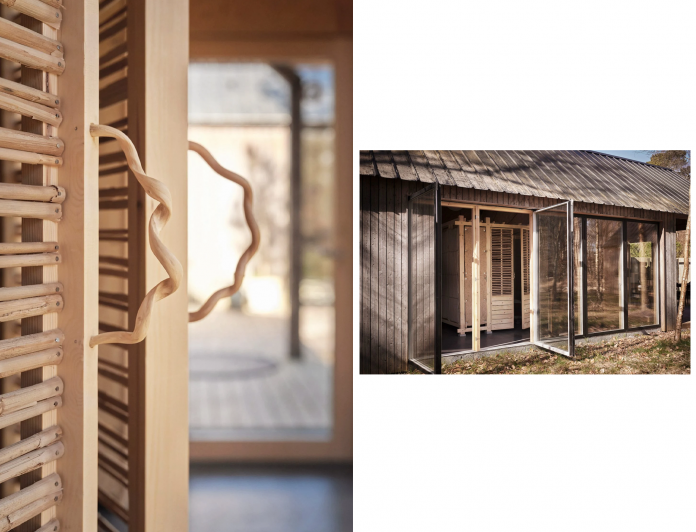
Walls are crafted with mixed techniques: the side walls are upholstered in linen stuffed with eelgrass, creating soft, insulating surfaces. The back wall features a unique brise soleil made from rolled hemp fibre—described by Martinsen as “cigar-like tubes”—that filters light in organic patterns.
The facade draws visitors in with its see-through cattail screens flanking the entrance doors. Handles made from twisted clematis stems add sculptural texture, while ash shavings mounted on timber beams form a delicately layered roof. Each of these elements tells a story—of local knowledge, traditional methods, and the revival of tactile experience in architecture. “The physical experience is important,” said Martinsen. “It’s where we feel, see, and smell—and thus understand and remember what we’ve learned.”
A cultural identity rooted in flora
Martinsen’s philosophy extends beyond environmental concerns. For her, working with local materials is also about cultural expression. As the lead curator of the Mindcraft exhibition in 2023—and a contributor in 2022—she has often explored how Danish design can articulate national identity in a globalised world.
“The pavilion showcases the unique character that emerges when local flora is combined with artisanal techniques,” she said. “Having a cultural visual identity is essential in a world where a certain expression can be created anywhere, at any time.” Indeed, in a time when architecture is increasingly homogenised by global trends and industrial materials, Martinsen’s guest pavilion is a quiet rebellion. It is not just a room made of plants—it is a statement of belonging, a call to slow down, and an invitation to re-examine what it means to build.
Plant-powered hospitality
As guests spend the night inside this immersive, plant-based space, Martinsen hopes they leave with more than just a good night’s sleep. She wants them to walk away with a renewed sensitivity to materials—and perhaps even a changed perspective on sustainability. “A strong understanding of materials can help us navigate toward more responsible behaviour,” she said. And that understanding begins not in lecture halls or policy papers, but through experience: through touch, through scent, through the simple act of waking up in a room built entirely by nature.

In her own quiet way, Sara Martinsen has shown how architecture can speak a local language, how design can deepen our connection to a place—and how even weeds, grasses, and overlooked plants might offer the foundation for something beautiful, meaningful, and lasting.