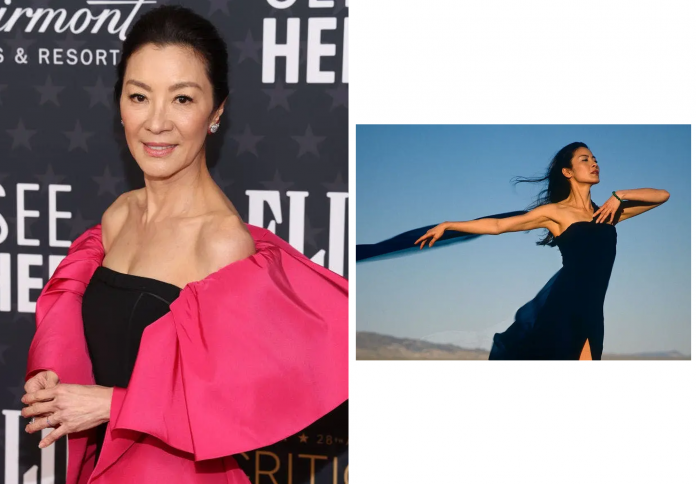
Michelle Yeoh’s Academy Award for Everything Everywhere All at Once was historic, but describing it as the moment she finally arrived misses the scale of the career that preceded it. Born in Ipoh, Malaysia, Yeoh trained in dance before injury redirected her toward screen work, then became a major action star in Hong Kong cinema. International audiences encountered her in Tomorrow Never Dies and Crouching Tiger, Hidden Dragon, while later roles in Crazy Rich Asians, Shang-Chi and the Legend of the Ten Rings, and Wicked demonstrated a range crossing genre and production culture. In 2023, she became the first Asian woman to win the Academy Award for Best Actress for her performance as Evelyn Wang. The victory mattered enormously, but Yeoh’s story is more instructive as continuity: decades of work made the so-called breakthrough possible.
Dance Training Became a Foundation for Screen Presence
Michelle Yeoh’s early ambition centered on dance. She studied ballet in Britain, but an injury disrupted the professional path she had imagined. That change did not erase the physical intelligence she had developed. Instead, it became one of the foundations of her film career.
Action performance depends on rhythm, spatial awareness, balance, and an understanding of how movement reads from a distance. Yeoh brought those skills into Hong Kong cinema, where she became known for performing demanding action with unusual clarity. Her physical work did not feel separate from acting; posture, timing, and control became ways of defining character.

Hong Kong Cinema Made Her an Action Star on Her Own Terms
Films such as Yes, Madam! and Police Story 3: Supercop established Yeoh in an industry whose action traditions were more physically direct than most Hollywood productions of the period. She worked inside choreography that required performers to communicate story through motion, often with practical stunts and tightly designed sequences.
That background matters because Yeoh later entered Western productions with an expertise that could not be reduced to novelty casting. By the time she appeared opposite Pierce Brosnan in Tomorrow Never Dies, she had already developed a screen authority independent of the Bond franchise. Her character could participate in action rather than merely observe it, reflecting skills audiences elsewhere had known for years.
Crouching Tiger Expanded the Emotional Vocabulary
Ang Lee’s Crouching Tiger, Hidden Dragon gave international viewers a different register of Yeoh’s work. As Yu Shu Lien, she combines martial precision with restraint, longing, loyalty, and mature romantic feeling. The performance helped demonstrate how seamlessly action and emotion could coexist when neither was treated as a secondary element.
The film’s global success broadened Yeoh’s recognition without fixing her inside one type. She could move into drama, fantasy, franchise filmmaking, and ensemble work while retaining the grounded physical presence that had shaped her earlier career.
Evelyn Wang Required Every Version of Her at Once
Everything Everywhere All at Once made unusually complete use of Yeoh’s accumulated experience. Evelyn Wang begins as an exhausted laundromat owner overwhelmed by taxes and family conflict, then moves through alternate realities that demand comedy, action, romance, absurdism, and grief. The role works because Yeoh can make each tonal shift feel connected to the same person.
Her 2023 Best Actress Oscar made her the first Asian woman to win the category. The milestone carried representational weight, but the performance itself resists being treated only as symbolism. Yeoh won for a character whose heroism comes from confronting ordinary disappointment as much as from mastering multiversal chaos.
Recognition Did Not Narrow the Next Chapter
After the Oscar, Yeoh continued moving across large-scale projects rather than settling into prestige roles designed to repeat the victory. She joined the Wicked films as Madame Morrible, bringing controlled authority to musical fantasy, and remained active in franchise and genre work. That variety fits a career in which categories have always been porous.
The most revealing fact about Michelle Yeoh is therefore not a surprising piece of trivia. It is the duration of her adaptability. She moved from dance training to Hong Kong action cinema, from Bond to wuxia, from romantic comedy ensembles to a maximalist American independent film, and from historic Oscar winner back into fantasy spectacle. Hollywood’s recognition arrived late relative to the work. Yeoh’s career had already demonstrated the range the industry eventually decided to celebrate.
Yeoh’s Career Also Exposes the Limits of Hollywood-Centered “Discovery” Narratives
When Western awards institutions finally celebrate an actor, coverage often rewrites the earlier decades as preparation for the moment that supposedly matters most. Michelle Yeoh’s filmography makes that framing especially inadequate. She was already a major star in Asian cinema and an internationally recognized performer long before Everything Everywhere All at Once gave Hollywood an awards-season narrative it could easily package.
A more accurate history has multiple centers. Hong Kong action cinema is not a prelude to an American Oscar, and Crouching Tiger, Hidden Dragon is not merely a stepping-stone toward English-language prestige. Each industry, language, and genre produced its own audiences and artistic demands. Yeoh’s achievement is that she moved among them without treating one as the final destination. Her Oscar matters precisely because representation within Hollywood matters, but it becomes richer when placed inside that larger map. The win did not validate everything before it. It forced a wider audience to notice the continuity that had been there all along—and perhaps to question why global careers are so often described as complete only after American institutions decide to recognize them.