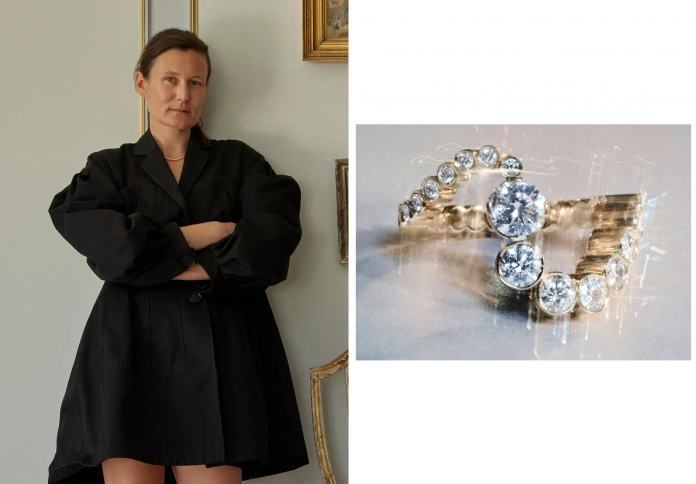
Sophie Bille Brahe’s jewelry begins with precious materials, but her creative logic is closer to memory than decoration. The Copenhagen designer trained as a goldsmith before completing a master’s degree at the Royal College of Art and launching her namesake label in 2011. Diamonds become stars; pearls become moons; the horizon where sea meets sky can become the curve of a ring. Just as important are the objects she grew up around. Brahe comes from a family with a long history of art patronage, and inherited furniture, sculpture, and stories continue to shape both her home and her boutiques. Two stone lions by Danish sculptor Bertel Thorvaldsen now guard her Madison Avenue store in New York. Their presence explains her philosophy unusually well: an object can be beautiful, useful, and contemporary while still carrying time inside it.
Craft Came Before the Brand
Sophie Bille Brahe decided unusually early that she wanted to become a goldsmith. After finishing school in Denmark, she entered a four-and-a-half-year apprenticeship focused on the technical disciplines of metalwork. The training was not glamorous, but it gave her a foundation that still shapes her design. Before a diamond can appear weightless, a setting has to survive. Before a curve feels effortless, metal has to be controlled.
She later completed a master’s degree at London’s Royal College of Art and returned to Copenhagen, launching her label in 2011. That trajectory—trade training followed by conceptual design education—helps explain why her work sits comfortably between craft, art, and fashion. The pieces may look delicate, but the decisions behind them are structurally exact.
.jpg)
Nature Becomes a Personal Geometry
Brahe often returns to the horizon, stars, moon, sea, and flowers as references. Her Grand Ensemble Ocean ring translates the line where water and sky meet into a wave of diamonds and bezel settings. Pearls frequently carry lunar associations, while diamonds are imagined as points of light emerging from the earth. The language is poetic, but the forms remain controlled.
Nature in her work is not represented through literal miniature landscapes. It becomes geometry, spacing, rhythm, and asymmetry. That abstraction is what keeps the jewelry from feeling illustrative. A wearer does not need to know the story in order to appreciate the balance of stones, but the story gives the designer a reason for arranging them exactly that way.
Family Objects Give the Stores a Different Scale of Time
Brahe grew up surrounded by inherited art and furniture connected to ancestors who supported artists in Denmark. Among the names woven into that history is Bertel Thorvaldsen, the celebrated nineteenth-century Danish sculptor. Her family’s relationship to such objects was not purely institutional; they were part of the domestic environment and the stories told around it.
That experience changed how she thinks about interiors. Brahe has said she is more interested in memories than in simply decorating a space. When opening her first Copenhagen store, she acquired a Thorvaldsen work. For the New York boutique that opened on Madison Avenue in 2024, she went further, purchasing a pair of stone lion sculptures connected to the former family property. They now occupy the shop as guardians and as pieces of biography.
Jewelry Works Best When Ownership Is Temporary
Fine jewelry is unusually suited to Brahe’s interest in inheritance because its materials often outlive the person who first buys them. Gold can be reworked. Diamonds and pearls move through families. A ring can acquire more emotional value after decades of wear than it had on the day it left the store. Designing for that kind of duration encourages a different relationship to trend.
Brahe’s pieces are contemporary, but they are rarely dependent on novelty effects that would date them immediately. That restraint is not conservatism. It is an awareness that the object may need to survive multiple wearers and contexts. A piece can be personal without being private; each owner adds another chapter to a material that already had a long history before it entered the studio.
An Archive Can Point Forward
The danger of working with family history is romanticizing it until the present disappears. Brahe avoids that by treating inheritance as raw material rather than instruction. The stone lions do not dictate the shape of a necklace. The family stories establish a way of thinking about continuity, patronage, craft, and the emotional life of objects.
That philosophy is visible in the brand’s growth from Copenhagen to New York and in the way her jewelry balances technical precision with apparently effortless compositions. Brahe is not trying to recreate an aristocratic past. She is asking what can still be carried from it: respect for craft, attachment to art, and the belief that objects gain meaning through time. Her jewelry becomes an archive that refuses to stay still, moving from maker to wearer and, ideally, far beyond both.
Jewelry Becomes Intimate When Scale Is Measured Against Memory
Sophie Bille Brahe’s work is often recognizable for precision, but its emotional force comes from the way small objects carry long timelines. Jewelry can remain physically unchanged while its meaning accumulates through gifting, inheritance, anniversaries, loss, and daily wear. A ring or earring may occupy only centimeters of space yet become one of the most biographically dense objects a person owns.
That quality helps explain why family, art, and interiors appear naturally in discussions of Bille Brahe’s design practice. She treats presentation as part of the object’s world rather than an afterthought. A store can frame jewelry with the same care a home frames inherited things: through light, spacing, color, and the choreography of looking closely. In an industry where luxury is often communicated through magnitude, her work makes a quieter case. Value can come from proportion, material control, and the private associations a wearer builds over time. The most successful jewelry does not need to announce every reference from across a room. It can wait until someone comes closer, which is also how memory often works—small, precise, and suddenly much larger than the object carrying it.