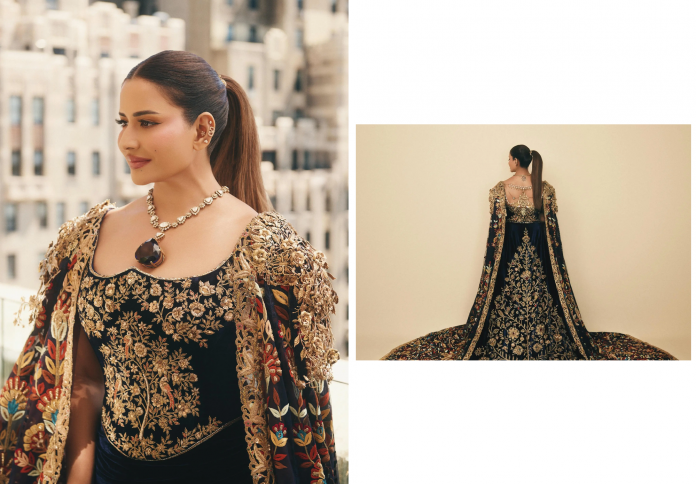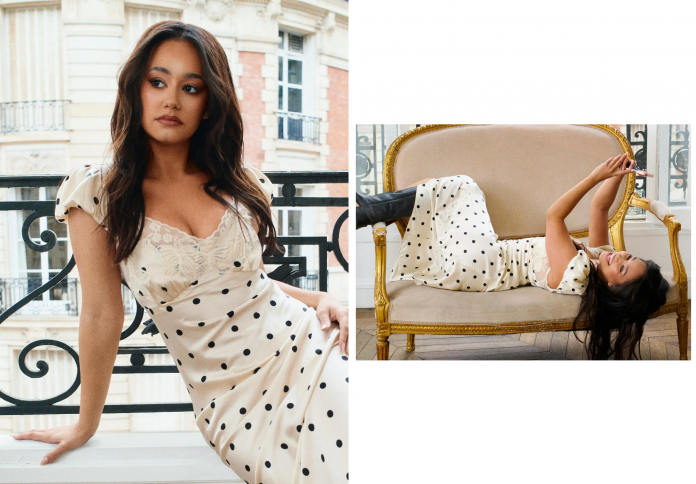
Léna Mahfouf has built a career by making highly visible life feel conversational, and her approach to fashion follows the same logic. The French creator, model, author, and podcaster—known to millions online as Léna Situations—has moved from YouTube and social media into campaigns, front rows, books, and major red carpets without settling into a single “French girl” uniform. Her appearance in Free People’s Spring/Summer 2026 campaign highlighted a freer, more eclectic side of that style, while her broader wardrobe moves easily between vintage-inflected casual pieces and precise couture. What holds the shifts together is not one silhouette but an attitude: experimentation without apology. Mahfouf’s fashion influence is useful precisely because it resists the fantasy that personal style arrives fully formed. Her clothes suggest something more contemporary and attainable—that taste develops through trying things, changing your mind, and letting different versions of yourself remain visible.
The Internet Made Style Development Public
Traditional fashion profiles often present personal style as if it were an innate gift: the subject simply “knows” what works. Léna Mahfouf belongs to a generation whose audiences have watched that knowledge develop in real time. Years of videos, travel diaries, event coverage, and everyday posts have created a long visual archive in which experimentation is part of the appeal.
That transparency changes the relationship between creator and follower. Viewers do not encounter only a polished campaign image; they also see the process around dressing, the jokes, the wrong turns, and the changing preferences. Mahfouf’s credibility therefore comes less from pretending to possess a perfect wardrobe than from showing that style is something a person can build through attention and play.

“Parisian” Does Not Have to Mean a Uniform
Global fashion media has spent decades exporting a simplified idea of French style: neutral colors, minimal makeup, a trench coat, a striped shirt, and the appearance of effortlessness. Mahfouf complicates that cliché because her wardrobe can be loud, romantic, tailored, playful, revealing, or intentionally oversized depending on the moment.
The range feels more truthful to contemporary Paris, where style is shaped by migration, youth culture, luxury, streetwear, vintage markets, nightlife, and social media at once. Mahfouf’s value as a style figure is not that she offers a new fixed formula to replace the old one. It is that she makes inconsistency productive. A person can love a dramatic runway look and still reach for an easy pair of jeans the next morning.
Free People Matched the Less Controlled Side of Her Taste
Mahfouf’s participation in Free People’s Spring/Summer 2026 campaign placed her inside a brand world associated with relaxed layering, texture, movement, and bohemian references. That casting made sense because it foregrounded the casual, self-directed side of her wardrobe rather than the couture-facing identity viewers might associate with major fashion events.
Campaign work can flatten a creator into a brand archetype, but the stronger collaborations select an existing part of someone’s style and amplify it. For Mahfouf, loose silhouettes and a slightly undone sensibility coexist naturally with more glamorous dressing. The contrast is part of her appeal. She does not need every partnership to tell the entire story; she needs each one to feel plausible within it.
A Creator Career Now Includes More Than Content
Mahfouf’s trajectory also illustrates how the role of “influencer” has expanded. She has written books, hosted a podcast, worked with major fashion companies, modeled, and created live and branded projects while maintaining the direct-to-audience channels that established her. The career architecture resembles a small media company more than a conventional celebrity lane.
Fashion is especially compatible with that structure because it rewards both image and point of view. An outfit can become a social post, a campaign asset, an interview topic, a red-carpet moment, and a source of community discussion at the same time. Mahfouf understands that circulation instinctively, but she avoids making every look feel optimized for virality. Humor and personal enthusiasm keep the clothes connected to a person rather than a content calendar.
“Unapologetic” Style Is Really Permission to Change
The most useful idea in Mahfouf’s fashion philosophy is not confidence as a permanent state. It is permission. An unapologetic approach allows someone to wear a look intensely, enjoy it, and later move on without treating the change as failure. That is closer to how style actually develops than the pressure to discover one lifelong aesthetic.
For her audience, especially younger viewers raised inside constant visual comparison, that flexibility has real cultural value. Social platforms can make every outfit feel like a public referendum. Mahfouf’s example suggests another approach: dress as a form of curiosity rather than proof. The result is a style identity broad enough to contain Free People ease, Paris fashion-week polish, couture spectacle, and ordinary clothes without requiring any one of them to become the definitive version of Léna.
Mahfouf’s Influence Depends on Keeping Taste Social Rather Than Prescriptive
Many style creators eventually become advice machines, expected to translate their popularity into rules about what to buy, what to avoid, and how to achieve a recognizable look. Léna Mahfouf is more persuasive when she resists that authority and treats fashion as conversation. Her best content makes taste feel shareable without insisting that it become universal.
That approach reflects how younger audiences actually encounter clothes. A person can save a couture image, buy vintage, borrow from a friend, wear a mass-market piece, and follow a luxury campaign without experiencing those choices as contradictions. Mahfouf’s wardrobe moves similarly across price points and levels of formality. The consistency comes from enthusiasm rather than a strict aesthetic doctrine. This makes her “unapologetic” language more useful than a conventional style formula. It does not promise that every experiment will flatter or age perfectly. It suggests that the act of trying is itself part of taste. In a digital culture that can turn every outfit into evidence for or against someone’s identity, that looseness feels almost radical: clothes can matter deeply without every look needing to prove who you are forever.