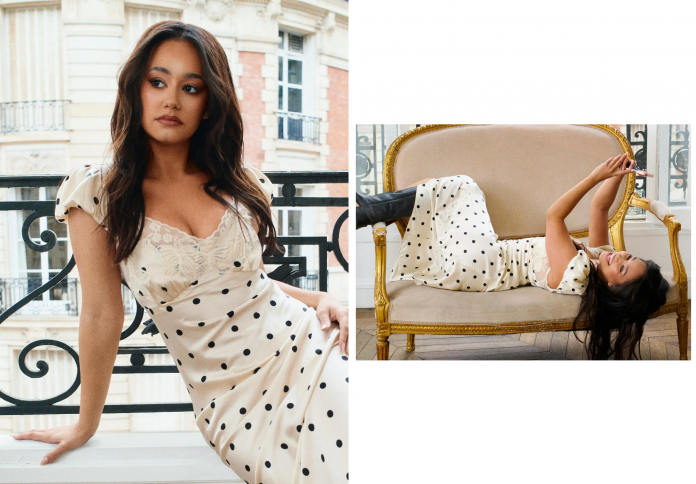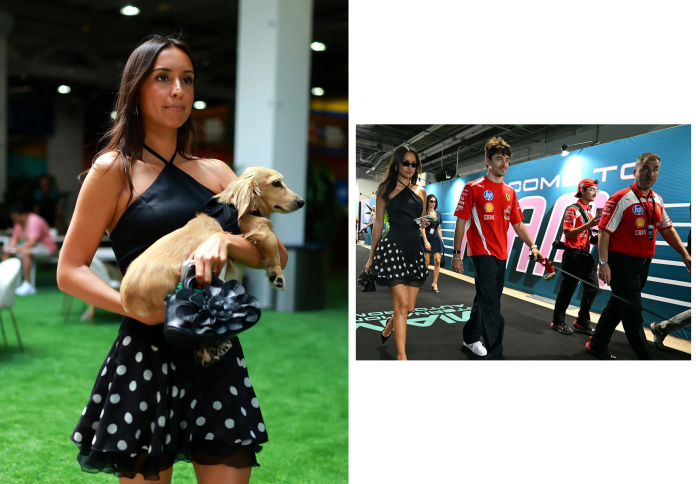
At the 2026 Miami Grand Prix, Alexandra Leclerc offered a compact lesson in the new visual economy of Formula 1. Trackside with her husband, Ferrari driver Charles Leclerc, she wore a black halter mini dress with a polka-dot skirt, oversized sunglasses, pointed heels, and a sculptural black bag, balancing Miami polish with enough movement to keep the outfit from feeling severe. Their dog Leo supplied the unscripted detail that made the photographs feel less like a fashion campaign. The look matters because the paddock is no longer treated as a purely sporting backstage. It has become a global arrival zone where athletes, partners, celebrities, sponsors, and designers circulate before the racing begins. Alexandra’s style fits that environment without turning it into costume: controlled, recognizably personal, and aware that the cameras now follow Formula 1 long before the lights go out.
The Paddock Has Become a Front Row
Formula 1’s expansion into entertainment culture has changed what happens around the race as much as what happens on the circuit. Miami is perhaps the clearest example. The event combines elite motorsport with hospitality, music, celebrity attendance, branded experiences, and an audience primed to document every arrival. The paddock is still a working environment, but it also functions as one of sport’s most visible fashion corridors.
Alexandra Leclerc understands that duality. Her Miami outfit was polished enough for the cameras without looking as though it belonged at an evening premiere. The black halter top created a clean, graphic line, while the polka-dot skirt added movement and a little humor. The result felt appropriate to the heat and energy of the weekend while remaining visually distinct beside team uniforms and technical racewear.
.jpg)
Accessories Kept the Look Controlled
Oversized black sunglasses, pointed-toe heels, and a structured handbag anchored the softer movement of the skirt. The accessories stayed within one dark palette, allowing silhouette and texture to do more work than color. That restraint is one reason the outfit photographed so well. Nothing competed for the role of “statement piece,” yet the composition was specific enough to be memorable.
Then there was Leo, the couple’s dog, tucked into the scene and immediately changing the mood of the images. Fashion photographs around major sporting events can become highly managed, but an animal introduces an element that resists total control. The contrast between sleek styling and an affectionate everyday gesture gave the look an ease that a more formal appearance might have lacked.
Marriage Changed the Public Frame, Not the Style
Charles and Alexandra married in Monaco in February 2026 after several years together, and their appearances since have been watched with the intensity attached to Formula 1’s most visible couples. The relationship inevitably expands the audience for Alexandra’s clothes, but her style has developed enough consistency that it does not read simply as an extension of the driver beside her.
That distinction matters. Partners of elite athletes have historically been treated as accessories to the sporting narrative, even when they bring their own careers and interests. Contemporary fan culture is more complicated. Viewers follow couples, dogs, travel, fashion, beauty, and race results through parallel feeds. Alexandra’s growing fashion visibility reflects that ecosystem, where personal style can become a public identity adjacent to sport rather than subordinate to it.
Formula 1 Fashion Works Through Contrast
Motorsport provides an unusually strong visual backdrop because the technical environment is so specific. Team colors, sponsor logos, fireproof race suits, carbon fiber, garages, and hospitality architecture create an aesthetic language before any guest arrives. Fashion works best against that setting when it either deliberately engages with the codes or offers a clear counterpoint.
Alexandra’s Miami look chose the second route. It did not mimic Ferrari red or borrow literal racing references. Instead, the femininity of the halter silhouette and polka dots played against the industrial precision of the paddock. That contrast is part of why Formula 1 has become attractive to fashion brands and style media. The sport supplies speed and machinery; the people around it introduce softness, glamour, irony, and individual taste.
The Race Weekend Is Now a Cultural Format
It would be easy to dismiss paddock style as distraction from the competition, but that misunderstands how modern sports audiences behave. Many fans enter Formula 1 through drivers, documentaries, social clips, fashion, or celebrity culture and then learn the sporting details later. The peripheral culture can be an entry point rather than an enemy of seriousness.
Alexandra’s Miami appearance belongs to that wider format. It is a fashion moment, a couple moment, and part of a race weekend without needing to pretend those categories are identical. Formula 1’s challenge is to absorb this expanding attention without losing the competitive core. Its opportunity is equally clear: few sports now produce such a rich visual world around the main event. A black mini dress in the paddock is not the race, but it helps explain why the circuit has become one of fashion’s newest stages.
Formula 1 Fashion Is Built Around Repeated Visibility
A single race-weekend outfit can circulate widely, but the real style opportunity around Formula 1 comes from repetition. Partners, drivers, athletes, and celebrities appear across practice, qualifying, race day, dinners, sponsor events, paddock arrivals, and travel photographs. That rhythm creates something closer to a seasonal wardrobe narrative than a one-off red carpet.
Alexandra Leclerc’s Miami appearance fits that environment. Her style is read beside Charles Leclerc’s sporting identity but also through the visual codes of a city known for heat, color, nightlife, and luxury hospitality. The challenge for anyone adjacent to a major driver is avoiding the appearance of dressing only as an accessory to the race. The strongest looks preserve a personal point of view while acknowledging the setting. This is why Formula 1 has become so useful to fashion brands: the sport offers recurring global stages where clothing is worn in motion, outdoors, among crowds, and inside a lifestyle story. The paddock is not a runway, but its constant photography has turned getting dressed for race weekend into a form of serialized public image-making.