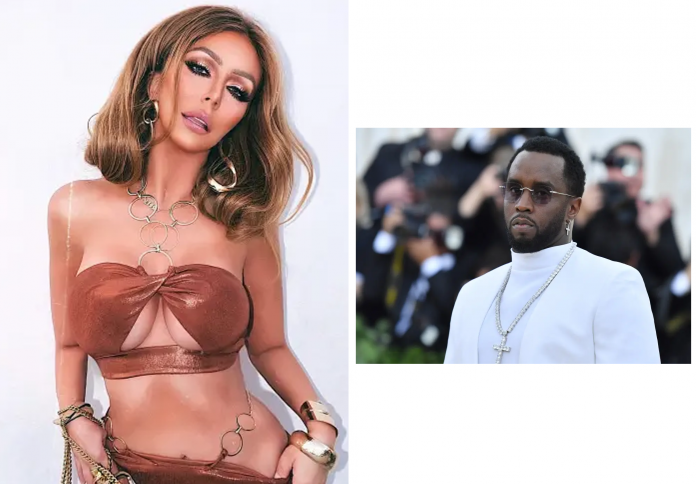
Sean “Diddy” Combs’s sentencing—a 50-month term in federal prison for two prostitution-related offenses—marked the legal climax of a devastating saga that has reshaped the landscape of the music industry. The verdict, handed down in October 2025, capped a federal trial filled with harrowing and graphic testimonies that detailed years of abuse and coercion from one of hip-hop’s most powerful figures. Yet, the most resonant response came not from the courtroom, but from a former protégé: Aubrey O’Day. The Danity Kane singer, whose career was launched and then controversially derailed by Combs’s mentorship on MTV’s Making the Band, quickly issued a stark, public warning to young, aspiring artists. Her message was clear and uncompromising: abandon the dream the moment a powerful figure demands a compromise of one’s safety or integrity, stressing that “No dream, however bright, can outweigh the pain and exploitation” that comes from ignoring the first signs of impropriety.
The Verdict That Rocked the Empire
The sentencing of the 55-year-old music mogul was delivered by U.S. District Judge Arun Subramanian, ending a case that had dominated headlines for months. Combs was ordered to serve 50 months—four years and two months—in federal prison, alongside a hefty fine and five years of supervised release. While the sentence took into account the thirteen months Combs had already served in custody, it was a profound reckoning for the entrepreneur who had once commanded one of the most influential empires in modern entertainment.

The sentence followed a federal jury’s partial verdict in July, where Combs was found guilty on two counts of transportation to engage in prostitution, violations of the federal Mann Act. Crucially, however, the jury acquitted him of the more severe charges, including sex trafficking and racketeering conspiracy, which could have put him behind bars for life. The mixed result reflected the complexity of the case, though the convictions alone marked a forceful blow against the culture of impunity that had protected high-profile abusers for decades.
Ahead of the judge’s final decision, prosecutors had sought a sentence of over eleven years, arguing that it was necessary to reflect the substantial damage inflicted upon the victims. Combs, tearful in the courtroom, offered an apology to his family, former girlfriends, and “all the victims of domestic violence,” calling his actions “disgusting, shameful and sick.” However, Judge Subramanian stood by the need for a “substantial sentence,” emphasizing that it was required “to send a message to abusers and victims alike that exploitation and violence against women is met with real accountability.”
The Cautionary Reminder
Following the sentencing, Aubrey O’Day took to social media to deliver what she called a “cautionary reminder” to the next generation of performers. Her X post was immediate, highly personal, and directly addressed the unspoken compromises often demanded in the pursuit of fame. O’Day’s message went viral, resonating far beyond the typical celebrity commentary and into the broader cultural discussion about abuse of power in the workplace.

The core of her warning was a chillingly simple piece of survival advice: “The real warning is this: the moment someone in a position of power oversteps your boundaries or demands more than is legitimately required of you, walk away and do not look back.” In an industry built on the promise of a single, life-changing opportunity, this counsel serves as a direct rejection of the long-held ethos that suffering and sacrifice are mandatory for success.
O’Day stressed that the biggest danger lies not in the court’s ultimate ruling, but in the vulnerability of remaining in a coercive environment. She urged young artists to “Protect yourself at the first sign of coercion or impropriety,” adding a final, vital piece of advice: “Your well-being is worth more than any opportunity.” Her words provide a much-needed blueprint for self-preservation, placing emotional and physical safety above any career ambition.
Aubrey’s Decades-Long Battle for Truth
O’Day’s statement carries particular weight due to her extensive and tumultuous history with Sean Combs. She first rose to prominence under the mogul’s guidance on the reality television show Making the Band, which documented the formation and struggles of the all-female group Danity Kane. Her time in the group was notoriously difficult, marked by public confrontations with Combs over her image and professional conduct, culminating in her controversial firing from the band on the show’s 2008 finale.

For nearly two decades, O’Day has been an outspoken critic, consistently claiming she was speaking the truth about the environment she worked in. Her history was recently thrust back into the spotlight when she revealed in 2023 that Combs had sent her a non-disclosure agreement, allegedly seeking to silence her and her former bandmates from ever disparaging him or his Bad Boy Records label. She claimed to have encouraged her colleagues to reject the offer, a move that reinforced her public stance as one of the mogul’s most consistent and determined detractors.
The Currency of Power and Control
Combs’s partial conviction and subsequent sentencing shine a harsh light on the systemic exploitation that has long been whispered about in the entertainment industry. The trial’s proceedings, which featured harrowing accounts from ex-girlfriends like Casandra “Cassie” Ventura and other accusers, detailed a culture where immense power was weaponized to control, coerce, and abuse young artists seeking a path to fame.

As noted by prosecutors in their sentencing argument, Combs’s “currency was control,” a commodity he used “to devastating effects on the victims.” For an aspiring artist, often young and away from established support systems, the promise of a big break from a mogul like Combs made resistance feel impossible. The power disparity in these relationships is so vast that the ability to simply “walk away,” as O’Day suggests, is a luxury that often feels unavailable to those desperate to succeed.
Ultimately, O’Day’s critique touched on the inherent imbalance in the justice system, noting that “Too often, those who misuse their power, even when exposed, face far fewer consequences than the harm inflicted upon their victims.” While Combs faces over four years in prison, this observation speaks to the lingering damage—the trauma, lost careers, and psychological scars—that the victims will carry long after the mogul’s sentence is complete.
Looking Beyond the Prison Walls

The sentencing of Sean “Diddy” Combs marks a significant, albeit incomplete, moment of accountability for the music industry. While the acquittals on the most serious charges left some feeling that full justice was denied, the trial process itself, and the subsequent sentence, have provided an undeniable public record of the dark side of the music machine. It validates the courage of accusers and survivors, offering a necessary truth to counter decades of carefully crafted public image.
Moving forward, the greatest legacy of this entire saga may not be the prison sentence, but the words of a former victim-turned-advocate. Aubrey O’Day’s powerful, unsolicited warning transcends the specific case of Sean Combs. It provides a universal, moral instruction manual for self-protection in an industry perpetually riddled with risk. Her plea for young talent to prioritize their well-being insists that the ultimate price of a dream—one’s integrity and safety—is simply too high to pay.