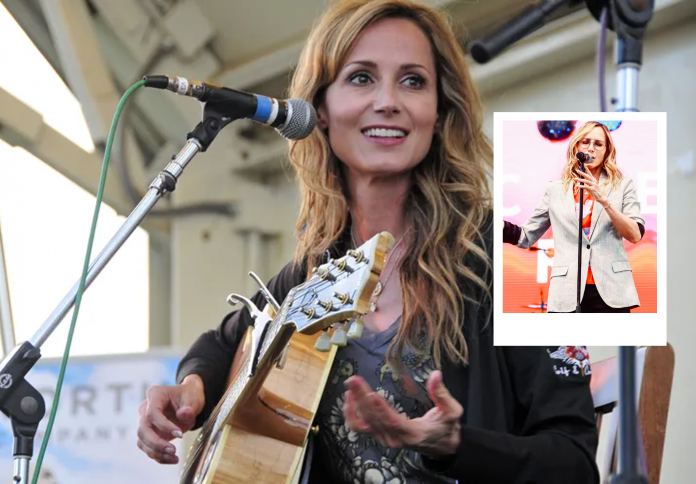
In 2010, Chely Wright shattered country music’s silence when she became the first major artist in the genre to publicly come out as gay. Now, 15 years later, the singer-songwriter opens up about the impact of that moment, the road she took to get there, and how Nashville continues to grapple with queer visibility in an evolving — but still complex — industry.
The weight of the first step
When Chely Wright came out as gay in 2010, it wasn’t just a career-defining moment — it was a life-saving one. At the time, the “Single White Female” singer had spent years battling internalized shame and depression. A near-suicide in 2006 became the catalyst for a radical life decision: to live openly and authentically.
:max_bytes(150000):strip_icc():focal(999x0:1001x2):format(webp)/chely-wright-063025-31b269b68fb34e9e8ca40cf50efa0747.jpg)
“I did not have a choice,” Wright recalls. “I knew that I was coming out just a few hours after I had not ended my life. If I wanted to survive on Earth, I had to come out or I wasn’t going to make it.”
Wright didn’t just want to come out — she wanted to do it right. She spent four years preparing her story, writing her memoir Like Me: Confessions of a Heartland Country Singer, and collaborating with advocacy groups like GLAAD and GLSEN to ensure her message would resonate not only with fans, but with the broader LGBTQ+ community. “I had a responsibility to raise my hand and say, ‘I am gay, and I’m proud of who I am,’” she says.
Finding courage in others — and becoming someone else’s
In the absence of queer country role models, Wright turned to trailblazers from other parts of the entertainment world — Rosie O’Donnell, Ellen DeGeneres, Melissa Etheridge, k.d. lang — whose visibility, she says, was both intimidating and inspiring.
“Their coming out scared me, made me mad — made me self-reflective,” Wright says. “I looked myself in the mirror, and I knew I didn’t have the courage to do what they’d done.”But when she realized that she was “a categorically successful, safe person with relative security,” it became clear that her privilege came with responsibility. Her visibility could — and did — change lives. “When I came out, I can’t tell you how many thousands of people said, ‘I didn’t think I knew a gay person.’”
Nashville’s slow — and selective — evolution
:max_bytes(150000):strip_icc():focal(999x0:1001x2):format(webp)/chely-wright-OUTLOUD-concert-series-063025-1df12877c16b494f83594620a79f260d.jpg)
Wright’s decision to come out circumvented the traditional country music machine. “There was no gatekeeper in Nashville that was going to say, ‘Let’s do this. Let’s tell this story,’” she explains. “So I went around what I knew to be the infrastructure, and I broke some rules.”
Fifteen years later, Wright says that the industry is in a better place — but only relatively so. “Nashville is not as unwelcoming a place as some think, and it’s not as welcoming a place as some would like to believe,” she observes.
While queer songwriters, stylists, and publicists have long worked in country music, she calls out the “willful ignorance” that suggests the industry can’t be homophobic because it tolerates — but rarely spotlights — queer contributors behind the scenes. “The closer to the power center you are, the less likely you are to admit there’s a problem,” Wright says. “Because if you do, then you have to do something about it.”
The personal cost of visibility
:max_bytes(150000):strip_icc():focal(749x0:751x2):format(webp)/chely-wright-tout-032425-4374dce2721147db84960bc739b1362d.jpg)
Despite being hailed as a pioneer, Wright recalls how some within the industry minimized her impact — questioning her motivations or dismissing her career as irrelevant by the time she came out. “They bent themselves out of shape because it was too hard for them to acknowledge, ‘I have a lot of power in a system that isn’t quite where we need to be,’” she says.
She also points out that coming out comes with a real price — one she believes many queer country artists still pay. “Anyone who thinks [coming out] didn’t affect the Osborne brothers’ career is not a serious person,” she says, referring to TJ Osborne, who came out as gay in 2021. “He paid a price. There were knocks on the door that didn’t come, sponsorship-wise, tour-wise, I promise you.”
Building momentum for the next generation
:max_bytes(150000):strip_icc():focal(749x0:751x2):format(webp)/chely-wright-kristin-chenoweth-ty-herndon-harvey-milk-benefit-concert-063025-d0962b59043d4bb9aa07f07dbfe8d93c.jpg)
Wright has watched the landscape shift, however slowly, as more artists take the leap. Ty Herndon, a close friend, came out five years after Wright with her guidance. “He said, ‘I want to do it and I want to do it well, and I want your help,’” she remembers. Later, TJ Osborne raised his hand at the peak of his career — a powerful act Wright describes as “incalculable” in its impact. Most recently, Maren Morris came out as bisexual in a quiet Instagram post during Pride Month 2024, signaling a new kind of agency.
“The time it takes to come out now shortens,” Wright says. “That’s the inertia built up behind the first. And once that first stage gate is tipped over, things can happen very quickly.” Still, she cautions against complacency. The LGBTQ+ community continues to face legislative attacks and cultural backlash, particularly in the South. “We’re all reckoning with how much progress was made in such a short amount of time, and how terribly fragile those freedoms and protections are,” Wright says.
Pride, legacy, and a call to action
Now 54 and the mother of two children with her wife Lauren Blitzer, Wright is as committed as ever to making space for others. She currently serves as the senior vice president of corporate social responsibility at ISS, and recently hosted a Pride Month event benefiting the God’s Love We Deliver charity in New York City.
:max_bytes(150000):strip_icc():focal(749x0:751x2):format(webp)/chely-wright-gods-love-we-deliver-063025-839e171725c1494d99367b4e50becc61.jpg)
To Wright, visibility is still vital — and coming-out stories still matter. “Representation matters. That’s why the firsts matter and the seconds and the thirds and the fourths,” she says. “We need more people to raise their hands, only if they feel safe and able.”
As country music continues to evolve, Chely Wright’s story serves as a reminder that progress is never guaranteed — but it is possible. And sometimes, it starts with one voice saying what had always been true: “I am gay, and I’m proud of who I am.”