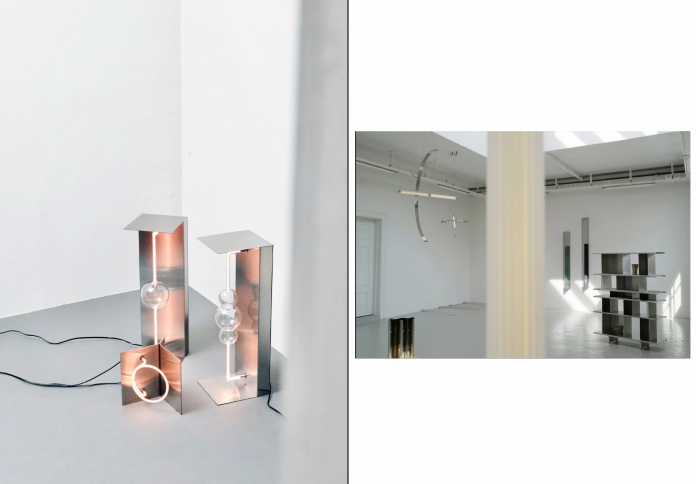
At this year’s 3 Days of Design in Copenhagen, Taiwanese gallery Fanzi presented Optical Flow, an exhibition that reimagines everyday objects—from yoga mat holders to suspended lamps—as functional sculptures. Curated by Fanzi founder Sandra Wang, the show featured five emerging designers whose playful yet technically precise creations aim to shift the perception of furniture and utility in contemporary design culture.
Furniture as legacy, not commodity

For Sandra Wang, the motivation behind Optical Flow was as much cultural as it was artistic. “In Europe, grandparents pass down furniture to their grandchildren,” Wang observed. “But in Taiwan, I don’t see that often. Maybe it will start from our generation.”
The exhibition, housed at the Christian Andersen Gallery in Copenhagen, brought together five Taiwanese designers who treat furniture and objects not just as tools for daily living, but as heirlooms, artifacts, and reflections of their creators’ cultural identity. In doing so, Wang hopes to inspire a generational shift in Taiwan—one in which young people see value not just in functionality, but in the artistry of the everyday.
Engineering light: A play of wires and illusion
A standout element of Optical Flow was its radical rethinking of lighting design. Taipei-based Chialing Chang, in collaboration with the engineering art collective Zap, created a series of pendant lamps that appear to defy gravity. Hung from the ceiling by only their conducting wires—stainless steel cables coated in a thin insulating layer—the lamps form closed electrical circuits while also supporting their own weight.

Each wire carries 12 volts of electricity directly into the LED light source, eliminating the need for bulky fixtures or visible power supplies. The result is both delicate and technical: minimalist structures that spin gently in response to air movement, reminiscent of kinetic sculptures. “Most people don’t realise how it works,” said Chang. “They think there’s a battery and it’s just a very beautiful lamp.”
Similarly, Yen-An Chen, a Design Academy Eindhoven graduate, paid homage to Taiwan’s fading neon signmaking industry by sculpting bulging glass tubes that cause the neon light within to fade, distort, and reappear in mesmerizing waves. It’s a poetic nod to a dying craft—and a testament to the expressive potential of technical precision.
Sculpting softness and steel
While light served as a central theme, materiality played an equally vital role in the exhibition. Ting-Hsuan Chang explored the dualities of hard and soft through resin, traditionally seen as a cold, industrial material. By employing handmade moulds and subtle coloring, she succeeded in giving her resin furniture pieces a tactile softness that invites touch—blurring the line between design object and domestic comfort.
In contrast, designer Coby Huang leaned into rawness with a modular shelving system made from uncoated steel. The rugged construction is not only functional but modular and minimalist, appealing to urban dwellers seeking flexible storage. But Huang’s most striking contribution was perhaps his wall-mounted sculpture designed to hold a yoga mat—touted as the “first-ever” of its kind.

Made from triangular steel tubing, the object doubles as a polished mirror and a magnet board, encouraging both display and interaction. It’s part art piece, part utility—designed for the entrance of a home where personal ritual meets public presentation.
A frame for the personal
Another piece that challenged the conventions of what a “design object” can be came from Taiwanese master framer Shun-Hsiung Hung. Rather than framing a painting or photograph, his oversized frame contains a hook at its center, intended to display personal items—anything from a tailored coat to a humble bag of oranges.
The work invites users to rethink the boundary between object and context. As Wang explained, “Normally, when people go to museums, they just focus on the artwork. But they forget that the frame itself is very important—like how we dress ourselves. With a nice frame, the auction price can double.” In this way, the frame becomes more than a supporting player; it is an architectural element, a stage for identity, and a redefinition of value.
Cross-cultural dialogue through design

The exhibition was also the result of an international collaboration with Danish designer Marie-Louise Høstbo, former head of design at Fritz Hansen. She contributed a vertical yoga mat holder crafted from sustainably sourced beech in Denmark, paired with a premium jute and rubber yoga mat that Wang described as “bigger, wider, nicer” than average.
This fusion of Taiwanese innovation with Danish craftsmanship underscores the global resonance of Optical Flow. “From the Danish perspective, it’s amazing to see that in just 12 years, 3 Days of Design has engaged with the whole world,” said Høstbo. “And it’s great to be collaborating with other cultures, where we can actually learn from each other and how we interact with design.”
Beyond function: Toward collectible culture
Ultimately, Optical Flow is more than an exhibition—it is a manifesto for a new generation of design in Taiwan. By blurring the boundaries between art and object, utility and expression, these five designers challenge the idea that furniture must fade into the background. Instead, their work insists on presence, personality, and permanence.
In a world where mass production still dominates, the exhibition offers an intimate counterpoint. These are not just products—they are propositions for a more considered, more meaningful way of living with the things we own.
Optical Flow was on view from June 18 to 20, 2025, at Christian Andersen Gallery in Copenhagen, as part of 3 Days of Design. The exhibition served not only as a showcase of talent but as an invitation to see—and value—the artistry in the everyday.