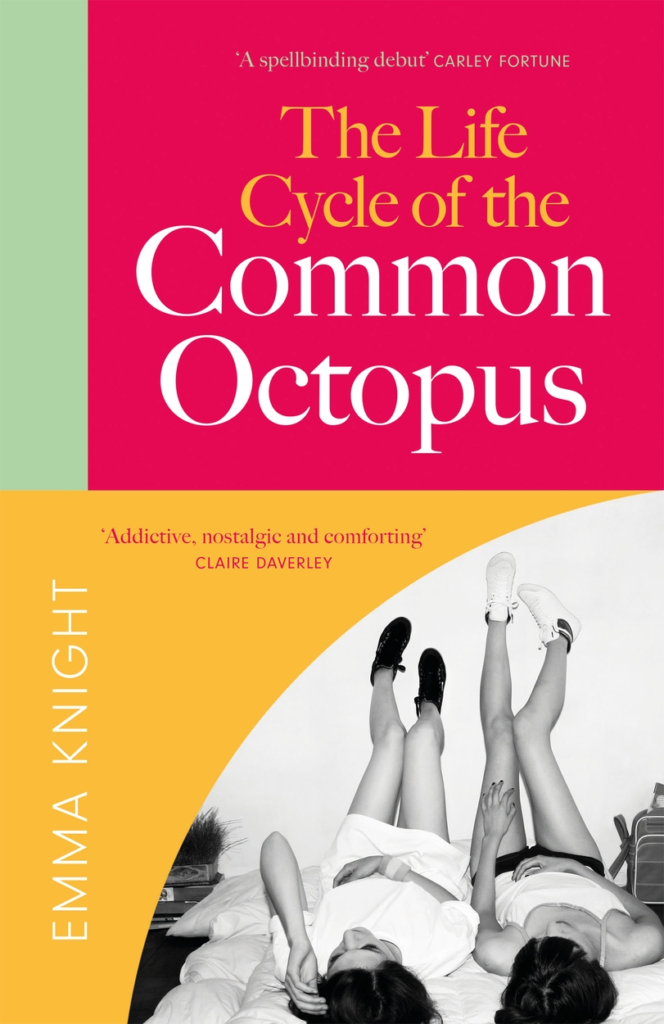
Emma Knight’s debut novel, The Life Cycle of the Common Octopus, is far from what its title suggests. It’s not a book about octopuses — but a sharp, nuanced coming-of-age story disguised as a heist. At its heart is Pen, a hyper-aware teenage girl navigating the choppy waters of identity, friendship, and self-discovery, all set against the backdrop of privilege, performance, and repression.I had the chance to speak with Emma from Lisbon, where she now lives, about her literary inspirations, the power of female friendship, and the deeply personal journey that led to this striking debut novel.
A world of privilege, performance, and quiet rebellion
Sinead McInerney (SM): Your novel captures a very specific texture — the tension of ambition mixed with the carefully maintained chaos of adolescent life on the East Coast. How much of Pen’s emotional landscape comes from your own experiences?
Emma Knight (EK): There’s definitely a lot of withholding and obscuring in that wiring. Repression, I realized while writing, is crucial in literature. If everyone could always say exactly what they feel, would we even have novels? I like exploring how manners, social conditioning, and the fear of judgment interfere with honesty and connection. So much of my favorite literature wrestles with these ideas.
SM: Pen’s friendship with Alice is conspiratorial — like a stylish escape plot. Were you inspired by your own friendships from your time at Edinburgh University?
EK: Absolutely. Monica Ainley de La Villardière, my best friend since childhood and a fashion journalist in Paris, helped me write that emotional precision. Our friendship isn’t Alice, but it’s definitely informed that dynamic. We didn’t live apart until grad school — that closeness shaped the novel.
Female friendship as a sacred bond
SM: The bond between Pen and Alice feels like an emotional vault — something deep and non-verbal. Could you talk about that?
EK: That line about Alice being glad to be near Pen, who absorbs others’ pain, comes from a very real place. Female friendships often serve as our emotional witnesses, especially when society insists romantic love is the only love that matters. But as I look at women in their fifties and beyond, it’s often those friendships that endure — complex, chosen, non-linear, but profoundly loyal.
SM: You paint an aristocratic world — castles, boarding schools, ancestral sadness — that feels both alluring and fragile. Were you writing as an insider or outsider?
EK: Somewhere in between. I’m Canadian, which helped me keep a certain observational distance, like Joan Didion’s “neutral uniform.” Edith Wharton is a great model for this — born into a world she understood deeply but critiqued mercilessly. I think that blend of closeness and detachment was important.

The models of Womanhood within the story
SM: Pen’s relationship with Christina is fascinating — Christina seems calm, whole, and unapologetic. Was she meant as a model or a warning?
EK: Christina embodies a woman who knows herself and has made conscious, unbitter choices. She’s not Pen’s inevitable future, but a vision of what’s possible when a woman prioritizes intimacy over performance, love over narrative. Pen is drawn to that wholeness.
SM: Pen wrestles with curating a perfect self and the urge to burn it all down. Could your novel be seen as a manual for girls who don’t want to choose sides?
EK: I love that idea! Pen starts overly concerned with others’ opinions, but gradually trusts herself more. It’s about reclaiming her desires and identity beyond expectations.
Creativity, motherhood, and artistic permission
SM: How did motherhood change your approach to creativity and writing?
EK: It changed everything. My second pregnancy was complicated, and during COVID, I was alone in hospital with a toddler at home. That stillness forced honesty and gave me urgency. I stopped waiting for perfect conditions and gave myself permission to write the novel I’d long convinced myself I wasn’t ready to start.
SM: How did you manage writing alongside your other roles?
EK: A mix of structure and surrender. I wrote longhand to avoid over-polishing, and retreated to a cabin in Algonquin Park without electricity, surrounded by nature and family, which helped me focus.
Emma Knight’s debut is a quietly revolutionary book — one that invites readers into a world where the smallest moments hold seismic emotional power. It’s a novel that lingers long after the last page, echoing the complex rhythms of friendship, identity, and the messy, beautiful process of growing up.