The 2026 Vanity Fair Oscars after-party, held on the evening of March 15, served as the ultimate finale to the awards season, trading the formal constraints of the Dolby Theatre for a display of uninhibited glamour. If the main ceremony honored cinematic legacy, this late-night fête functioned as a playground for fashion’s most daring experimentalists. As Hollywood’s brightest stars descended upon the party, the red carpet became a canvas for bold tailoring, intricate archival couture, and the season’s defining trend: sheer, statement-making ensembles. For the industry’s rising icons, the event was not merely a celebration, but a definitive moment to cement their status as the new guard of cultural influence, turning the post-awards circuit into a runway that felt more urgent and contemporary than ever before.
The Duo of the Night: Connor Storrie and Hudson Williams
Among the evening’s most anticipated arrivals were Heated Rivalry stars Connor Storrie and Hudson Williams, whose joint appearance solidified their reputation as the year’s most buzzy red-carpet duo. Storrie arrived in a bespoke Saint Laurent ensemble—a sheer turtleneck paired with tailored trousers that emphasized a sophisticated, minimalist edge—complemented by Tiffany & Co. jewelry and a vintage TAG Heuer watch. Beside him, Williams leaned into the avant-garde with a custom Balenciaga blouse, featuring a dramatic, cape-like silhouette that became an instant highlight of the night, styled with Bulgari accessories and Christian Louboutin footwear. Their coordinated arrival, accompanied by Williams’ partner Katelyn Rose Larson, captured the essence of the event: a blend of high-fashion audacity and the magnetic, carefree energy of Hollywood’s new generation.
A Showcase of Artistic Vision
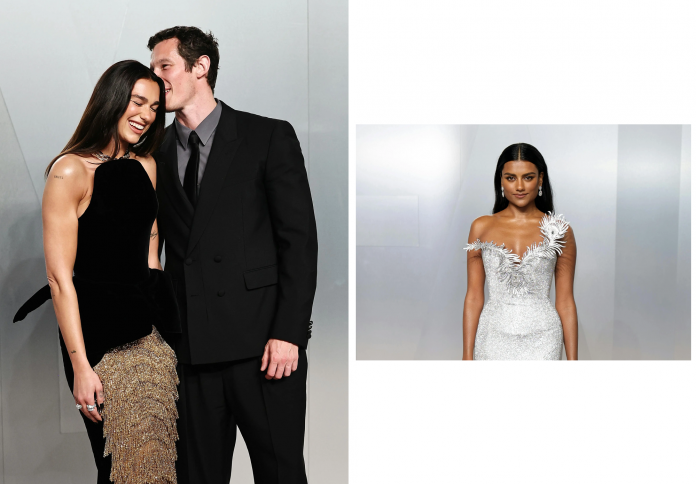
The red carpet was dominated by a diverse array of creative expressions that moved far beyond the traditional gown. Olandria Carthen made a striking entrance in a custom gown by Pajtim Raci, accented with Atazure jewelry, further cementing her position as a force in modern evening wear. Other notable standout looks included Simone Ashley in a masterfully constructed Tamara Ralph design, and Sarah Pidgeon, who opted for a custom Calvin Klein collection dress paired with archival Stuart Weitzman sandals. The variety of designers—ranging from Chanel and Gucci to the structural brilliance of Loewe—reflected an industry in the midst of a stylistic transition, where the focus has shifted toward individualistic, high-concept pieces that prioritize bold silhouettes and tactile complexity.
The After-Party as a Cultural Barometer
The 2026 Vanity Fair after-party ultimately served as a vital pulse-check for the entertainment industry. The transition from the ceremony’s polished formality to the party’s more rebellious energy highlighted a shift in how we perceive the “celebrity uniform.” As the evening progressed, the focus turned toward a more fluid aesthetic, where masculine tailoring embraced lace, transparency, and high-jewelry accents, and where classic elegance was consistently disrupted by modern, structural experimentation. The event was a reminder that even as platforms and narratives in the entertainment world evolve, the red carpet remains the primary site where fashion and pop culture collide, creating moments of lasting visual history.