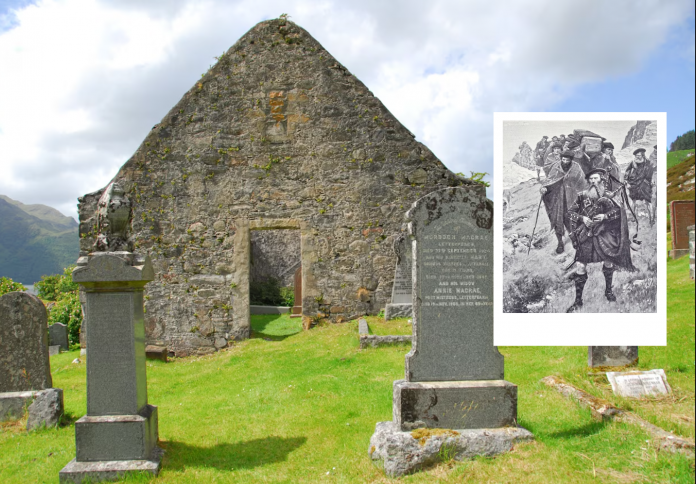
In the remote Highlands and scattered islands of Scotland, a network of ancient paths known as “coffin roads” tells a powerful story of ritual, reverence, and resilience. Once routes for funeral processions carrying the dead to sacred burial grounds, these trails now invite hikers to follow in their footsteps—through some of the most striking, storied, and soul-stirring landscapes in the country.
A path between worlds
Across the mist-veiled mountains and vast moorlands of Scotland, narrow footpaths trace a solemn and nearly forgotten past. Known as coffin roads or corpse roads, these routes were once the only means of transporting the deceased from remote settlements to consecrated burial grounds—often dozens of miles away. Carried on shoulders, the caskets moved over wild terrain, through forests, rivers, and steep passes. The journeys were long, harsh, and steeped in folklore.

In his book The Coffin Roads, author and theologian Ian Bradley chronicles the customs that surrounded these final pilgrimages. In the Highlands and Hebrides, where isolated communities had no churches or graveyards of their own, funeral processions could last days. The body was never allowed to touch the ground, and rest stops were marked with cairns—piles of stones that can still be seen scattered in lonely spots, far from any village.
But coffin roads were more than practical routes—they were deeply spiritual. Bradley explains how traditions such as winding paths (to confuse lingering spirits), crossing water (which ghosts could not follow), and always pointing the corpse’s feet toward the grave were intended to guide both the dead and the living through a transition. These were community-led rites, solemn but not always somber. “Multi-day wakes often turned raucous,” Bradley writes, with whisky flowing freely and women chanting laments, known as keening, behind the bearers.
Tracing Scotland’s cultural spine
While the practical use of coffin roads faded more than a century ago, the paths remain. Thanks to organizations like ScotWays, which maintains access to historic trails, and mountaineering groups dedicated to preserving rural lore, hikers today can still walk them. Tim Simons, a volunteer director at ScotWays, notes that while many of these routes have been lost to memory, those that endure offer quiet solitude and a powerful sense of place. “You can walk all day and not meet another soul,” he says.
Each route is unique, shaped by the terrain and traditions of its region. Some are short and contemplative, perfect for a day’s stroll through ancient landscapes. Others stretch deep into rugged wilderness, offering a physical challenge matched by emotional resonance.
Coffin walks for beginners

For those new to hiking—or new to the coffin road story—Kilmartin Glen is the perfect introduction. Located just two hours from Glasgow, this valley is home to one of Europe’s most important prehistoric landscapes. More than 350 relics—standing stones, burial cairns, and barrows—dot a six-mile corridor, many of them older than Stonehenge or the Egyptian pyramids.
Bradley calls this “the archetypal coffin road,” pointing out that archaeological evidence suggests its main function was funerary, not residential. A three-mile loop on mostly flat terrain connects major sites and offers a window into the region’s ancient relationship with death and ceremony.
Another accessible route is the Green Isle Walk, which skirts the shore of Loch Shiel. Once a junction for multiple coffin roads, the path leads to a jetty where boats ferried coffins to St. Finan’s Isle—a sacred burial ground still in use today. Just under three miles round trip, the walk passes through groves of Scots pine and open meadows dotted with sheep, with views across the water to a haunting isle of gravestones and ruins.
Intermediate hikes through sacred isles
For a more remote and immersive experience, head to the Isle of Harris in the Outer Hebrides. The island’s rugged coffin road crosses the dramatic hill pass of Bealach Eòrabhat, through moorland and mountain to white sand beaches and ancient cemeteries along the west coast. This eight-mile trek features some of the most cinematic terrain in Scotland—so much so that it stood in for Jupiter in 2001: A Space Odyssey, and inspired Peter May’s thriller Coffin Road.

Craig McDonald, a guide with Wilderness Scotland, calls this their most-requested coffin trek. “It’s moderately difficult,” he says, “but manageable if you’re prepared.” The trail’s challenge lies not in elevation, but in navigation: “The path fades in sections, so having a map—and knowing how to use it—is key.” When the mist rolls in, as it often does, the landscape becomes even more mysterious.
For seasoned hikers: rugged trails and powerful echoes
Some of Scotland’s coffin roads are not for the faint of heart—but for experienced hikers, they offer a glimpse into the true effort these processions once demanded. The 20-mile route from Kenmore to Applecross on the Applecross peninsula winds through remote and wild country, with coffin cairns and wrought-iron gates marking the way. The path likely led to Clachan Church, built on the ruins of a seventh-century monastery. It’s beautiful, boggy, and features several river crossings—best tackled in dry weather or with waterproof boots and a sense of adventure.
Even more demanding is the 26-mile coffin road to Kintail, a trek through one of Scotland’s most majestic National Scenic Areas. The path climbs through Munros, high mountain passes, and past the Falls of Glomach—one of Britain’s highest waterfalls. The route ends at Clachan Duich, a sacred graveyard that surrounds the remnants of an 11th-century church. Stories of smugglers’ huts, ancient massacres, and ghostly visions along the way make this one of Scotland’s most evocative hikes. As Bradley puts it, “You really feel the hardship—what it meant to carry a coffin through that landscape.”
Planning your journey
The Scottish Highlands are accessible via flights into Inverness, Glasgow, or Edinburgh. From there, you can rent a car or take public transport to trailheads. To reach the Isle of Harris, flights connect to nearby Stornoway on the Isle of Lewis, and ferries run from Skye and Ullapool.
While many trails can be tackled independently, proper preparation is essential. Scotland’s weather is unpredictable, and many paths are unmarked. Organizations like Mountaineering Scotland offer resources and training, while guided trips from operators like Wilderness Scotland ensure safe and enriching experiences.
Whether you’re walking to honor the past or to explore some of the world’s most breathtaking landscapes, Scotland’s coffin roads offer more than a hike—they offer a haunting, humbling connection to history, myth, and memory.