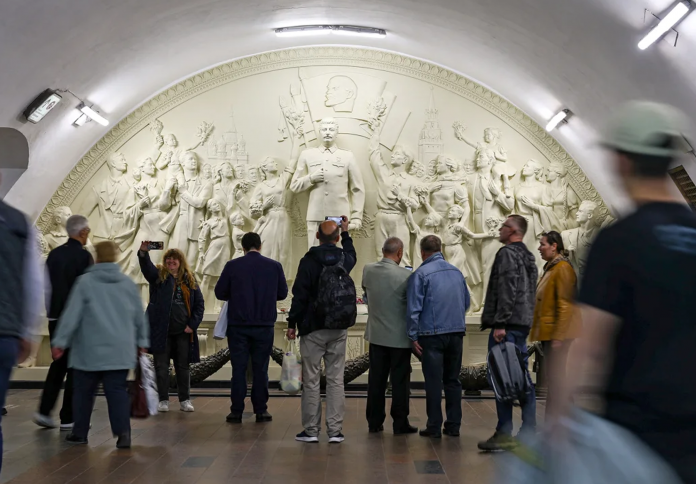
A recently unveiled monument to Joseph Stalin in Moscow’s subway station has sparked controversy across Russia. The life-size sculpture, recreating a 1950 monument, depicts Stalin standing on Red Square surrounded by admiring Soviet citizens. While some Russians view it as an important historical tribute, others condemn it as a glorification of a dictator responsible for widespread suffering.
A historical tribute or a painful reminder?
The new monument, located in the Taganskaya metro station, is a faithful reproduction of an original artwork installed in 1950, three years before Stalin’s death. The original was lost during a 1966 station renovation, and this restoration was presented to the public on May 15 to celebrate the 90th anniversary of the Moscow metro system.
The monument’s original title, “Gratitude of the People to the Leader and Commander,” honors Stalin’s leadership in securing Soviet victory during World War II—a milestone Russia marked with great pomp this year. For many Russians, Stalin symbolizes national strength and resilience. Moscow resident Yevgeny Ivanov expressed his respect for Stalin’s legacy, stating, “He has something to be proud of. A man did something — we must respect what he did.”
Similarly, Kirill Frolov, another local, acknowledged Stalin’s complex and brutal history but emphasized his role in industrializing the Soviet Union and leading it to victory in World War II. “This man did more for our country than anyone else. That’s why I think that this [monument] is good and there should be more,” he said, reflecting a sentiment shared by a segment of the population that sees Stalin as a pivotal figure whose memory should be preserved for younger generations.
Voices of opposition and protest
However, not everyone shares this view. The liberal Yabloko party’s Moscow branch strongly condemned the monument, labeling it a celebration of a “tyrant and dictator.” They called on the metro authorities to instead focus on honoring the victims of Stalin’s brutal purges and repressions.
“The return of symbols of Stalinism to Moscow is spitting in the face of history and an act of mockery against the descendants of the repressed,” Yabloko declared in a formal statement. Their protest echoes the painful memories of nearly 700,000 people executed during Stalin’s 1937-38 Great Terror, as well as the millions who suffered in the harsh gulag prison camps scattered across the Soviet Union.
Adding to the controversy, two signs bearing critical quotes from Russian Presidents Vladimir Putin and Dmitry Medvedev were initially placed near the monument but later removed by unknown individuals, highlighting the deep political tensions surrounding Stalin’s legacy.
From de-Stalinization to resurgence
Following Stalin’s death, Soviet leader Nikita Khrushchev launched a campaign of de-Stalinization in 1956, condemning Stalin’s crimes and systematically removing his images and monuments. Yet, in recent years, some Stalin monuments have re-emerged in parts of Russia, reflecting a complex and divided national memory.
Alexander Zinoviev, a scholar of Soviet architecture, suggested that the monument’s return parallels contemporary political and social trends in Russia. “It is the same self-isolation, the same conservative ideology and reliance on our own strength,” he said, drawing a connection between Stalin-era themes of unquestioning loyalty and the current political climate amid Russia’s strained relations with the West over the war in Ukraine.
Zinoviev observed that the monument’s message—trust in leadership and suppression of criticism—resonates with today’s Russia. “It is very in tune with our time,” he concluded, emphasizing how the monument serves not only as a historical relic but also as a symbol reflecting current ideological currents.
A nation divided over its past
The unveiling of the Stalin monument in the Moscow metro has reopened painful debates about history, memory, and identity in Russia. For some, it is a tribute to a leader who helped build and defend the Soviet state. For others, it is a stark reminder of tyranny, repression, and the human cost of Stalin’s rule.
This controversy illustrates the broader struggle within Russian society to reconcile its Soviet past. As the monument stands amidst daily commuters, it forces a reflection on how history is remembered and used in the present, and whether honoring such a polarizing figure is a step toward unity or a source of renewed division.
The new Stalin monument in Moscow’s subway station is more than a piece of art—it is a flashpoint in an ongoing conversation about Russia’s complicated history. As the country continues to grapple with its past and future, the monument stands as a powerful symbol, both reflecting and shaping public attitudes toward one of the most controversial leaders of the 20th century. Whether seen as homage or hubris, it undeniably reignites discussions on memory, power, and the legacy of Stalin’s era in contemporary Russia.