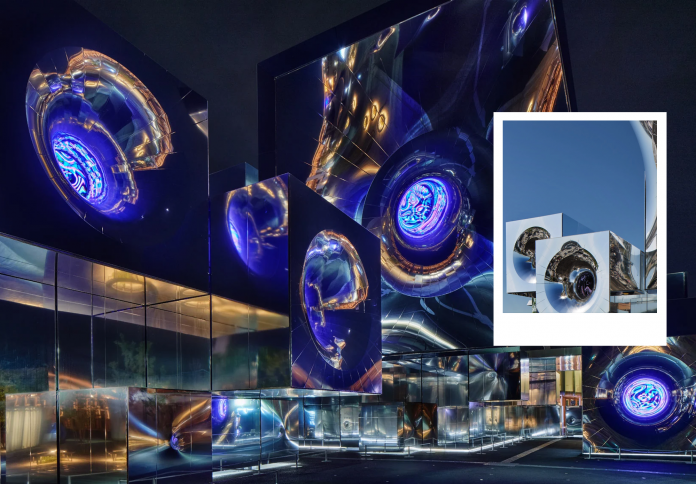
At Expo 2025 in Osaka, Noiz Architects has unveiled a shimmering architectural installation that questions the nature of presence, perception, and space in a digital age. The Null² Pavilion — with its vibrating mirrored skin and voxel-inspired structure — stands as a futuristic monument to the intersection of architecture, technology, and human experience.
An architecture of emptiness and interaction
As one of eight Signature Pavilions at Expo 2025 Osaka, Null² is a bold reflection on the meaning of space and form in a world shaped by screens, simulations, and digital doubles. Designed by Tokyo- and Taipei-based Noiz Architects, the pavilion takes its name from the Buddhist concept of “emptiness” — a philosophical idea reimagined here through a provocative and dynamic spatial form.
“From the very beginning of the design process, we considered how the significance of visiting a physical Expo has evolved since the 1970s,” says Keiuske Toyoda, co-founder of Noiz Architects. “In an internet age where information is instantly accessible, we asked ourselves: What can architecture offer that the digital cannot? The answer was to build something that lives in both worlds — a building that behaves, responds, and breathes.”
This philosophy manifests in a faceted steel structure clad in shimmering, wind-sensitive membranes that ripple and reflect the surrounding cityscape. The design challenges not only architectural convention but also the very idea of what a pavilion can be — not just a building to observe, but an entity to interact with.
From Minecraft to material innovation

Visually, Null² draws on the aesthetic of voxels — the three-dimensional equivalent of pixels commonly seen in video games like Minecraft. These digital building blocks are translated into real-world geometry, resulting in a form composed of clustered cubes that feel both playful and alien. “The voxel metaphor allowed us to build something low-resolution, yet complex,” explains Toyoda. “We wanted to encourage public engagement through form — to let people explore, touch, and discover.”
This approach extends into the pavilion’s material experimentation. The façade is clad in a new kind of mirrored membrane, developed by Noiz in collaboration with Japanese material specialists Taiyo Kogyo. The material has a metallic texture but is highly flexible and stretch-resistant, enabling it to form subtle curves and wave-like surfaces that react to environmental forces.
Wind causes the membrane to pulse and shimmer, distorting reflections of the sky and surroundings in real time. Embedded woofers and robotic arms inside several of the pavilion’s voxel modules allow further control of the membrane’s movement. With low-frequency sound vibrations and mechanical motion, the façade becomes kinetic — a constantly shifting skin that feels alive. “In a way, the building becomes a creature — breathing, vibrating, responding,” Toyoda says. “It’s a synthesis of matter, motion, and meaning.”
Exploring digital nature and parallel selves

Beyond the exterior, Null² offers an immersive interior experience that continues the theme of digital duality. The main exhibition space features 360-degree screens and multimedia installations designed by researcher and media artist Yoichi Ochiai. Visitors are invited to interact with their digital twins — avatars that respond to presence, motion, and data input — highlighting the porous boundary between physical identity and virtual persona.
“The architecture of Null² serves to function as an ‘interspace’, where countless parallel worlds intersect,” says Toyoda. “It embodies Ochiai’s vision of ‘digital nature’ and the Expo’s broader theme of exploring new relationships between humans and technology.”
This layered experience — of mirrored surfaces, fluid movement, and interactive technology — positions Null² as not merely a spectacle, but a statement. It asks: what does it mean to be present? Where does the digital end and the real begin? And how can architecture embrace, rather than resist, the complexity of 21st-century identity?
Design for disassembly and future use

In keeping with its forward-thinking ethos, Null² was also conceived with sustainability in mind. The entire structure is designed to be easily dismantled and reassembled elsewhere after the Expo concludes. “The pavilion isn’t just an installation for six months,” Toyoda notes. “It’s a modular system that can evolve and be reused — physically and conceptually.”
Noiz Architects, founded in 2007 by Keiuske Toyoda and Jia-Shuan Tsai, is known for exploring the interface between architecture, computation, and interaction. With offices in Tokyo and Taipei, the firm frequently works across disciplines to create work that defies categorization — blending art, science, and space in unexpected ways.
At Expo 2025 Osaka, Null² stands out as a testament to their design philosophy — a radical reimagining of the architectural pavilion as both a physical presence and a responsive system. In a global moment where the boundaries between digital and real are increasingly fluid, Noiz Architects offers a compelling vision of a future where buildings move, mirror, and adapt — not just to our needs, but to our presence.
Project details:
Architect: Noiz Architects
Location: Expo 2025, Osaka
Pavilion name: Null²
Material innovation: Mirrored membrane by Noiz x Taiyo Kogyo
Interactive elements: Woofers, robotic arms, wind-responsive façade
Interior program: 360° digital installation by Yoichi Ochiai
Themes: Digital identity, interactive architecture, post-physical experience
Future use: Fully disassemblable and reusable structure