In Canada’s Northwest Territories, a journey down the Nahanni River delivers staggering landscapes, Indigenous heritage, and a deep connection to one of the world’s great wildernesses.
A flight into the unknown
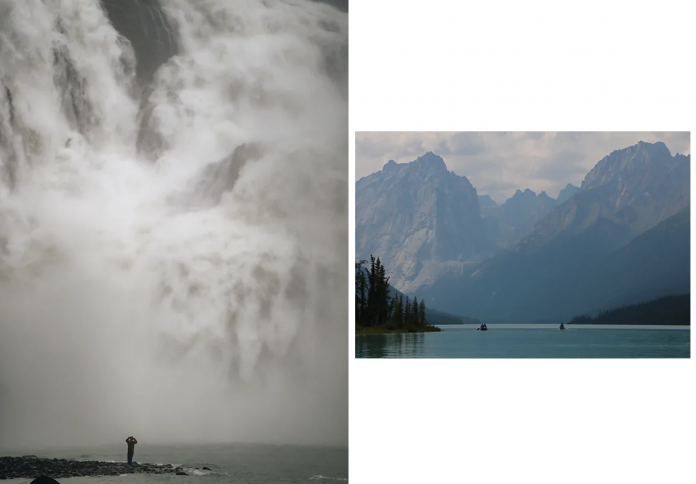
“Pop these earmuffs on—you’ll need them,” says the co-pilot of our 1967 Twin Otter floatplane as its propellers roar to life. Moments later, we’re airborne, soaring above an endless mosaic of boreal forest, rugged canyons, and the thunderous white spray of Virginia Falls. The flight offers only a glimpse of the wild majesty awaiting us in Nahanni National Park Reserve. We’re about to embark on an 11-day, 217km paddling journey down the iconic Nahanni River—one of Canada’s most legendary wilderness experiences.
Situated in the Northwest Territories, the Nahanni is more than a river. It’s a passage through time and terrain so remote and unspoiled, only a few hundred people explore it each year. For my partner and me, this trip is a once-in-a-lifetime adventure, one that blends peaceful drifting with rich history, cultural learning, and breathtaking geology.
Canoeing the ‘Grand Canyon of Canada’
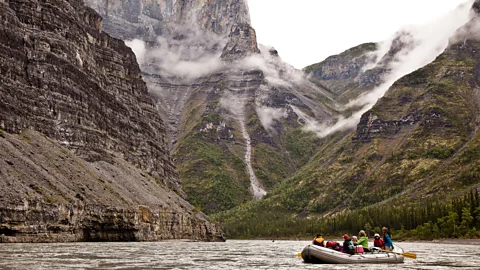
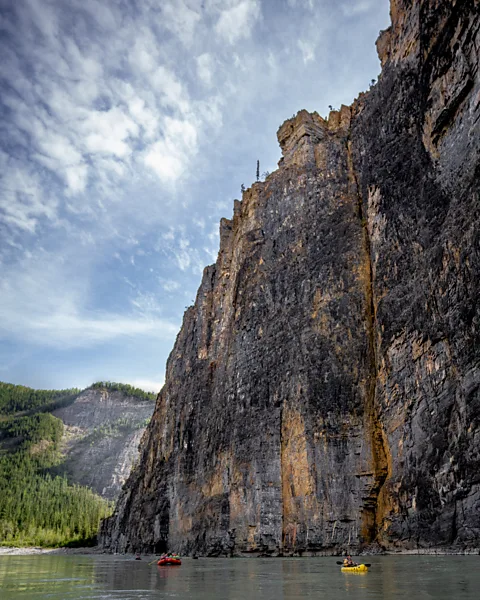
Since RM Patterson’s 1954 book The Dangerous River introduced the Nahanni to the world, the river has earned mythical status among Canadian paddlers. Carving through towering limestone cliffs and deep canyons, the river is often dubbed “the Grand Canyon of Canada”—and for good reason. In places, the sheer rock walls rise more than 1,200m, creating a cathedral of stone through which the river gently flows.
Unlike Patterson’s rugged solo trip, ours is no adrenaline-fueled whitewater expedition. Guided by a seasoned team from Nahanni River Adventures, we experience the river as a series of immersive days: paddling, hiking, relaxing at pristine campsites, and absorbing the stories etched into this land. Our route begins just below the 96m-high Virginia Falls—twice the height of Niagara—and ends in the tiny community of Nahanni Butte, just outside the park’s boundary.
A park built on partnerships
At Virginia Falls, we’re greeted by Jaclyn Paddison, a Parks Canada interpretation officer, who guides us along a wooden boardwalk to a viewpoint above the crashing waters. Here, the iconic Parks Canada “Red Chairs” overlook Mason’s Rock, a lone stone monolith splitting the falls’ torrent in two. It’s a staggering sight—one that helped save the river.
Paddison explains that in 1970, then-prime minister Pierre Elliott Trudeau paddled this very river. Inspired by its raw beauty—and alarmed by proposed hydroelectric development—he advocated for its protection. By 1972, the Nahanni was designated Canada’s first National Park Reserve, created in collaboration with the Dehcho First Nations to allow traditional land use. It became the country’s first UNESCO World Heritage Site in 1978, and its protection expanded again in 2009 to include the entire South Nahanni watershed.
“This park holds a lot of firsts,” Paddison tells us, handing each of us a bundle of tobacco to cast into the wind—an offering to the Dene ancestors who have navigated and protected this river for millennia. “For them, the river has always been a lifeline.”
Life on the river
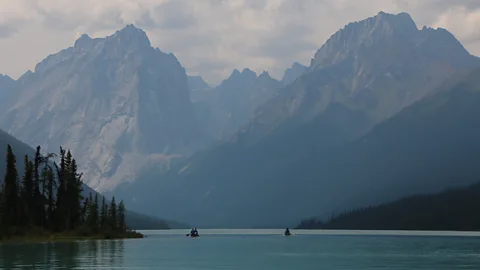
With the roar of Virginia Falls behind us, the river soon settles into a gentle rhythm. Our rafts glide past rugged peaks and alpine plateaus. Unlike more intense whitewater routes, this section is more about contemplation than conquest. We drift through five major canyons—named in reverse order by early explorers—each more dramatic than the last.
Guides prepare gourmet meals over open flames and in Dutch ovens: cinnamon buns for breakfast, lamb and carrot cake for dinner, all enjoyed with the soundtrack of rushing water. Campsites are remote, peaceful, and equipped with a portable “loo with a view” system that ensures we leave no trace.
One of the most stunning stops is at The Gate, the entrance to Third Canyon. As the river slices through 32km of sedimentary rock, the landscape narrows and the cliffs rise sharply—nature’s own fortress. Later in the trip, we swim in the icy waters of the “Chasm of Chills” and hike to breathtaking viewpoints, always accompanied by a sense of profound seclusion.
Stories from the land
One of the most meaningful aspects of our journey is learning from Indigenous guides like Bobbi Rose Koe. A proud member of the Teetl’it Gwich’in First Nation, Rose Koe founded Dinjii Zhuh Adventures to train and empower the next generation of Indigenous river guides.
“When I started guiding, I didn’t see others who looked like me,” she says. Through a partnership with Joel Hibbard, owner of Nahanni River Adventures, she’s created a platform for First Nations guides to share their language, culture and traditional knowledge with travellers.
“People talk about reconciliation, but what we’re doing is more than that—it’s transformation,” Rose Koe explains. “We’re changing the narrative of who belongs in these spaces and how we tell the story of this land.”
A journey few ever take
As our expedition nears its end, we pass through First and Second Canyon—arguably the most dramatic of all. We’re rewarded with rare wildlife sightings: a lynx darting through brush, bison swimming across the river, and a freshly caught Arctic Grayling that our guide expertly grills for the group.
Each bend in the Nahanni reveals more than just natural beauty—it reveals layers of time, culture, and connection. This is a place where solitude is not only possible but expected. Where few tread, and even fewer forget.
For those willing to make the journey—both the physical voyage and the deeper one—it’s easy to understand why the Nahanni is considered one of the greatest wilderness river experiences on Earth. More than a trip, it’s a meditation on what it means to be part of something vast, ancient, and wild.