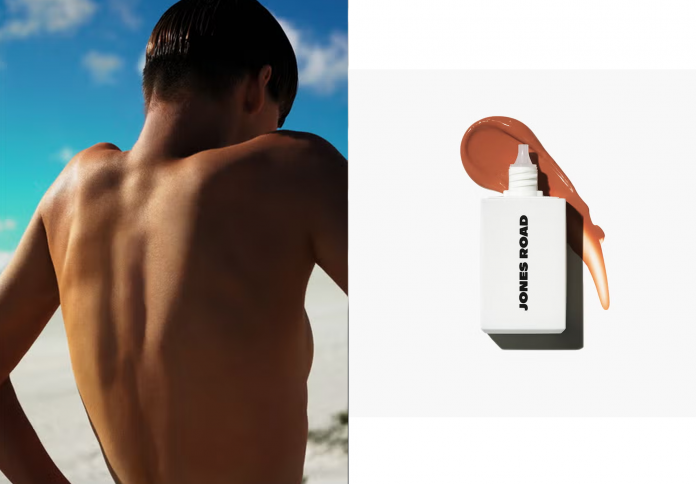
It’s been two decades since Jergens made self-tanning mainstream—and the sunless glow has never been more accessible. But in an age of viral withdrawals, clean beauty, and shifting ideals, is the golden hour of faux tanning fading? We explore the psychology, the innovation, and the cultural tug-of-war behind our bronzed obsession.
The glow that won’t quit
When comedian Nikki Glaser opened her set at New York’s Beacon Theatre with a monologue about fake tanning, it wasn’t the punchline most expected—but it hit home. “It’s like job security,” she joked about her recent spray tan, adding that the bronzed glow made her feel as though she had her life together.
For many, that confidence boost is the real benefit of sunless tanning. But Glaser’s humor contrasts sharply with a growing corner of social media questioning our collective obsession with being tan. Kylei Halbakken, for instance, has racked up half a million views on TikTok by documenting her decision to stop self-tanning. “After I quit, I felt relieved,” she says. “I didn’t dread my Thursday-night self-tan routine anymore.”
Her posts reached millions, including Emma Brausen—another longtime faux-tan devotee—who recently decided to embrace her natural skin tone. “As an expecting mother, I realized the ritual wouldn’t fit into my new life,” Brausen says. “I wanted to feel more natural and less dependent.”
Why we crave the tan

Despite the growing anti-tan sentiment online, many people still swear by the bronzed effect of self-tanner—and the emotional payoff it brings. According to psychologist Carolyn J. Heckman, who co-leads the Cancer Prevention and Control Program at Rutgers Cancer Institute, there’s a strong link between tanning and mood.
“Women report feeling healthier, more attractive, more fit, and sexier after tanning—whether it’s from the sun or self-tanners,” Heckman explains. But the desire to tan can go deeper. Her research into indoor tanning reveals behavioral parallels with substance dependence. “Even when the mood-boosting effects fade, some individuals continue tanning compulsively. That’s a hallmark of addiction.”
The stats back it up. In 2024, SUGARED + BRONZED—a nationwide airbrush tanning chain—saw a 35% increase in new clients and a 25% rise in recurring monthly services. Seventy percent of those appointments were repeat customers. Tanning, it seems, remains a reliable source of comfort, confidence, and control.
From orange streaks to clean science
Self-tanning has come a long way since its earliest, carrot-hued beginnings. While tanning agents were discovered in the 1920s, it wasn’t until the ’60s and ’70s that they hit the market—with famously orange results. The real breakthrough came in 2005, when Jergens introduced its Natural Glow line: a gradual, affordable tanning lotion that finally delivered a believable bronze.
The star ingredient in most modern self-tanners is DHA (dihydroxyacetone), a sugar-derived compound that reacts with the skin’s outer layer to create a temporary browning effect. “Too much DHA on fair skin can lead to an unnatural orange tone,” explains Sophie Evans, tanning expert at St. Tropez. “That’s why formulas now cater to specific undertones—fair, olive, deep—to mimic real tans more precisely.”
Still, even the most advanced product isn’t foolproof. “Most people who love spray tans or at-home tanners eventually get hooked,” says Alexandra DiMarchi, global tanning expert for Lux Unfiltered. “But the upkeep—streaks, transfer, uneven fading—can be a hassle.” That’s exactly what led Halbakken to quit. “I became less self-conscious after stopping,” she says. “I didn’t have to worry about looking patchy or staining my sheets. It was freeing to let go of that pressure to look ‘perfect’ all the time.”
Cultural contrasts and shifting ideals
For many, the appeal of a tan goes beyond vanity. In some cultures, it’s even a form of resistance. Beauty editor Parizaad Khan Sethi, who grew up in India, remembers how lighter skin was idealized when she was a child. “Fairness equaled beauty,” she says. “Girls were discouraged from playing outdoors for fear of tanning.”
So when Sethi started sunbathing—and eventually turned to self-tanner—it was more than a beauty choice. “I wanted deeper, richer skin tones,” she explains. “To me, that looked powerful and beautiful. When I discovered self-tanning, it felt like liberation without the sun damage.”
That damage, of course, is real. Dermatologist and Mohs surgeon Dr. Dendy Engelman points out the obvious but often overlooked risks of UV exposure: “Sunbathing accelerates aging, causes skin damage, and increases the risk of skin cancer. The only safe tan is a fake one.”
A better bronze, no sun required
Thankfully, today’s self-tanning products are not only safer—they’re smarter. “The quality of DHA has improved dramatically,” says DiMarchi. “Now we have tanning waters, mists, serums, and customizable drops. It’s easier, more precise, and far more natural-looking.”
New-generation brands like Tan-Luxe, Saltyface, and Caudalíe have blurred the line between skincare and tanning, infusing DHA with hydrating ingredients and antioxidant-rich formulas. Even legacy names like St. Tropez and Jergens have adapted, offering glow drops and hybrid moisturizers that tan gradually without the mess.
Another welcome upgrade? The scent. Gone are the days of the telltale “fake tan” odor, replaced with gourmand, citrus, or fresh-wood fragrance profiles—and odor-neutralizing tech that masks DHA’s distinct aroma. For Engelman, these innovations make sunless tanning a no-brainer. “I use self-tanner as part of my self-care,” she says. “It hides imperfections, makes me feel good, and doesn’t put my skin at risk.”
So… have we hit peak self-tan?
Despite the anti-tan content going viral, the data and demand say no—at least not yet. Self-tanning remains a ritual of control, confidence, and comfort in a world that often feels uncertain. But as clean beauty gains momentum and diverse skin tones are increasingly celebrated in media and fashion, the why behind tanning is under deeper scrutiny.
Maybe we haven’t reached “peak self-tan” after all. Maybe we’ve just hit a point where the glow is less about fitting in—and more about feeling good in your own skin, whatever color it may be.