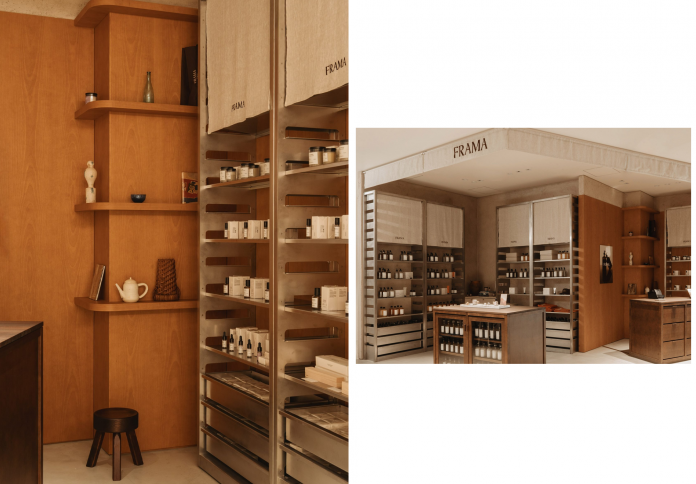
Danish design brand Frama has launched its first permanent international store in Tokyo’s Shibuya Parco shopping centre, an opening that marks a deep, enduring connection between Scandinavian minimalism and Japanese aesthetic philosophy. Designed in-house, the 16-square-metre space is a tactile, minimalist sanctuary that aims to “reflect the architecture of wellbeing,” blending Danish design language with local Japanese craftsmanship. The interior is characterized by a natural, calming palette of local cypress and cedar woods, contrasted with pale stone and bare steel. The design purposefully engages the senses and creates a moment of spatial clarity, reimagining the retail experience as a sensorial ritual. This small Tokyo outpost is a conscious effort to amplify the shared values of craft, quality, and longevity that unite the design cultures of both Japan and Denmark.
A Synergy of Danish and Japanese Aesthetics
Frama Tokyo is the culmination of a decade-long connection between the Danish brand and the Japanese market, a relationship that deeply informed the store’s design brief. Founder Niels Strøyer Christophersen emphasized that the project was not about simply catering to a foreign market but about reinforcing the synergy between Frama’s established design language and the refined Japanese aesthetic. The two regions share core values that are fundamental to Frama’s identity, including a commitment to craft, quality, longevity, and the preservation of tradition, especially within the sphere of design.

The interior design is a direct expression of this cultural blending, expertly mixing local Japanese materials and makers with custom Frama designs developed and manufactured in Denmark. The result is a space that feels both inherently familiar to Frama’s existing clientele and deeply respectful of its Tokyo location. By choosing to open their first international store in Japan, the brand acknowledged the country’s high standards for retail, recognizing Japanese stores as “masters of retail” experience. This reverence for authenticity and the approach to service as an art form served as an additional inspiration, ensuring the small physical space would deliver an experience that transcends its size.
Tactility and Material Contrast
The small scale of the 16-square-metre store necessitated a highly focused and impactful approach to materiality, which Frama achieved through strategic material contrasts designed to engage the senses and create tactile interest. The primary shell of the shop utilizes local Japanese wood, with walls and counters crafted from cypress and cedar. This use of indigenous timber establishes a warm, organic base for the space, lending a subtle, natural fragrance and texture that contributes to the overall calming atmosphere.

This organic warmth is juxtaposed with the crisp, cold industrial quality of stainless-steel shelves, which line three of the four walls and are used to display the brand’s Care collection of fragrances and beauty products. The steel provides a clean, minimalist structure, allowing the products to take center stage. Furthering this interplay are woven curtains situated at the top of the tall steel shelves, adding a soft, textile element that breaks up the hard lines of the metal and wood. In a final nod to organic form, some of the built-in wooden shelves are designed to curve around corners, softening the geometry of the compact interior and enhancing the natural, welcoming feel. The entire interior is further unified by a stone cladding, which reinforces the natural and tactile theme across the remaining surfaces.
The Architecture of Wellbeing
The guiding philosophical concept for the store’s design was to “reflect the architecture of wellbeing,” a mission that informed every decision, from the choice of materials to the final colour palette. The resulting atmosphere is intentionally welcoming and calming, conceived as a quiet sanctuary within the bustling Shibuya Parco shopping center. This focus on wellbeing translates into a design that aims for spatial clarity, allowing customers to encounter the brand’s products in an environment that encourages presence and sensory engagement.

Frama’s selection of a natural colour palette—dominated by tan and dark wood, pale stone, and bare steel—was crucial to this concept. According to Christophersen, these tones form part of a “new chapter for the Frama Care Collection – one that unites sensorial rituals with spatial clarity.” The subdued, earthen hues create a coherent, evolving visual language that promotes a sense of tranquility and order. By stripping away visual clutter and relying on the inherent beauty of natural materials, the store subtly prompts a reflective state, transforming the act of retail into a component of a sensorial ritual centered on self-care and peaceful engagement.
Subtle Nods to Interior Design
While the Frama Tokyo store is dedicated to showcasing the brand’s Care collection, its design deftly incorporates subtle references to Frama’s broader work in furniture and interior design. Despite the lack of standalone furniture pieces for sale, the minimalist shelving and surfaces are curated with small, evocative items. Small sculptures and homewares are strategically placed on the shelves, serving as visual cues and tchotchkes that hint at the brand’s larger aesthetic world.

The small, open space is demarcated from the main flow of the shopping centre by a simple yet elegant fabric fascia, a soft boundary that signals a transition into a more introspective environment. This use of a textile boundary, along with the integrated furniture elements like the curved wooden shelving, ensures that the store feels less like a temporary shop-in-shop and more like a permanent, architecturally coherent installation. The store acts as a three-dimensional mood board, allowing visitors to experience Frama’s foundational principles of material honesty and minimalist design, inviting them into a complete design philosophy that extends well beyond the personal care products on display.