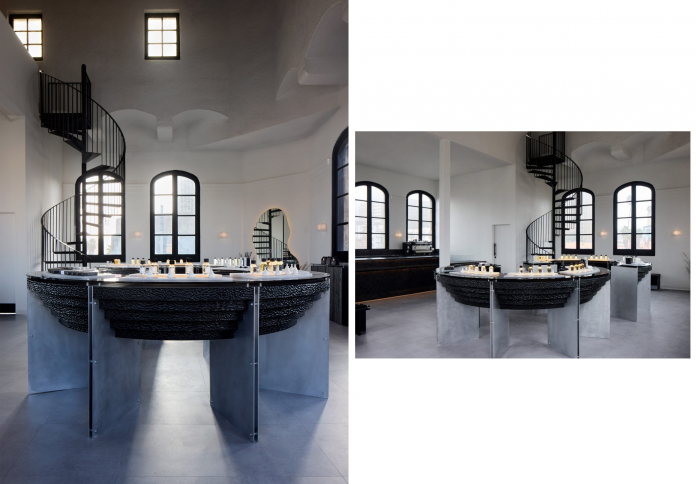
In a softly lit bell tower from the 1920s, the scent of cedarwood and citrus floats beneath a ceiling of quiet tension. This is Elorea Koreatown, a boutique designed by Studio Paul Chan as a total sensory experience—where scent meets space, and fragrance becomes a form of architecture. Here, ancient rituals collide with cyber-industrial precision, and perfume isn’t merely sold, but staged as performance.
Translating scent into structure
Designing a space that evokes fragrance—ephemeral, emotional, ungraspable—was the conceptual cornerstone of Chan’s approach. To echo the layered composition of a perfume, the studio composed the boutique as a series of spatial “notes”: top, heart, and base. From first glance to final linger, visitors move through atmospheres designed to unfold like olfactory chords.

This philosophy crystallizes in the central display—a looping, almost-complete figure of eight that dominates the 1,160-square-foot interior. The shape implies continuity and ritual, a circuit of return. Its machined aluminum legs and dark reflective surface suggest both weight and illusion: scent given physical presence, then dissolved again in reflection.
Material tension as spatial poetry
The boutique’s aesthetic tension lies in its material contrasts. Polished surfaces rest against hand-finished ones; elemental woods are held within sleek, machined frames. High-performance black glass echoes the shimmer of perfume bottles, while hand-chiselled wood tiles—treated with the Japanese Shou Sugi Ban technique—nod to craft traditions passed down through generations.

At the heart of the space, a bar clad in those blackened tiles evokes a coastal altar. Its inverted ziggurat silhouette recalls sacred form while grounding the visitor in a ritual of scent and refreshment. It’s at once rustic and futuristic, intimate yet imposing—a study in spatial ambiguity where opposites create atmosphere.
Where ritual replaces retail

Rather than a typical sales counter, the bar serves drinks inspired by Elorea’s signature ingredients—bergamot, sandalwood, or smoked tea—blurring boundaries between scent and taste. Small black stools offer visitors a place to linger, echoing the stepped modularity of the central display and reinforcing the continuity of design language throughout the space.

At night, the boutique transforms again. Bottles on the figure-eight podium glow from below, casting soft halos onto the dark floor. Wall sconces and concealed cove lights gently warm the textured surfaces, lending a near-religious stillness. The boutique becomes less a shop than a spatial ceremony—one dedicated to slowing time and heightening awareness.
Fragrance as architecture, architecture as emotion

Chan describes the space as “an immersive installation, not just a boutique.” This ethos echoes through every detail—from the shimmering aluminum supports to the poetic restraint of the lighting. The store doesn’t just sell perfume; it stages it. Fragrance here is not a product but a protagonist.

Located within a 1920s Spanish Colonial Revival bell tower, the store draws on its architectural shell to ground its future-facing vision. In the hands of Studio Paul Chan, history becomes a vessel for new mythologies—where scent, space, and self converge in quiet, exquisite tension. The result is a boutique that doesn’t compete for attention, but commands presence. It asks nothing more, and nothing less, than that you breathe.