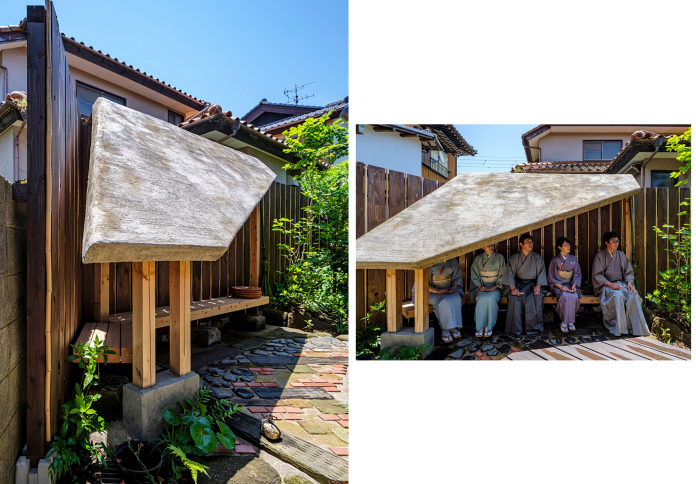
In the quiet suburbs of Chiba, Japan, a small timber pavilion has emerged as a profound statement on the value of the handcrafted in a rapidly industrializing world. Local studio Kurosawa Kawara-Ten has completed the “Sekiyuan Waiting Area,” a contemplative structure designed to serve the Sekiyuan tea room. More than just a functional shelter, the project is a collaborative effort between the architects and the tea room’s master—himself a ceramicist and artist. Topped with a sloping roof of mortar and soil excavated from its own garden, the pavilion is designed to age gracefully, eventually becoming a living part of the landscape as it is overgrown with moss. As “Magazine World” explores, this “DIY” architectural intervention is a poetic response to the vanishing skills of traditional Japanese artisans.
Reclaiming the Craft in the Suburbs
The Sekiyuan Waiting Area was born from a desire to reintroduce a sense of tactility and locality into the suburban architecture of Chiba. Kenichi Kurosawa, the founder of Kurosawa Kawara-Ten, views the project as a challenge to the modern construction industry’s reliance on mass-produced materials and specialized, detached labor. By opting for a “self-build” approach, the architects and the client became the primary makers, ensuring that every joint and surface carried the mark of human intent. Kurosawa believes that when an addition to an existing structure isn’t a “life-or-death necessity,” the act of building itself becomes the primary purpose, fostering a deeper connection to the culture of the site.

This philosophy is particularly relevant in contemporary Japan, which is currently facing a severe shortage of skilled building artisans. For Kurosawa, the question of whether “DIY can become architecture” is central to the future of the built environment. By utilizing traditional techniques in a modern suburban context, the studio is attempting to bridge the gap between high-design architecture and the grassroots culture of making. The resulting pavilion is not just a place to wait; it is a repository of local knowledge and a testament to the enduring power of the artisan.
The Ritual of the Roji
The pavilion is strategically located along the “roji,” the ceremonial narrow passage that leads from the street into the tea room’s garden. This path is a crucial component of the Japanese tea ceremony, serving as a transitional space where guests can shed the concerns of the outside world before entering the tea house. The garden itself, designed by Takeda-ya Sakuteiten, utilizes salvaged rocks and tiles as paving, further emphasizing the theme of reuse and material memory. The waiting area provides a moment of pause within this ritualistic journey, offering a simple timber bench sheltered from the elements.

The pavilion’s form is meticulously aligned with the raised timber deck of the main tea house, creating a visual harmony between the two structures. Its back is formed by an existing wooden fence at the edge of the site, while the front is supported by four slender timber pillars resting on concrete and stone blocks. This lightweight, open construction ensures that the pavilion remains a part of the garden rather than an enclosure, allowing the sounds and scents of the surrounding nature to permeate the waiting experience.
A Living Roof of Soil and Moss
The most distinctive feature of the Sekiyuan Waiting Area is its steep, sloping roof. The angle of the roof was designed to evoke the feeling of passing through a “nijiri-guchi”—the traditional low crawlspace used to enter a tea room, which humbles the guest and emphasizes equality within the ceremony. To create the roof’s unique texture, the architects applied a mixture of mortar and soil excavated directly from the garden. This surface was then lightly brushed to create a porous, organic finish that is specifically designed to invite the growth of moss over time.

This “living roof” reflects the tea ceremony culture’s deep appreciation for “wabi-sabi,” or the beauty found in the rustic, the imperfect, and the weathered. As the seasons pass, the earthen surface will deepen in color and texture, eventually becoming a lush green canopy that blends seamlessly with the foliage of the garden. Kurosawa explains that this practice also draws on the ancient tradition of crafting tea ceremony instruments from wild plants and trees, bringing the architecture into a direct, evolving dialogue with the natural world.
Architecture as Cultural Connection
The completion of the Sekiyuan Waiting Area adds to Kurosawa Kawara-Ten’s growing portfolio of projects that prioritize local and recycled materials. The studio previously gained attention for transforming a vacant house in Ichihara City into a workspace using similar principles of sustainability and craft. In a broader context, the project sits alongside other recent Japanese tea room innovations, such as the shingle-covered mountain tea room in Kyoto by 2m26 and Onomiau. Together, these projects signal a renewed interest in small-scale, highly specific interventions that honor Japan’s rich architectural heritage.

Ultimately, the Sekiyuan Waiting Area is a quiet revolution. It demonstrates that even the smallest structure can have a significant cultural impact when it is built with care, collaboration, and a respect for the environment. By allowing the building to “grow” alongside the garden, Kurosawa Kawara-Ten has created a space that celebrates the passage of time. It is a reminder that in our rush toward the future, there is immense value in slowing down, digging into the earth, and building something by hand that is intended to last—and change—for generations.