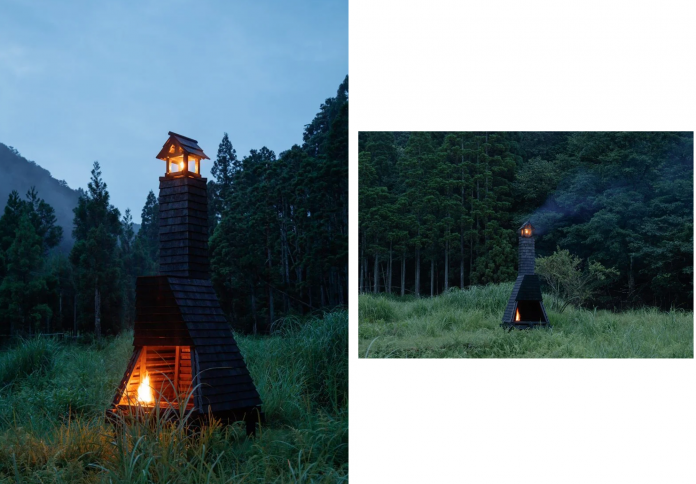
In the tranquil mountains north of Kyoto, a unique micro tea room invites visitors to slow down and experience the ancient ritual of tea in intimate solitude. Le Picabier, designed by the Kyoto-based architecture studio 2m26 in collaboration with Paris’s Onomiau, is a poetic fusion of tradition and modernity. Clad in charred cedar shingles and shaped like a crooked chimney, this tiny pavilion serves one person, offering a rare moment of quiet connection with fire, nature, and time itself.Commissioned by Villa Kujoyama — a creative residency supported by the French Institute in Japan — Le Picabier is a thoughtful dialogue between Japanese craftsmanship and Western architectural influences. Its minimal footprint and expressive form embody the emotional power of architecture as a vessel for ritual and reflection.
A small space with big inspiration
Le Picabier, also known as Yachō, is designed intentionally for a single occupant. The footprint is based on the traditional size of a tatami mat — a mere 95.5 by 64 centimeters — emphasizing economy of space and purity of design. Slightly elevated on a wooden platform, the tea room is not just a functional shelter but a sculptural object that draws on poetic architectural traditions.
The founders of 2m26, Mélanie Heresbach and Sébastien Renauld, cite American architect John Hejduk as a key inspiration. Known for his enigmatic, abstract forms, Hejduk’s architecture combines rationality with emotional intensity — qualities 2m26 sought to channel in Le Picabier. Its leaning, chimney-like shape is both whimsical and mysterious, inviting curiosity while providing a sense of refuge. “We wanted to pay tribute to John Hejduk, referring to the rationality, poetry and strangeness of his architecture,” Heresbach and Renauld explained. This homage to “shapes of strangeness” results in a tea room that feels timeless yet contemporary, a place where simplicity transcends into subtle complexity.
Materials and craftsmanship rooted in tradition
Le Picabier’s construction reflects a deep respect for traditional Japanese building techniques and local materials. The structure’s core and base are crafted from cypress, prized for its natural durability, pleasant scent, and regional significance. The exterior is clad in cedar shingles, treated through yakisugi — an ancient Japanese method of charring wood to enhance longevity and weather resistance.
This yakisugi finish gives the tea room a striking blackened surface that contrasts beautifully with the lush green of the surrounding forest. Inside, the shingles are coated with kakishibu, a natural dye made from fermented persimmon juice, which protects the wood from insects and moisture while also honoring centuries-old cultural practices. Such meticulous attention to materials and finishes demonstrates 2m26’s commitment to sustainability, craftsmanship, and heritage, bridging past and present through architecture.
The ritual of fire and light
At the heart of Le Picabier is a miniature fire pit designed to boil water for tea — the elemental center of the tea ceremony. The fire pit’s angled opening and the tea room’s chimney work in harmony to channel smoke outward, blending practical function with sensory experience.
Crowning the chimney is a lantern inspired by those found in traditional Japanese shrines. This lantern holds a single candle whose flame marks the beginning and end of the tea ritual. “The candle expresses time passing through its unstable flame,” explained Heresbach and Renauld. The gentle flicker invites contemplation and mindfulness, turning a simple moment into a profound act.
This play of light and shadow, fire and smoke, evokes the essence of wabi-sabi — the Japanese aesthetic that finds beauty in imperfection, transience, and quiet moments of solitude.
Continuing a dialogue with Japanese tradition
Le Picabier is one of several projects by 2m26 exploring Japanese vernacular architecture through a contemporary lens. Previous works include a sheep pen topped with a traditional thatched roof and a timber chicken coop inspired by shrine architecture. These projects reveal the studio’s fascination with blending functional rural structures with poetic form and historic building techniques.
By reinterpreting tradition in fresh ways, 2m26 encourages us to rethink how architectural heritage can inform modern life. Le Picabier’s small scale and enigmatic form invite visitors to appreciate the emotional depth that can be found in simple, handcrafted spaces.
In a world of constant distraction and noise, Le Picabier offers a rare invitation: a space designed for one, where the timeless ritual of tea becomes an immersive encounter with nature, craftsmanship, and the passage of time. Le Picabier stands as a testament to the rich possibilities of collaboration between cultures, the power of architecture to evoke emotion, and the enduring significance of ritual. Nestled in the Kyoto mountains, it transforms a humble act into a moment of poetic solitude, reminding us of the beauty that lies in stillness and simplicity.