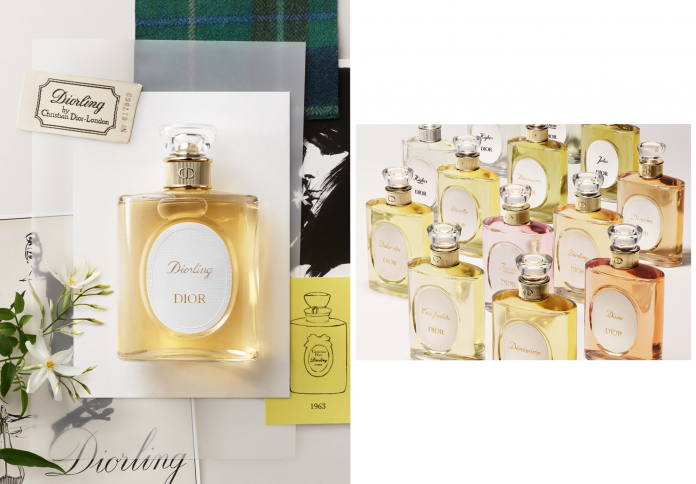
The Dioriginals collection, announced in October 2026, brought 13 fragrances from Christian Dior's perfume history back into focus under the guidance of Francis Kurkdjian. The project drew on archival work and contemporary techniques, positioning restoration as a creative act rather than a simple reissue. For a fashion house whose identity is bound up with historical silhouettes, the decision to recover scents is particularly meaningful: perfume can preserve an era's aesthetic ambitions while remaining difficult to reproduce exactly across decades. Ingredients, regulations, manufacturing methods and tastes can change. Dioriginals therefore invites a richer question than whether an old formula can be copied. It asks what faithfulness means when the sensory object itself has lived through several generations of technological and cultural change.
Thirteen Doors Into a Perfume History
Dior introduced Dioriginals as a group of 13 fragrances shaped by research into the house's past. A collection of this scale encourages people to think about perfume history beyond the few names most familiar to contemporary shoppers. Some scents once circulated widely before receding from general awareness, while others survive as references among collectors and historians. Bringing them into a unified project makes the archive visible as a living source of creative material.
Yet an archive does not answer every question about smell. Written formulas and surviving references can help guide a reconstruction, but a fragrance is experienced through materials, concentrations and the way it develops on skin. Restoring a scent means interpreting evidence, not simply displaying an old object behind glass.
Francis Kurkdjian and the Work of Interpretation
Francis Kurkdjian's role connects the project to contemporary perfumery. A modern perfume creator approaching archival material must decide how to honor an earlier artistic intention while working with today's resources and expectations. The distinction between reproduction and interpretation is essential: the final result can be faithful to a historical character without claiming that every ingredient or aspect of the experience is identical to the past.
This is a difficult undertaking because scent is partly material and partly memory. People who loved an earlier edition may remember it through the context of their lives, a kind of emotional record no technical restoration can guarantee. New wearers arrive without that history. A thoughtful revival has to give both audiences reasons to engage.
Diorling and the Value of an Obscure Name
Diorling was among the fragrances presented in the collection, a reminder that perfume history contains names not necessarily prominent in current mainstream advertising. Such recoveries can broaden the public's understanding of a luxury house. Instead of repeating only its most successful modern launches, Dior can show how differing aesthetics existed across its history. The archive becomes an alternative to the constant pressure for novelty.
For consumers, the appeal may be educational as much as sensory. Experiencing a reconstructed fragrance can raise questions about materials, changing expectations of femininity and the evolution of taste. Yet it is worth distinguishing that curiosity from a claim that older styles were automatically better. Historical interest and personal preference need not produce the same conclusion.
Technology Meets the Archive
The project was described as combining archival research with newer technologies. In perfumery, that pairing points to a broader challenge: historical formulas may need to be studied within current technical possibilities. Some raw materials and production methods can become less practical over time, while analytical and formulation tools develop. The goal is to preserve a recognizable artistic idea under conditions different from those of its origin.
No public description of the project alone can prove that a new fragrance is chemically identical to an earlier one. Such a claim would require detailed technical documentation. The more useful way to consider restoration is as an informed act of interpretation, grounded in evidence yet performed by a contemporary creator. That also makes the perfumer's judgment a central part of the work.
The question of authenticity becomes particularly difficult when an archive enters a retail environment. Museums usually invite visitors to examine distance and context, while perfume counters encourage immediate sensory and personal judgement. Dioriginals has to function in both registers. Its historical significance invites curiosity about the house's changing aesthetics; its status as a contemporary collection asks whether the fragrances stand up to ordinary use. Neither mode of engagement should invalidate the other.
A revived formula can also teach a different lesson about time. Fragrance families rise and fall in popularity, yet styles that feel unfamiliar now may become interesting precisely because they challenge contemporary preferences. Making room for that unfamiliarity is more ambitious than simply selling nostalgia. It asks a new audience to encounter the past without pretending the distance between eras has vanished.
When Heritage Becomes Something to Wear
Dior's archive gains a different kind of life when its fragrances return to the skin rather than remaining in bottles preserved as historical objects. Perfume can be appreciated for its design history, but it also has to be worn, smelled and understood in the present. That dual role gives Dioriginals a distinct position within a market often dominated by new launches and celebrity campaigns.
The collection's wider value may lie in making restoration part of contemporary beauty culture. Instead of implying that innovation always means inventing something without precedent, Dior illustrates a more complicated possibility: the past can offer unfinished conversations. The outcome will be judged both by the quality of the perfumes and by how carefully the house explains what has, and has not, been recovered.